Children Outpace AI in Language Learning: New Framework Reveals Key Differences


3 Sources
[1]
Brains over bots: Why toddlers still beat AI at learning language
Even the smartest machines can't match young minds at language learning. Researchers share new findings on how children stay ahead of AI -- and why it matters. If a human learned a language at the same rate as ChatGPT, it would take them 92,000 years. While machines can crunch massive datasets at
[2]
Why Children Learn Language Faster Than AI - Neuroscience News
Summary: Despite AI's massive processing power, children still far outperform machines in learning language, and a new framework helps explain why. Unlike AI systems that passively absorb text, children learn through multisensory exploration, social interaction, and self-driven curiosity. Their
[3]
Children are much better at learning language than AI - Earth.com
In raw processing power, a large language model will outclass toddlers. Yet when a team of researchers did the math, they found a startling gap: if humans learned language at the same rate as ChatGPT, it would take them 92,000 years. The calculation highlights a long-standing mystery. Children
Share
Copy Link
A new study highlights how children's multisensory, active learning approach gives them a significant edge over AI in language acquisition, potentially reshaping AI development and our understanding of human cognition.
The Remarkable Language Learning Abilities of Children
A groundbreaking study published in Trends in Cognitive Sciences has shed light on why children are significantly more adept at learning language than even the most advanced artificial intelligence (AI) systems. Led by Professor Caroline Rowland of the Max Planck Institute for Psycholinguistics, in collaboration with colleagues at the ESRC LuCiD Center in the UK, the research presents a novel framework that explains children's remarkable language acquisition abilities
1
.The study reveals a startling statistic: if humans were to learn language at the same rate as ChatGPT, it would take them 92,000 years to achieve fluency. This vast difference highlights the unique capabilities of the human brain in language acquisition, especially during early childhood
2
.The Key to Children's Language Learning Success
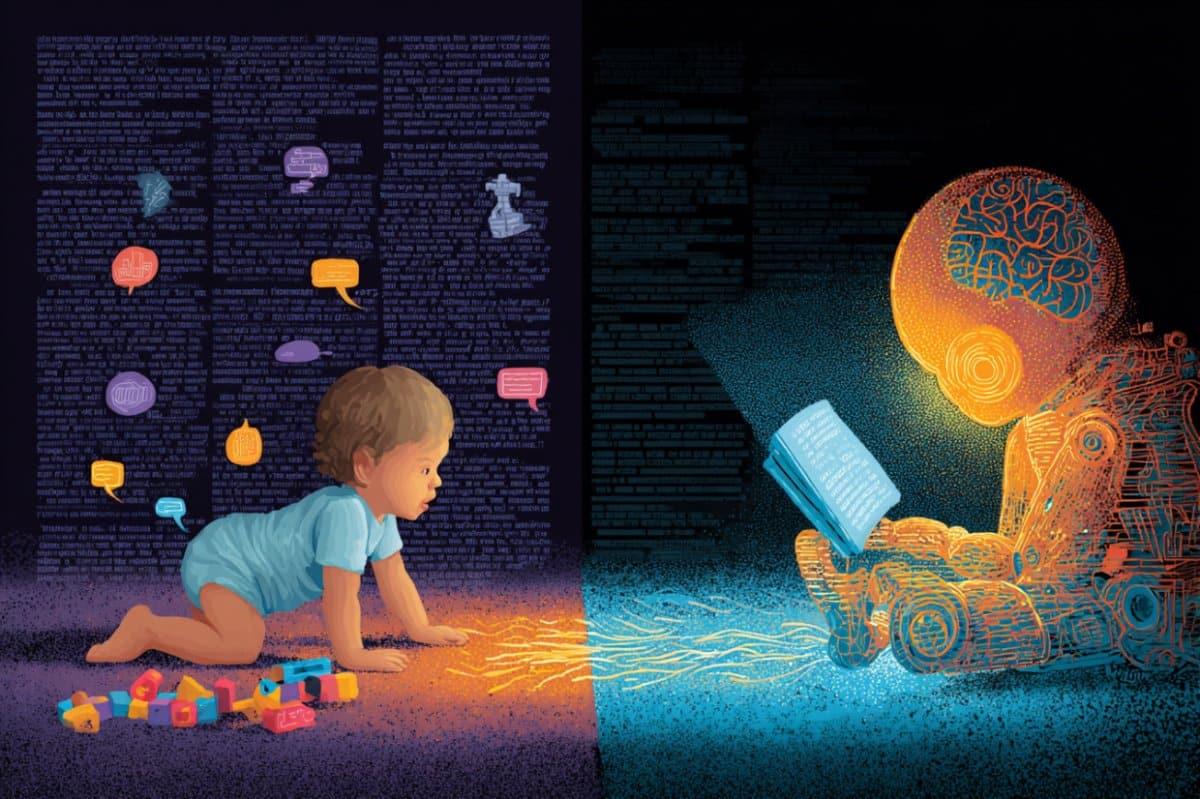
The research team proposes that the critical factor in children's rapid language acquisition is not the quantity of information they receive, but rather how they process and learn from it. Unlike AI systems that primarily learn from written text, children engage in an active, multisensory learning process deeply embedded in their social and physical environments
3
.
Source: Neuroscience News
Professor Rowland explains, "AI systems process data ... but children really live it. Their learning is embodied, interactive, and deeply embedded in social and sensory contexts"
1
.The Multifaceted Approach of Child Language Learning
The framework identifies several key components that contribute to children's superior language learning abilities:
-
Multisensory Integration: Children use all their senses to understand language, creating rich, coordinated signals that help them decipher linguistic patterns
2
. -
Embodied Learning: Through physical exploration and interaction with their environment, children generate new opportunities for language learning
3
.

Source: Phys.org
-
Social Immersion: Caregivers instinctively adapt their speech to the child's needs, providing a personalized, dynamic learning experience
3
. -
Incremental Plasticity: The young brain's ability to rapidly reorganize allows for efficient adaptation to different stages of language learning
3
. -
Motivation and Curiosity: Children's innate desire to understand their world drives sustained, self-motivated language practice
3
.
Related Stories

Implications for AI Development and Beyond
This research has far-reaching implications not only for our understanding of child development but also for the future of AI. Rowland suggests that AI researchers could learn valuable lessons from studying how babies acquire language
1
.The insights gained from this study could potentially reshape machine learning strategies. Some researchers are already experimenting with embodied AI agents that explore virtual environments, attempting to bridge the gap between artificial and human language learning
3
.Beyond AI, the framework could inform approaches to adult second-language acquisition, evolutionary linguistics, and educational practices. It suggests that immersive, interactive learning environments may be more effective than traditional rote learning methods
3
.References
Summarized by

Navi
[2]
Related Stories
New AI Model Mimics Toddler Learning, Offering Insights into Human Cognition and AI Development
24 Jan 2025•Science and Research

AI and neuroscience reveal how children's brains master language from age 2 to 10
11 Mar 2026•Science and Research
Study Reveals AI Language Models Learn Like Humans, But Lack Abstract Thought
13 May 2025•Science and Research

Recent Highlights
1
Microsoft and Nvidia Launch Surface Laptop Ultra: A $2,599 AI-Ready PC With RTX Spark Chip
Technology

2
Trump Consulted Grok AI Before Ordering Venezuela Invasion and Capture of Nicolás Maduro
Policy and Regulation

3
Scientists Build AI Model That Reconstructs Images From Brain Scans in Record Time
Science and Research

Recent Highlights
Today's Top Stories







Don’t drown in AI news. We cut through the noise - filtering, ranking and summarizing the most important AI news, breakthroughs and research daily. Follow topics that matter to you and stay ahead.


