4 Sources
[1]
China's AI-fueled IPO boom hits $54 billion this year, with chipmakers and Shein's $1.7 billion IPO | Fortune
Chinese markets are booming with new public stock offerings, energized by the craze for artificial intelligence and other advanced technology and a growing preference to list shares in Hong Kong and Shanghai. In the latest big stock listing, shares in China-founded e-commerce and fast fashion giant Shein are due to debut Tuesday in Hong Kong in a blockbuster initial public offering raising $1.7 billion, in one of the city's biggest new share sales this year. In July, CXMT, China's largest memory chipmaker, raised more than $8.6 billion in Shanghai in the second-largest IPO for its Nasdaq-style STAR market, mainland China's second-largest IPO. Its shares jumped 466% on the first day of trading. Unitree, one of China's leading humanoid robot makers, also made its listing debut in Shanghai in August. Shares rose 460% on the first day of trading. "The current IPO boom is powered by investor appetite for AI and robotics," said Ruiying Zhao, a senior research analyst at S&P Global Market Intelligence. Trading in Shanghai's stock market, for one, is heavily driven by retail investors. AI driving Chinese IPO boom CXMT's IPO in Shanghai "placed China in a strategically significant position in tech manufacturing related to AI," said Perris Lee, head of APAC equity capital markets for ION Analytics. "It's also a testament to China's tech self-sufficiency ambitions." Founded in China in 2016, the company's revenue surged more than 700% year-on-year to 50.8 billion yuan (about $7.5 billion) in the first three months of 2026 on a spike in demand for computer chips needed for AI. IPO proceeds in Hong Kong and Shanghai so far this year have already surpassed the funding raised last year, according to the financial data platform LSEG. It says IPOs and secondary listing activities on the Hong Kong and Shanghai exchanges raised a total of over $54 billion from so far in 2026, surpassing last year's total of more than $46 billion. Combined Hong Kong and Shanghai proceeds so far this year accounted for roughly 21% globally, ranking them only behind only the Nasdaq's roughly 55% global share, LSEG said. There, the mega $75 billion IPO by SpaceX in June made the U.S. exchange the world's biggest IPO market this year. Since China limits foreign purchases on mainland exchanges, many Chinese companies do parallel listings in Hong Kong to help raise international capital. Fewer big Chinese companies listing overseas Stricter U.S. and Chinese regulatory scrutiny in recent years of big Chinese companies listing in U.S. markets, especially those in strategically important sectors like advanced technologies, has led some Chinese companies to stick closer to home. Listing overseas typically takes more time compared with doing IPOs in China, said Howie Farn, a capital markets partner at the law firm Freshfields. In Hong Kong, recent public stock listings of Apple-supplier Luxshare Precision Industry, and Zhongji Innolight, which makes optical transceivers used in data centers, were among this year's largest deals and were also a reflection of investor demand for advanced technologies. More companies are looking to hold their IPOs in Hong Kong or Shanghai, like robotics firms AGIBOT and Deep Robotics. Shein also explored the possibility of listings in the U.S. and London before opting for Hong Kong. Investors are wary of a possible AI bubble in China, too After massive oversubscriptions and huge gains in their share debuts, some companies have seen their market value shrink. Chinese robot maker Unitree's share price had fallen more than 40% as of Friday from its peak share price on the day of its trading debut. "The critical question remains: is the AI sentiment enough?" said Zhao from S&P, as the similar question that raised worries among investors in the U.S. also now also applies to China. "For a durable market cycle, investors will demand sustainable revenue, visible profit margins, and realistic valuations. The global AI frenzy also has also drawn attention away from companies like Shein. "The AI investment cycle is absorbing much of the risk appetite that would have otherwise flowed to a company like Shein," said Jacob Cooke, CEO of WPIC Marketing + Technologies. Shein's IPO puts the company's value at around $27 billion, a fraction of its peak valuation a few years ago, though that is partly due to U.S. and EU moves to restrict de minimus tax-exemptions for imports of small packages.
[2]
Global Market: China's IPO boom gains momentum as AI, robotics fuel investor appetite
China's IPO market is gaining momentum, fuelled by strong investor appetite for AI, robotics and advanced technology companies. Hong Kong and Shanghai have already raised over $54 billion through IPOs and secondary listings in 2026, while blockbuster debuts such as CXMT and Unitree highlight the enthusiasm for tech stocks. Chinese stock markets are witnessing a surge in new public offerings, driven by strong investor interest in artificial intelligence, robotics and other advanced technologies, while more companies are choosing to list in Hong Kong and Shanghai, according to the Associated Press (AP). The latest major listing is expected to come from China-founded e-commerce and fast-fashion company Shein, whose shares are scheduled to debut in Hong Kong on Tuesday. The initial public offering is expected to raise about $1.7 billion, making it one of Hong Kong's largest listings this year. US MarketsPowered By As on 29 Aug 2026, 01:30 AM IST S&P 500 Top Gainers Solstice Advanced Mat63.53(12.76%) Workday204.72(5.76%) Domino's Pizza350.00(5.40%) Lululemon Athletica120.81(5.05%) Gainers" S&P 500 Top Losers PayPal Holdings53.66(-12.71%) Coterra Energy32.56(-8.62%) PG&E16.60(-7.52%) Generac Hldgs183.80(-6.84%) Losers" The IPO activity follows several blockbuster technology listings on mainland Chinese exchanges. In July, CXMT, China's largest memory chipmaker, raised more than $8.6 billion in Shanghai, making it the second-largest IPO in China's Nasdaq-style STAR Market and the second-largest IPO on the mainland this year. Its shares surged about 466% on the first day of trading. The momentum continued in August when humanoid robot maker Unitree debuted in Shanghai. The company's shares jumped around 460% on their first trading day, highlighting the intense enthusiasm surrounding China's artificial intelligence and robotics sectors. According to AP, analysts see investor appetite for AI and robotics as a major force behind the current IPO boom. Shanghai's stock market is also heavily influenced by retail investors, whose enthusiasm for technology themes has helped drive sharp gains in newly listed companies. China's Push for Technology Self-Sufficiency CXMT's blockbuster listing also underlined China's ambitions to strengthen its domestic technology and semiconductor manufacturing capabilities. The company, founded in China in 2016, has benefited from a sharp increase in demand for memory chips used in AI-related applications. Its revenue jumped more than 700% year-on-year to 50.8 billion yuan, or about $7.5 billion, in the first three months of 2026, according to the information cited by AP. The strong performance of technology companies has helped make AI-related businesses a key attraction for investors, particularly as China seeks greater self-sufficiency in strategically important industries. Hong Kong and Shanghai Gain Ground The strength of China's IPO market is also reflected in fundraising figures. Data from LSEG, cited by AP, shows that IPOs and secondary listings in Hong Kong and Shanghai have raised more than $54 billion so far in 2026. That has already surpassed the more than $46 billion raised across the two markets during all of last year. Together, Hong Kong and Shanghai have accounted for roughly 21% of global IPO proceeds this year, ranking behind the Nasdaq, which has captured around 55% of global proceeds. The US market has been boosted by the massive $75 billion SpaceX IPO in June, which made the Nasdaq the world's biggest IPO market this year. Chinese Firms Prefer Domestic and Hong Kong Listings China's restrictions on foreign investment in mainland stock exchanges mean many Chinese companies use Hong Kong as a route to access international investors. At the same time, increased regulatory scrutiny in both the US and China has made American listings less attractive for some companies, particularly those operating in strategically sensitive technology industries. AP cited capital-markets lawyers as saying that overseas listings can also take longer to complete than IPOs in China. Hong Kong has nevertheless attracted several large technology-related listings this year. Recent offerings from Luxshare Precision Industry, an Apple supplier, and Zhongji Innolight, which manufactures optical transceivers used in data centres, have ranked among the year's larger deals. Other robotics companies, including AGIBOT and Deep Robotics, are also considering listings in Hong Kong or Shanghai. AI Rally Raises Valuation Concerns Despite the strong debut performances, the IPO boom has also raised concerns over valuations and whether investor enthusiasm can be sustained. Some newly listed companies have already seen their share prices retreat sharply after their initial surges. Unitree, for instance, had fallen more than 40% from its debut-day peak as of Friday. The decline highlights a broader question facing investors: whether excitement around AI and robotics can translate into sustainable revenues and profits rather than simply driving short-term speculative gains. The concerns mirror debates in the US, where investors have also questioned whether the enormous capital flowing into AI-related companies is supported by sufficiently strong earnings and long-term business prospects. Shein Enters a More Selective Market Shein's Hong Kong listing comes against this backdrop of intense demand for technology stocks. The company has reportedly explored listings in the US and London before settling on Hong Kong. The IPO is expected to value Shein at around $27 billion, significantly below the company's peak valuation several years ago. The lower valuation partly reflects regulatory changes in the US and Europe, including efforts to restrict tax exemptions for low-value imports. The contrast between Shein's offering and the explosive debuts of Chinese AI and robotics companies illustrates how investor preferences have shifted. The global AI investment cycle is attracting a significant share of the market's risk appetite, potentially leaving less enthusiasm for consumer-focused businesses such as Shein. China's IPO market is therefore entering a period of rapid expansion, but the durability of the boom may ultimately depend on whether the excitement surrounding AI and advanced technology can translate into sustainable earnings, rather than short-lived post-listing rallies.
[3]
AI IPOs in China: AI and robotics drive an IPO boom in China as Shein lists in Hong Kong
In the latest big stock listing, shares in China-founded e-commerce and fast fashion giant Shein are due to debut Tuesday in Hong Kong in a blockbuster initial public offering raising $1.7 billion, in one of the city's biggest new share sales this year. Chinese markets are booming with new public stock offerings, energized by the craze for artificial intelligence and other advanced technology and a growing preference to list shares in Hong Kong and Shanghai. In the latest big stock listing, shares in China-founded e-commerce and fast fashion giant Shein are due to debut Tuesday in Hong Kong in a blockbuster initial public offering raising $1.7 billion, in one of the city's biggest new share sales this year. In July, CXMT, China's largest memory chipmaker, raised more than $8.6 billion in Shanghai in the second-largest IPO for its Nasdaq-style STAR market, mainland China's second-largest IPO. Its shares jumped 466% on the first day of trading. Unitree, one of China's leading humanoid robot makers, also made its listing debut in Shanghai in August. Shares rose 460% on the first day of trading. "The current IPO boom is powered by investor appetite for AI and robotics," said Ruiying Zhao, a senior research analyst at S&P Global Market Intelligence. Trading in Shanghai's stock market, for one, is heavily driven by retail investors. AI driving Chinese IPO boom CXMT's IPO in Shanghai "placed China in a strategically significant position in tech manufacturing related to AI," said Perris Lee, head of APAC equity capital markets for ION Analytics. "It's also a testament to China's tech self-sufficiency ambitions." Founded in China in 2016, the company's revenue surged more than 700% year-on-year to 50.8 billion yuan (about $7.5 billion) in the first three months of 2026 on a spike in demand for computer chips needed for AI. IPO proceeds in Hong Kong and Shanghai so far this year have already surpassed the funding raised last year, according to the financial data platform LSEG. It says IPOs and secondary listing activities on the Hong Kong and Shanghai exchanges raised a total of over $54 billion from so far in 2026, surpassing last year's total of more than $46 billion. Combined Hong Kong and Shanghai proceeds so far this year accounted for roughly 21% globally, ranking them only behind only the Nasdaq's roughly 55% global share, LSEG said. There, the mega $75 billion IPO by SpaceX in June made the U.S. exchange the world's biggest IPO market this year. Since China limits foreign purchases on mainland exchanges, many Chinese companies do parallel listings in Hong Kong to help raise international capital. Fewer big Chinese companies listing overseas Stricter U.S. and Chinese regulatory scrutiny in recent years of big Chinese companies listing in U.S. markets, especially those in strategically important sectors like advanced technologies, has led some Chinese companies to stick closer to home. Listing overseas typically takes more time compared with doing IPOs in China, said Howie Farn, a capital markets partner at the law firm Freshfields. In Hong Kong, recent public stock listings of Apple-supplier Luxshare Precision Industry, and Zhongji Innolight, which makes optical transceivers used in data centers, were among this year's largest deals and were also a reflection of investor demand for advanced technologies. More companies are looking to hold their IPOs in Hong Kong or Shanghai, like robotics firms AGIBOT and Deep Robotics. Shein also explored the possibility of listings in the U.S. and London before opting for Hong Kong. Investors are wary of a possible AI bubble in China, too After massive oversubscriptions and huge gains in their share debuts, some companies have seen their market value shrink. Chinese robot maker Unitree's share price had fallen more than 40% as of Friday from its peak share price on the day of its trading debut. "The critical question remains: is the AI sentiment enough?" said Zhao from S&P, as the similar question that raised worries among investors in the U.S. also now also applies to China. "For a durable market cycle, investors will demand sustainable revenue, visible profit margins, and realistic valuations. The global AI frenzy also has also drawn attention away from companies like Shein. "The AI investment cycle is absorbing much of the risk appetite that would have otherwise flowed to a company like Shein," said Jacob Cooke, CEO of WPIC Marketing + Technologies. Shein's IPO puts the company's value at around $27 billion, a fraction of its peak valuation a few years ago, though that is partly due to U.S. and EU moves to restrict de minimus tax-exemptions for imports of small packages.
[4]
AI and robotics drive an IPO boom in China as Shein lists in Hong Kong
HONG KONG -- Chinese markets are booming with new public stock offerings, energized by the craze for artificial intelligence and other advanced technology and a growing preference to list shares in Hong Kong and Shanghai. In the latest big stock listing, shares in China-founded e-commerce and fast fashion giant Shein are due to debut Tuesday in Hong Kong in a blockbuster initial public offering raising $1.7 billion, in one of the city's biggest new share sales this year. In July, CXMT, China's largest memory chipmaker, raised more than $8.6 billion in Shanghai in the second-largest IPO for its Nasdaq-style STAR market, mainland China's second-largest IPO. Its shares jumped 466 per cent on the first day of trading. Unitree, one of China's leading humanoid robot makers, also made its listing debut in Shanghai in August. Shares rose 460 per cent on the first day of trading. "The current IPO boom is powered by investor appetite for AI and robotics," said Ruiying Zhao, a senior research analyst at S&P Global Market Intelligence. Trading in Shanghai's stock market, for one, is heavily driven by retail investors. AI driving Chinese IPO boom CXMT's IPO in Shanghai "placed China in a strategically significant position in tech manufacturing related to AI," said Perris Lee, head of APAC equity capital markets for ION Analytics. "It's also a testament to China's tech self-sufficiency ambitions." Founded in China in 2016, the company's revenue surged more than 700% year-on-year to 50.8 billion yuan (about $7.5 billion) in the first three months of 2026 on a spike in demand for computer chips needed for AI. IPO proceeds in Hong Kong and Shanghai so far this year have already surpassed the funding raised last year, according to the financial data platform LSEG. It says IPOs and secondary listing activities on the Hong Kong and Shanghai exchanges raised a total of over $54 billion from so far in 2026, surpassing last year's total of more than $46 billion. Combined Hong Kong and Shanghai proceeds so far this year accounted for roughly 21 per cent globally, ranking them only behind only the Nasdaq's roughly 55 per cent global share, LSEG said. There, the mega $75 billion IPO by SpaceX in June made the U.S. exchange the world's biggest IPO market this year. Since China limits foreign purchases on mainland exchanges, many Chinese companies do parallel listings in Hong Kong to help raise international capital. Fewer big Chinese companies listing overseas Stricter U.S. and Chinese regulatory scrutiny in recent years of big Chinese companies listing in U.S. markets, especially those in strategically important sectors like advanced technologies, has led some Chinese companies to stick closer to home. Listing overseas typically takes more time compared with doing IPOs in China, said Howie Farn, a capital markets partner at the law firm Freshfields. In Hong Kong, recent public stock listings of Apple-supplier Luxshare Precision Industry, and Zhongji Innolight, which makes optical transceivers used in data centers, were among this year's largest deals and were also a reflection of investor demand for advanced technologies. More companies are looking to hold their IPOs in Hong Kong or Shanghai, like robotics firms AGIBOT and Deep Robotics. Shein also explored the possibility of listings in the U.S. and London before opting for Hong Kong. Investors are wary of a possible AI bubble in China, too After massive oversubscriptions and huge gains in their share debuts, some companies have seen their market value shrink. Chinese robot maker Unitree's share price had fallen more than 40 per cent as of Friday from its peak share price on the day of its trading debut. "The critical question remains: is the AI sentiment enough?" said Zhao from S&P, as the similar question that raised worries among investors in the U.S. also now also applies to China. "For a durable market cycle, investors will demand sustainable revenue, visible profit margins, and realistic valuations. The global AI frenzy also has also drawn attention away from companies like Shein. "The AI investment cycle is absorbing much of the risk appetite that would have otherwise flowed to a company like Shein," said Jacob Cooke, CEO of WPIC Marketing + Technologies. Shein's IPO puts the company's value at around $27 billion, a fraction of its peak valuation a few years ago, though that is partly due to U.S. and EU moves to restrict de minimus tax-exemptions for imports of small packages.
Share
Copy Link
Chinese stock markets are witnessing an AI-fueled IPO boom with over $54 billion raised in 2026 through Hong Kong and Shanghai listings. CXMT's $8.6 billion memory chipmaker debut and Unitree's humanoid robot IPO saw first-day surges of 466% and 460% respectively, while Shein's $1.7 billion listing highlights growing investor appetite for advanced technology amid China's push for technology self-sufficiency.
Chinese stock markets are experiencing an AI-fueled IPO boom that has already raised over $54 billion in 2026, surpassing last year's total of more than $46 billion
1
. The surge in Hong Kong and Shanghai listings reflects intense investor appetite for AI and robotics companies, with retail investors heavily driving trading activity in Shanghai's stock market2
. Combined proceeds from Hong Kong and Shanghai exchanges now account for roughly 21% of global IPO activity, ranking second only to Nasdaq's 55% share3
.CXMT, China's largest memory chipmaker, raised more than $8.6 billion in Shanghai in July, marking the second-largest IPO on mainland China's Nasdaq-style STAR market
1
. The company's shares jumped 466% on the first day of trading, demonstrating extraordinary market enthusiasm for semiconductors critical to AI infrastructure4
. CXMT's revenue surged more than 700% year-on-year to 50.8 billion yuan (about $7.5 billion) in the first three months of 2026 on spiking demand for computer chips needed for AI applications2
. "CXMT's IPO in Shanghai placed China in a strategically significant position in tech manufacturing related to AI," said Perris Lee, head of APAC equity capital markets for ION Analytics. "It's also a testament to China's push for technology self-sufficiency ambitions"3
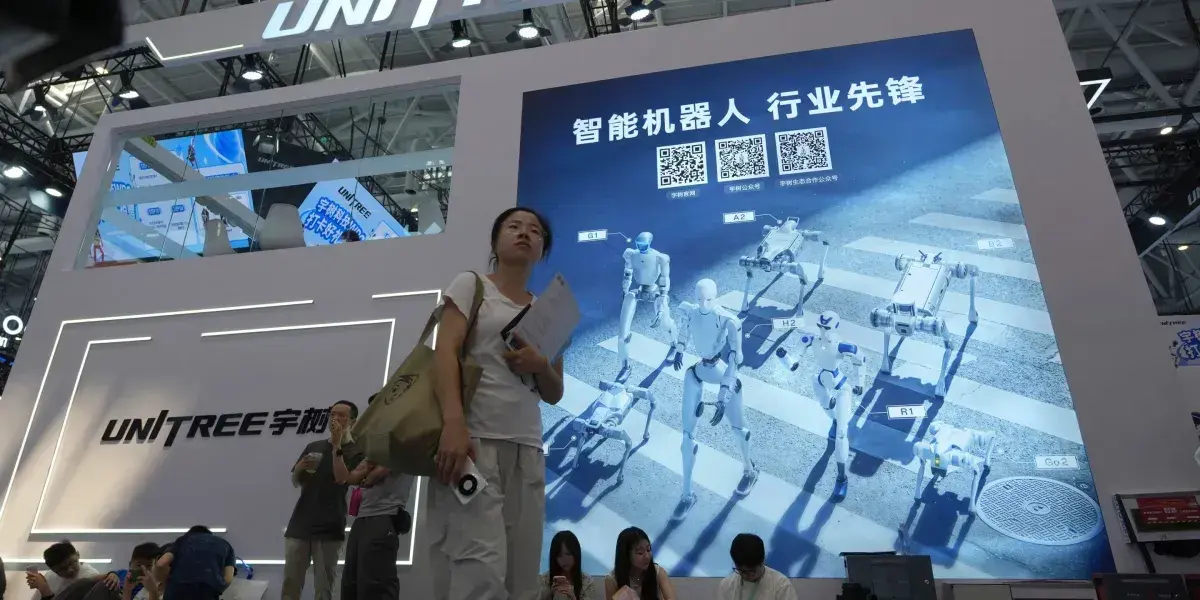
.Unitree, one of China's leading humanoid robot makers, debuted in Shanghai in August with shares rising 460% on the first day of trading
1
.
Source: Fortune
The spectacular Unitree IPO performance underscores how robotics companies are capturing significant capital reallocation within the current market cycle. "The current IPO boom is powered by investor appetite for AI and robotics," said Ruiying Zhao, a senior research analyst at S&P Global Market Intelligence
4
. Other robotics firms including AGIBOT and Deep Robotics are now looking to hold their IPOs in Hong Kong or Shanghai, following this momentum2
.China-founded e-commerce and fast fashion giant Shein debuted in Hong Kong with a blockbuster initial public offering raising $1.7 billion, representing one of the city's biggest new share sales this year
3
. The Shein IPO valued the company at around $27 billion, a fraction of its peak valuation from a few years ago, partly due to U.S. and EU moves to restrict de minimus tax-exemptions for imports of small packages1
. Shein explored listings in the U.S. and London before opting for Hong Kong, reflecting broader regulatory shifts affecting where Chinese companies choose to go public4
.Related Stories

Stricter U.S. and Chinese regulatory scrutiny in recent years of big Chinese companies listing in U.S. markets, especially those in strategically important sectors like advanced technologies, has led some Chinese companies to stick closer to home
2
. Listing overseas typically takes more time compared with doing IPOs in China, according to Howie Farn, a capital markets partner at law firm Freshfields3
. Since China limits foreign purchases on mainland exchanges, many Chinese companies execute parallel listings in Hong Kong to help raise international capital1
. Recent Hong Kong listings of Apple-supplier Luxshare Precision Industry and Zhongji Innolight, which makes optical transceivers used in data centers, were among this year's largest deals reflecting continued investor demand for advanced technologies4
.After massive oversubscriptions and huge gains in their share debuts, some companies have seen their market value shrink significantly. Unitree's share price had fallen more than 40% as of Friday from its peak share price on the day of its trading debut
1
. "The critical question remains: is the AI sentiment enough?" said Zhao from S&P, noting that similar concerns raised worries among investors in the U.S. now also apply to China. "For a durable market cycle, investors will demand sustainable revenue, visible profit margins, and realistic valuations"2
. The global AI frenzy has drawn attention away from companies like Shein. "The AI investment cycle is absorbing much of the risk appetite that would have otherwise flowed to a company like Shein," said Jacob Cooke, CEO of WPIC Marketing + Technologies3
. Watch whether these AI-driven companies can deliver on their revenue promises and maintain investor confidence as the market tests whether current valuations reflect genuine business fundamentals or speculative enthusiasm.Summarized by
Navi
02 Jan 2026•Business and Economy

17 Apr 2026•Business and Economy

06 Aug 2026•Business and Economy

1
Policy and Regulation

2
Technology

3
Technology