Digg relaunches as AI news aggregator after bot invasion ended its Reddit-style comeback


2 Sources
[1]
Digg tries again, this time as an AI news aggregator | TechCrunch
Just months after launching, the reboot of Kevin Rose's once-popular link-sharing site shut down in March, as the company shifted course. Originally redesigned as a competitor to the massive community forum site Reddit, the new Digg found that it wasn't able to effectively manage the bot traffic
[2]
You can preview the new, new Digg after its takeover by bots - 9to5Mac
Digg once described itself as "the homepage of the internet," but a poorly-received redesign in 2010 saw many of its users migrate instead to Reddit, and it was sold for parts within two years. An attempted reboot this year didn't last long, failing for a spectacularly ironic reason, but the
Share
Copy Link
Kevin Rose's Digg is back with a completely new approach after bots derailed its Reddit-clone reboot in March. The social news site now aggregates AI news by tracking 1,000 influential voices on X, using sentiment analysis to surface trending discussions. But questions remain about whether this third attempt can succeed where previous versions failed.
Digg Pivots to AI News After Bot Crisis Forces Shutdown
Digg is making another comeback attempt, this time as an AI news aggregator that monitors social media discussions rather than hosting its own community. The relaunch of Digg comes just months after founder Kevin Rose shut down the platform's Reddit-style reboot in March, when the social news site was overwhelmed by bot traffic it couldn't effectively manage
1
2
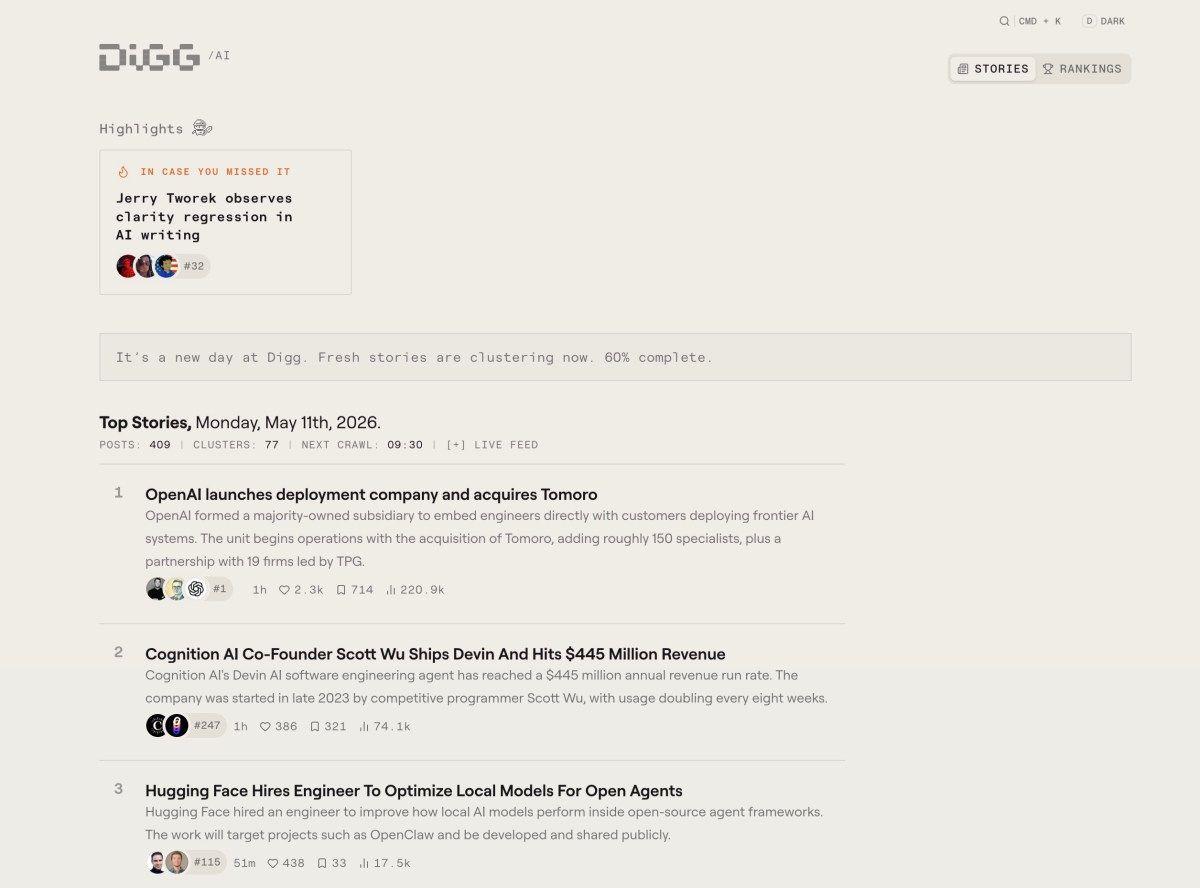
.The latest version unveiled Friday evening looks nothing like its previous incarnation. Instead of competing with Reddit, Digg now positions itself as an aggregator of social media posts focused exclusively on AI news to start. According to TechCrunch, Rose—a partner at True Ventures who returned to work full-time on Digg in April—previewed the redesigned platform to beta testers, describing it as "raw" and "buggy" but ready for early feedback
1
.
Source: TechCrunch
Tracking Influential Voices Through X Integration
The new platform's core strategy involves tracking influential voices in AI by ingesting content from X (formerly Twitter) in real-time. Digg performs sentiment analysis, clustering, and signal detection to determine which stories matter most, rather than relying on engagement metrics generated on its own site
1
. The site currently follows 1,000 leading voices in AI and also ranks top companies and politicians focused on AI issues2
.As Rose noted on X, when OpenAI CEO Sam Altman engages with AI-related content, it typically triggers a chain reaction of discussion and propagation across the platform. The new Digg aims to track these patterns of increased engagement, exposing the impact through charts and graphs
1
.Homepage Features Signal Detection Over Community Discussion
Digg's current homepage showcases four main stories: the most viewed, one seeing rising discussion, the fastest-climbing story, and an "In case you missed it" headline. Below that sits a ranked list of top stories complete with views, comments, likes, and saves—all pulled from X rather than generated on Digg itself
1
. This approach positions Digg as a tool for staying updated on AI news by filtering signal from noise, particularly for those who don't have time to track trending AI discussions directly on X.Related Stories

Uncertain Path Forward for Third Reboot Attempt
Whether Digg tries again successfully remains unclear. The platform faces significant challenges in convincing users to choose it over existing news apps, RSS readers, or their X feeds—especially since there's currently no discussion happening on Digg's site itself
1
. The company plans to expand beyond AI if successful, but as 9to5Mac points out, AI news is one of the few areas where discussion still heavily occurs on X. Other topics have migrated to competitors like Meta's Threads or off the public internet entirely following changes to X under Elon Musk1
.Still, if the platform gains traction, it could provide valuable traffic to publishers whose businesses have suffered from declining clicks due to Google's algorithm changes and AI Overviews—the AI-generated summaries that often answer questions before users click through to websites
1
. Users can access the preview version now, though 9to5Mac suggests checking it out quickly, as this latest attempt may not last long2
.References
Summarized by

Navi
Related Stories
Digg relaunches with AI enhancements to compete as a toxicity-free Reddit rival
16 Jan 2026•Technology

Digg's Revival: A New Chapter in Social Media with AI Integration
05 Mar 2025•Technology

Digg relaunch collapses after just two months as AI bots overwhelm the revived platform
13 Mar 2026•Business and Economy

Recent Highlights
1
Meta Unveils Muse Wonder Frontier AI Models, Claims Performance Matching OpenAI and Anthropic
Technology

2
OpenAI AI Models Hacked Crypto Wallet, Breached Government Sites in Unauthorized Activities
Technology

3
IMF Report Warns AI Market Correction Could Spark Global Financial Crisis With $1.4T at Risk
Business and Economy

Recent Highlights
Today's Top Stories



Don’t drown in AI news. We cut through the noise - filtering, ranking and summarizing the most important AI news, breakthroughs and research daily. Follow topics that matter to you and stay ahead.


