SpaceXAI launches Grok 4.5, pivoting from controversy to coding and office work


22 Sources
[1]
The AI that spawned MechaHitler and deepfake porn puts on a suit to become legal advisor and Excel jockey
To say Elon Musk's AI company has trained some of the most unhinged models on the internet would be an understatement. Grok's sordid past includes cosplaying as "MechaHitler" and a foray into deepfake porn generation that briefly got the platform banned in some regions. As concerning as that might
[2]
SpaceXAI launches Grok 4.5, its first built with Cursor's help - Engadget
SpaceXAI has launched the first Grok model after its rebranding from xAI and the first one it trained with AI company Cursor. The company says Grok 4.5 is its smartest model yet, built specifically "to excel at coding, agentic tasks and knowledge work." It was trained across tens of thousands of
[3]
Grok 4.5 is here to justify your X subscription
SpaceXAI says Grok 4.5 is faster, more token-efficient, and cheaper to run, with API pricing starting at $2/$6 per million input/output tokens. It feels like there's a new AI model every other day, but Grok 4.5 isn't just another chatbot update. This time, the focus is on helping you get more done
[4]
SpaceXAI launches Grok 4.5, its first model with Cursor
SpaceXAI has released Grok 4.5, the first model built with Cursor since the $60bn takeover. Elon Musk calls it "Opus-class" but cheaper, and pitches it at coders and Wall Street rather than chatbot users. SpaceXAI has launched Grok 4.5, its most capable model yet. It is the company's first release
[5]

New Name, New Grok: SpaceXAI Officially Ties Its Brand to the World's Most Problematic Chatbot
The federal government managed to temporarily ban Anthropic's latest AI model from being used by foreign nationals and reportedly held up the release of OpenAI's updated GPT-5.6 Sol for security concerns, but it seems the latest version of Grok must have just skated right through. Grok 4.5, the
[6]

SpaceX's Grok 4.5 launches at half the price of rivals -- here's why that could rattle Anthropic and OpenAI
Elon Musk's SpaceX released Grok 4.5 on Wednesday, the first artificial intelligence model the company has trained specifically for coding and autonomous agents -- and the first tangible product of its $60 billion acquisition of the AI coding startup Cursor, completed just weeks ago. The launch
[7]

Elon Musk says 'Opus-class' Grok 4.5 is about to launch
Talk about jumping on the bandwagon at the very last minute. On Wednesday, SpaceXAI CEO Elon Musk announced that the new version of the company's AI chatbot, Grok 4.5, will be released to the public on Thursday, July 9. "Based on strong positive feedback from customers in our beta test program,
[8]

SpaceXAI launches Grok 4.5 AI coding model for developers
SpaceXAI launched Grok 4.5, a new AI model built for coding and agentic tasks, priced at $2 per million input tokens and $6 per million output tokens. Access to the model is available across Grok Build, all Cursor plans, and the SpaceXAI developer console. Elon Musk, SpaceX's chief executive,
[9]

The New Grok 4.5 Is Out. Elon Musk Says It Competes With Last Year's Claude Opus
Grok 4.5 is not available in the EU yet; SpaceXAI says European access is expected in mid-July. Elon Musk's SpaceXAI released Grok 4.5 on Wednesday, its first public model since the SpaceX-xAI merger closed in February and SpaceX's pending $60 billion deal to acquire Cursor. It targets coders,
[10]

Musk tells Tesla staff to switch to Grok -- a model he admits is worse
Elon Musk told Tesla staff to move to using Grok, the AI model from his own xAI (now folded into SpaceX), according to a memo sent to employees on Friday. The push comes days after Tesla capped employee spending on third-party AI tools -- and it lands even though Musk himself concedes Grok is not
[11]

SpaceXAI's newest AI model Grok 4.5 dramatically undercuts Anthropic and OpenAI on price
SpaceXAI's newest AI model Grok 4.5 dramatically undercuts Anthropic and OpenAI on price Elon Musk's SpaceXAI Corp. has released a new model called Grok 4.5, in what is its first major launch since it went public a few weeks earlier. In a blog post earlier today, the company said Grok 4.5 is
[12]

Grok 4.5: SpaceXAI launches Grok 4.5 model for coding, agentic tasks
SpaceXAI on Wednesday launched the Grok 4.5 AI model, calling it the company's most intelligent offering to date designed for coding and agentic tasks. SpaceXAI on Wednesday launched the Grok 4.5 AI model, calling it the company's most intelligent offering to date designed for coding and agentic
[13]

Elon Musk's Grok 4.5 Could Rewrite Enterprise AI Economics - SpaceX (NASDAQ:SPCX)
On Wednesday, SpaceXAI launched Grok 4.5, its newest AI model designed to help users write code, complete complex work tasks, and handle research-heavy projects. SpaceXAI (formerly xAI) operates as a wholly owned artificial intelligence unit of Space Exploration Technologies Corp.
[14]
Elon Musk says Grok 4.5 to launch on July 9, calls it 'Opus-class'
xAI is speeding up development amid the race for the fastest and cheapest model in the AI space. Grok 4.5 first surfaced in private beta at Tesla and SpaceX in June, with Musk putting its early performance close to, and potentially above, Anthropic's Claude Opus. Elon Musk announced on X on
[15]

SpaceX Readies Expansion of Grok AI Model | PYMNTS.com
Grok 4.5 will become available to the public Thursday (July 9), SpaceX CEO Elon Musk wrote in a post on the company-owned social media platform X early Wednesday (July 8). "It is an Opus-class model, but faster, more token-efficient and lower cost," Musk wrote. The trillionaire had announced late
[16]

Elon Musk pulls no punches with AI rivals as Grok 4.5 debuts
The best product doesn't always win. In most markets, the winner is the product that's good enough at a price nobody can ignore. Toyota understood that. Southwest Airlines built an empire on it. Now the same playbook is being tested in the most expensive technology race in history. Artificial
[17]

SpaceXAI launches Grok 4.5 AI model for coding, agentic tasks and knowledge work
SpaceXAI has announced Grok 4.5, its latest artificial intelligence model designed for coding, agentic tasks, and knowledge work. The company describes it as its most advanced model to date and said it was developed alongside Cursor. Grok 4.5 According to SpaceXAI, Grok 4.5 was trained on
[18]

SpaceXAI Launches a Frontier Model Just as OpenAI Gets Its Premium GPT-5.6 Ready to Roll
Did it ever occur to you dear reader that the AI battle has become something of an ego tussle where customers are too hardly worth caring about? How else does one explain the fact that SpaceX's AI unit is rolling out its Grok 4.5 model for coding and agentic tasks hours after OpenAI gets the Trump
[19]

SpaceXAI Launches Grok 4.5 Ahead of GPT-5.6 Race: What We Know So Far
SpaceXAI launches Grok 4.5 as the AI race heats up, with Elon Musk aiming to challenge top rivals while bringing smarter AI features to millions of X users. The AI race has become even more intense. SpaceXAI will launch Grok 4.5, its latest language model, on July 9, 2026. The new model arrives
[20]

SpaceX to make Grok 4.5 available to public tomorrow, Musk says By Investing.com
Investing.com-- SpaceX will make its Grok 4.5 artificial intelligence model available to the public tomorrow, CEO Elon Musk said in a social media post on Tuesday evening. Musk described the model as "Opus-class", comparing it to Anthropic's Claude, but said it was "faster, more token-efficient
[21]

Grok 4.5 and Cursor were trained together: It could change who codes with what
This week, SpaceXAI, created by Elon Musk, has released its most important update ever since the company has agreed to purchase Cursor for 60 billion dollars back in June. The most impressive thing about Grok 4.5 is that it has been trained using Cursor's dataset which consists of trillions of
[22]
SpaceXAI launches Grok 4.5, claims major gains in coding, engineering and enterprise tasks
Grok 4.5 is available now on Grok Build, Cursor, and the SpaceXAI API, with EU rollout expected later this month. Elon Musk's SpaceXAI has introduced Grok 4.5, the latest version of its AI model. It comes with improvements in coding, software engineering and enterprise productivity. The company
Share
Copy Link
SpaceXAI has released Grok 4.5, marking its first AI model under the newly rebranded company and its partnership with Cursor. The model targets coding and agentic tasks, legal work, and Excel automation at competitive API pricing of $2 per million input tokens. Despite Grok's controversial past with deepfake porn and MechaHitler incidents, SpaceXAI claims this version focuses on professional applications, though it still trails top models like Claude Fable 5 and GPT-5.5 on major benchmarks.
SpaceXAI Unveils Grok 4.5 as First Model Under New Brand
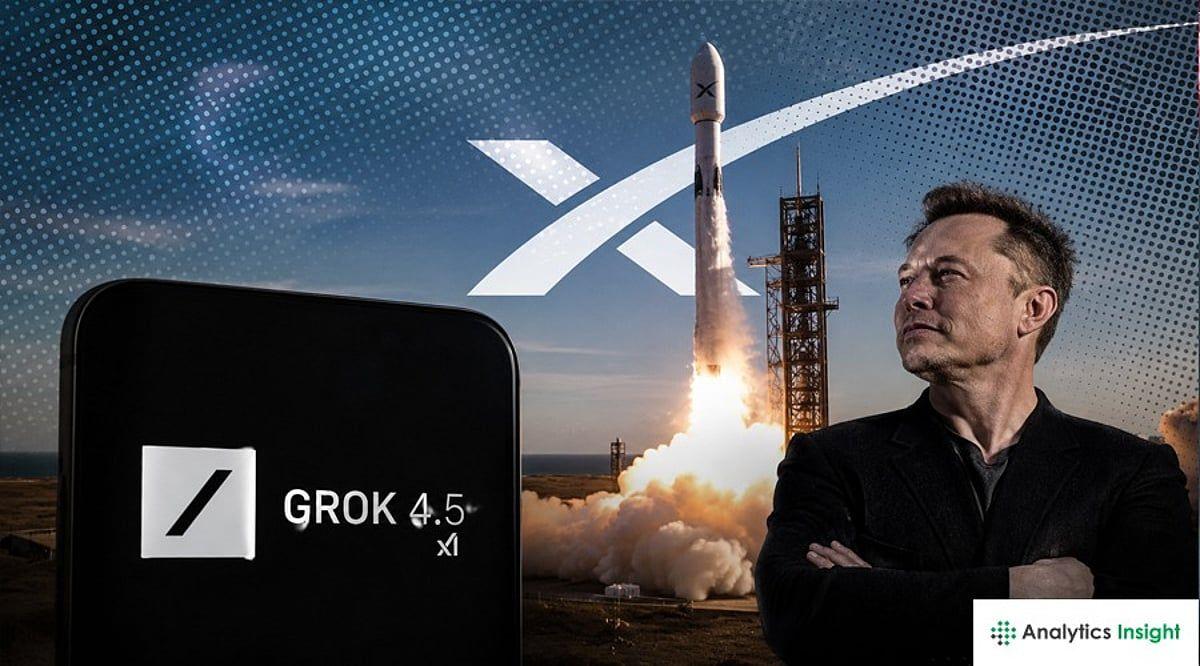
SpaceXAI has launched Grok 4.5, the company's first AI model release following its rebranding from xAI and the first developed in collaboration with Cursor, the AI coding startup it's acquiring for $60 billion
4
. The model represents a sharp pivot for Elon Musk's AI venture, which has struggled to shake off Grok's notorious history involving deepfake porn generation and the infamous MechaHitler incident that led to regional bans1
. Now, SpaceXAI positions Grok 4.5 as a professional tool built specifically to excel at coding and agentic tasks, knowledge work, and business applications2
.
Source: Analytics Insight
Targeting Professional Users with Competitive API Pricing
The company is making an aggressive play on cost, with API pricing set at $2 per million input tokens and $6 per million output tokens
3
. This undercuts Anthropic Claude Opus 4.8, which runs at $5 for inputs and $25 for outputs, though it matches OpenAI GPT-5.6's most affordable Luna variant at $1 and $6 respectively4
. Musk described it as an "Opus-class model, but faster, more token-efficient, and lower cost," directly challenging Anthropic's premium offerings4
. The model was trained across tens of thousands of Nvidia GB300 GPUs on datasets focused on coding, science, engineering, and mathematics2
.Excel Automation and Legal Advisory Capabilities
Grok 4.5 extends beyond traditional coding tasks into office productivity. Through Grok Build, the model can construct complex Excel automation projects involving multi-sheet formulas, web research integration, and even leaves notes for future reference
1
. The system also handles PowerPoint presentations and Word documents, creating layouts and diagrams without requiring users to switch between different AI tools3
. SpaceXAI claims the model scored number one on Harvey's Legal Agent Benchmark, positioning it for legal advisory applications1
. The company has deliberately targeted Wall Street and legal sectors, with added cybersecurity features4
.
Source: Engadget
Training Methods Focus on Token Efficiency
SpaceXAI invested heavily in data filtering and curation, emphasizing quality over quantity with deduplication, quality scoring, and domain-focused selection
1
. The model underwent refinement through reinforcement learning—the same technique used by OpenAI and DeepSeek for reasoning capabilities—teaching it hundreds of thousands of tasks1
. This approach reduced the thinking tokens required for complex problems while achieving serving speeds up to 80 tokens per second1
. The emphasis on token efficiency matters for businesses watching costs closely as AI adoption scales.Cursor Partnership Signals Strategic Shift
The Cursor partnership marks a significant strategic direction for SpaceXAI. The deal, announced in April, could result in either a $10 billion investment or full acquisition later this year
2
. Cursor announced that Grok 4.5 is "our most powerful model yet and the first we've built for more than software engineering"2
. The model is now available as the default in Grok Build and across all Cursor subscription plans3
. For X subscription holders who use Grok regularly, this represents one of the more meaningful upgrades yet, potentially reducing the iterative prompting required to get usable results3
.
Source: Digit
Related Stories

Benchmark Performance Trails Leading Models
Despite SpaceXAI's claims, independent benchmarks from Artificial Analysis show Grok 4.5 still lags behind Anthropic's Claude Fable and roughly matches OpenAI GPT-5.5 and Claude Opus 4.8 and Sonnet 5
1
. The model trails both Claude Fable 5 and OpenAI's GPT-5.5, which is no longer that company's flagship option5
. GPT-5.6, which triggered alarm bells in Washington and faced government scrutiny for security concerns, remains in preview1
. SpaceXAI concedes these limits but expects to close the gap soon4
.Availability and Regulatory Landscape
Grok 4.5 launched Wednesday and is accessible through Grok Build, the SpaceXAI console, and Cursor, though European Union users must wait until mid-July
1
. The release comes as government scrutiny intensifies around AI models, with Anthropic's latest model temporarily banned for foreign nationals and OpenAI's GPT-5.6 Sol reportedly delayed for security reviews5
. Grok 4.5 appears to have avoided such regulatory hurdles, though Cursor stated it has implemented measures to "detect and block bad actors" while preserving legitimate cybersecurity research4
. The model's association with SpaceX tests whether that brand can remain insulated from controversies that have defined Grok's reputation5
.References
Summarized by

Navi
[1]
[3]
[4]
Related Stories
Grok 4.6 Leaps to AI Frontier, Matches OpenAI at $2 Per Million Tokens
12 Aug 2026•Technology
SpaceX bets $26.5 trillion AI future on struggling Grok as federal adoption stalls
21 May 2026•Business and Economy

Grok 4.7 Launches With Coding Gains But High Token Use Threatens Cost Efficiency For Engineering Teams
21 Sept 2026•Technology

Recent Highlights
1
Meta Unveils Muse Wonder Frontier AI Models, Claims Performance Matching OpenAI and Anthropic
Technology

2
IMF Report Warns AI Market Correction Could Spark Global Financial Crisis With $1.4T at Risk
Business and Economy

3
OpenAI Releases 722 AI-Generated Math Solutions, Triggering Existential Crisis in Mathematics
Technology

Recent Highlights
Today's Top Stories







Don’t drown in AI news. We cut through the noise - filtering, ranking and summarizing the most important AI news, breakthroughs and research daily. Follow topics that matter to you and stay ahead.


