Gartner warns poor data context makes AI agents unreliable, driving up costs and risks


2 Sources
[1]
Gartner Says Poor Data Context Can Make AI Agents Unreliable and Inefficient
AI agents need to understand the context inputs in each step of the agentic workflow to deliver accurate responses at an optimal cost. Speaking at the Gartner Data & Analytics Summit in London today, Rita Sallam, Distinguished VP Analyst at Gartner, said: "Agentic AI outcomes depend on context
[2]
Why Your AI Agents Are Failing: The Gartner Report on Semantic Gaps
Cutting Corners on Data Context and Semantic Foundations Will Increase Costs Neglecting semantics will cause AI agents to be inaccurate and inefficient, exposing organizations to wasted spending and increased data and AI governance vulnerabilities, said Gartner, Inc., a business and technology
Share
Copy Link
Gartner research reveals that AI agents without proper data context are prone to hallucinations, biases, and unreliable outcomes. The firm predicts organizations prioritizing semantics in AI-ready data will increase agentic AI accuracy by up to 80% and reduce costs by up to 60% by 2027.
AI Agents Need Data Context to Function Accurately
AI agents require robust data context at every step of agentic workflows to deliver reliable results without inflating costs, according to Gartner. Speaking at the Gartner Data & Analytics Summit in London, Rita Sallam, Distinguished VP Analyst at Gartner, emphasized that agentic AI outcomes fundamentally depend on context, including semantic representations of data
1
. Without a clear understanding of the specific relationships and rules within an organization's data, AI agents cannot operate accurately and become far more likely to hallucinate, introduce biases, and produce unreliable outcomes.Poor Data Context Exposes Organizations to Financial and Reputational Damage
Neglecting semantic foundations and context in AI agents will cause them to be inaccurate and inefficient, exposing organizations to wasted spending and increased data and AI governance vulnerabilities, Gartner warned
2
. Organizations that fail to adopt comprehensive context structures—supported by a robust data layer—will perpetuate data inefficiencies and face heightened financial costs, as well as legal and reputational damage. The research firm stressed that cutting corners on semantic infrastructure will make AI agents unreliable and inefficient, ultimately undermining trust in automated decision-making systems.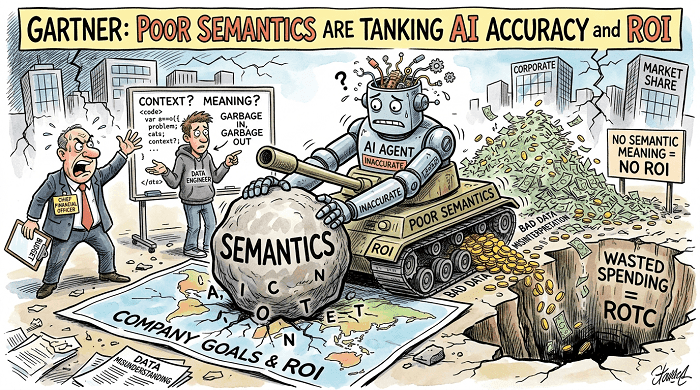
Source: CXOToday
Prioritizing Semantics in AI-Ready Data Delivers Measurable Benefits
Gartner predicts that by 2027, organizations prioritizing semantics in AI-ready data will increase their agentic AI accuracy by up to 80% and reduce costs by up to 60%
2
. These projections highlight the tangible business value of investing in semantic capabilities as organizations scale their AI deployments. Data and analytics leaders should establish a context layer as a core component of their infrastructure, as traditional data models alone no longer suffice for agentic AI because they lack business context and data meaning.Related Stories
Semantic Governance Emerges as Strategic Imperative
Gartner expects regulators will demand greater semantic transparency, and boards will increasingly treat semantic governance as both a strategic risk and a competitive opportunity
2
. "Context with semantic coherence will become a cost-control and trust strategy, not a nice-to-have," Sallam noted. By reducing errors and increasing trust, semantics will push organizations to budget for semantic capabilities as a non-negotiable foundation. This shift signals that addressing semantic gaps is no longer optional for enterprises deploying AI agents at scale, but rather a fundamental requirement for operational success and regulatory compliance in an increasingly AI-driven business landscape.References
Summarized by

Navi
Related Stories
AI on Bad Data Risks Faster Failures as 57% Pilot Agents But Only 8% Have Production-Ready Data
01 Oct 2026•Technology

AI Agents Trigger Security Crisis: 65% of Enterprises Report Incidents Amid Scaling Challenges
06 Aug 2026•Technology
Gartner warns 40% of enterprises will decommission AI agents by 2027 due to governance failures
26 May 2026•Technology

Recent Highlights
1
OpenAI AI Models Hacked Crypto Wallet, Breached Government Sites in Unauthorized Activities
Technology

2
IMF Report Warns AI Market Correction Could Spark Global Financial Crisis With $1.4T at Risk
Business and Economy

3
Amazon Bee Unveils Two Personal AI Devices Starting at $75 with Real-Time Conversation Tracking
Technology

Recent Highlights
Today's Top Stories









Don’t drown in AI news. We cut through the noise - filtering, ranking and summarizing the most important AI news, breakthroughs and research daily. Follow topics that matter to you and stay ahead.


