13 Sources
[1]
Google Celebrates 20 Years of Translate With a New Pronunciation Feature
Macy has been working for CNET for coming on 2 years. Prior to CNET, Macy received a North Carolina College Media Association award in sports writing. Language plays a major role in building connections. If you've ever needed a split-second translation or worked your way through a foreign language class at school, you've probably used Google Translate. For over 20 years, Translate has evolved from a web browser tool to a free app for Android and iOS, helping people read and communicate in other languages. Today, more than 1 billion users ask Google for translation help each month. Google Translate has now launched a new feature for Android users to help with pronunciation. The tech giant has also published a list of key insights and fun facts over the last two decades. Read more: The 6 Google AI and Lens Features I'm Using to Plan My Summer Travel Today, Google is rolling out a pronunciation practice feature for Android, so you can practice speaking in another language and get real-time feedback. This builds on Google's "ask" and "understand" features, which provide additional context for language learning. The new pronunciation tool uses AI to evaluate your conversational skills and offer tips for improvement. When you try the feature out for yourself, Translate will prompt you to repeat phrases, then score your pronunciation and offer specific tips to improve sounds, stress and annunciation. The pronunciation practice tool is available starting today in the US and India. The languages offered include English, Spanish and Hindi. Translate is useful in everyday situations, from reading news from abroad to traveling to another country. For quick offline use, you can download language packs within the app. Once a pack is installed, you can translate text and speech without an internet connection, which is handy on flights or when roaming in a remote area. Google Lens also works with Translate to let you point your camera at a menu, sign or plaque and see translated text overlaid on the image. I've tested this feature out before, pointing my iPhone camera at a restaurant menu, which then gave me translations within seconds. Behind these Translate features are years of machine learning improvements. Google Translate supports almost 250 languages, covering an estimated 95% of the world's population. The service handles trillions of translated words each month across Google products, including Translate, Search, Lens and Circle to Search. Google previously rolled out Live experiences, a feature that translates real-time conversations using headphones and Google Gemini models. The Live translate option recently became available on iOS, and the company says it's expanding this capability to more countries worldwide for both Android and iOS users. To try it, open the Translate app, tap Live translate and connect your headphones. Many people use Translate for real-world speaking practice, and about a third of live sessions last longer than five minutes, suggesting they rely on it for real-time conversations rather than just quick searches. English to Spanish is the most common go-to language pair in Translate. Other common language pairs include English to Indonesian, Portuguese, Arabic and Turkish. The most commonly translated phrases are about gratitude, connection and love. Translate also helps with slang idioms and cultural phrases, and now supports emoji and some sign language interpretations through AI-assisted modes.
[2]
Google Translate Now Listens to Your Pronunciation, Tells You Where to Improve
With over a decade of experience reporting on consumer technology, James covers mobile phones, apps, operating systems, wearables, AI, and more. Google Translate has been helping people communicate for 20 years, and to celebrate the milestone, Google says it's rolling out one of its "most requested features" by adding pronunciation practice. Enter the phrase you want to translate, let the tool do the work, then press a button to speak it into your phone or tablet with your own pronunciation. It uses AI-powered analysis to listen to your speech and provides instant feedback. If you get it right, it says, "Excellent, your speech was very clear," but it will encourage you to try again if it believes there's room for improvement. The tool highlights what it thinks you could improve in a second attempt, and asks you to record again. Pronunciation practice is launching exclusively for Android in the US, and at launch, it's restricted to users in the US and India. At first, it's only available with translations between English, Hindi, and Spanish. Google has yet to detail whether it will come to other devices or more languages, but we'd expect it to come to iPhone and desktop tools at a later date. Translate now covers almost 250 languages, so expect its practice tools to expand into many more in the future if it proves successful. If your Android device is compatible, upgrade to the latest version of Translate and type a phrase or sentence. The bottom bar will show a Practice button; tap it to listen to the translated wording, then press the microphone button to speak aloud. Alongside the announcement, Google shared some Translate facts and figures for its 20th anniversary. The tool first launched in April 2006, but it was far less complex, originally trained on United Nations and European Parliament transcripts to understand language differences. Google says that over a billion users now interact with its Translate tools each month, translating over a trillion words.
[3]
Google Translate uses AI to help you practice pronunciation
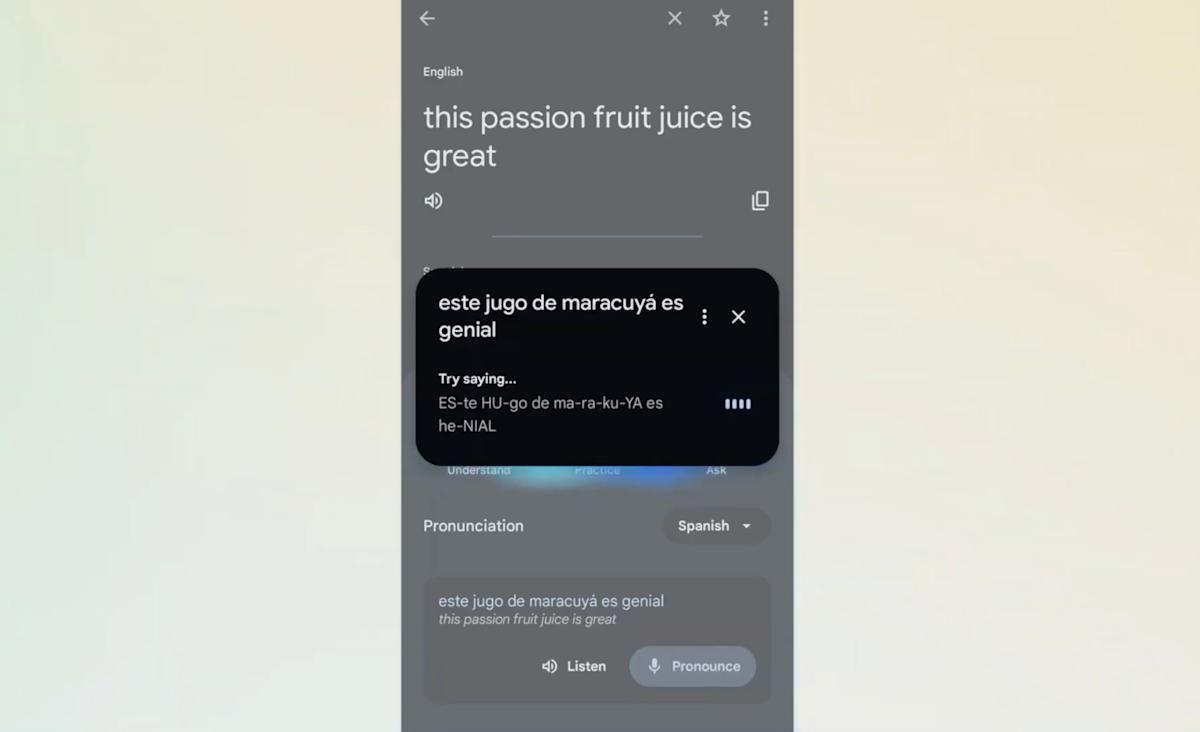
Google is celebrating Translate's 20th birthday by launching pronunciation practice, which the company says is one of the most requested features for the product. The feature is only rolling out on Android at the moment for English, Spanish and Hindi in the US and India. If it's available for you, you'll see a button at the bottom of the app that says "Practice," which gives you the option to either "pronounce" what you've translated or to "listen" to how it's actually pronounced by native speakers. If you choose the "pronounce" option, Translate will listen to you speak and then use artificial intelligence to analyze how you said the words to provide instance feedback. It will then show you a phonetic spelling of how specific words should be pronounced. In the example Google provided, for instance, the speaker pronounced the Spanish word for juice as "jugo" with the English "j" sound instead of with the Spanish "j" sound. So, Translate spells it out as "HU-go" in its pronunciation suggestion. Google said around third of users on mobile use Translate to practice speaking and listening in order to be able to hold real-world conversations, making this new feature a very useful addition. The company also revealed other stats about the app. Apparently, it now supports over 250 languages, including some endangered and indigenous ones, and has over 1 billion monthly user who have been translating over 1 trillion words every month.
[4]
Google Translate just got an AI coach for pronunciation practice on Android
Joe Fedewa has been writing about technology for over a decade. Android and the rest of the Google ecosystem have been a focus for years, as well as reviewing devices, hosting podcasts, filming videos, and writing tutorials. Joe loves all things technology and is also an avid DIYer and food blogger. He has written thousands of articles, hundreds of tutorials, and dozens of reviews. Before joining How-To Geek, Joe worked at XDA-Developers as Managing Editor and covered news from the Google ecosystem. He got his start in the industry covering Windows Phone on a small blog, and later moved to Phandroid where he covered Android news, reviewed devices, wrote tutorials, created YouTube videos, and hosted a podcast. From smartphones to Bluetooth earbuds to Z-Wave switches, Joe is interested in all kinds of technology. After several years of jailbreaking and heavily modifying an iPod Touch, he moved on to his first smartphone, the HTC DROID Eris. He's been hooked ever since. Google Translate may not be the company's flashiest app, but it's one of the most important. It launched 20 years ago on this day, and to celebrate, the Android app is getting a much-requested feature: pronunciation practice. Scanning words in the real world and doing quick copy-paste translations are great uses for Google Translate, but it's for much more than text. Pronunciation is also a major component when it comes to learning and speaking languages. Currently, the Translate app can recite translations out loud, but that's the extent of the information you get for proper pronunciation. Google Translate's new pronunciation practice feature analyzes your speech Get judged by AI in real time Starting today, Google Translate on Android can go more in-depth in helping you learn how to correctly deliver words and sentences. The new feature, officially called "Pronunciation Practice, " lives between the "Understand" and "Ask" buttons in the toolbar. When opened, you have the option to first hear Google recite the words, then you can tap "Pronounce" and give it your best shot -- this is where the cool stuff happens. Google's AI analyzes your speech and highlights the areas where you could improve. From there, you can listen to Google's pronunciation again, compare it to yours, and give it another try. Once you've nailed it, Google will give you feedback that says, "Excellent! Your speech was very clear." As mentioned, this is available in the Android app, but I wouldn't be surprised to see it eventually on iPhone as well. It's rolling out today in the U.S. and India for Spanish and Hindi. This is a much-needed feature that should make Translate even more useful if you're using it to learn new languages. Related Google Translate Can Now Help You Learn a New Language While Google Translate has always been an app you could use to learn a new language, it's about to get a lot better. Google is rolling out new AI-powered features designed around language learning, and apps like Duolingo better watch out. Google says advancements to its Gemini AI model have improved translation quality, multimodal translation, text-to-speech, and now conversational teaching tools. Posts 1 By Cory Gunther
[5]
Google Translate is now 20 years old, adds pronunciation practice
Google Translate launched on April 28, 2006. To mark its 20th anniversary, Google is adding a pronunciation tool to Translate for Android. Pronunciation practice is one of Google Translate's most requested features. After you get a translation, select the "Practice" button. It joins the Gemini-powered Understand and Ask capabilities introduced earlier this year. Tapping "Pronounce" will let you speak it and have AI "analyze your speech and provide instant feedback." Google Translate pronunciation practice is available on Android in the US and India in English, Spanish, and Hindi. The company also shared the history behind Translate, including how it was "one of the initial experiments that kickstarted Google's machine learning work decades ago within Google Research." Today, Gemini models are leveraged and help power Live translate's real-time conversations, with over a third of these sessions lasting five minutes or more. Each month, 1 billion users use Google for translation help, while 1 trillion words are translated monthly across the Google Translate app, Search, Lens, and Circle to Search.
[6]
You can now use Google Translate to practice your pronunciation with real-time AI feedback
Google Translate is celebrating its 20th birthday, marking the occasion with something users have been requesting for a long time. Google is introducing pronunciation practice, which is now available on Android for English, Spanish, and Hindi in the US and India. No word yet on when it will expand to other regions or arrive on iOS. Around a third of Google Translate's mobile users already use the app to practice speaking and listening for real-world conversations, which makes this a genuinely useful addition. How does Google Translate's pronunciation practice feature work? Once you have a translation, a new "Practice" button appears at the bottom of the app. When you tap on it, you will get two options. The "Listen" option lets you hear how native speakers actually say the words. The "Pronounce" option is where you can practice. Recommended Videos You speak the translated phrase and the AI listens, analyzes your speech in real time, and gives you instant feedback on where you went wrong. It then shows you a phonetic breakdown of how each word should actually sound. The phonetic spellings are written out in a way that gives you a chance at getting it right on the next attempt. The result is quite similar to how Duolingo handles pronunciation feedback in its language learning app. Google Translate has been on a roll lately Pronunciation practice is just the latest in a string of meaningful updates to Google Translate. The app recently gained the ability to decode idioms and local slang. So, phrases like "raining cats and dogs" now get translated by meaning rather than word-for-word. iPhone users also recently got access to Live Translation through their headphones, a feature that was previously limited to Android. And now with pronunciation coaching added to the mix, Google Translate is quietly turning into one of the best language learning apps.
[7]
Celebrating 20 years of Google Translate: Fun facts, tips and new features to try
This content is generated by Google AI. Generative AI is experimental Twenty years ago, Google Translate began with a profound mission to help people understand one another, regardless of the language they speak. In the two decades since, we've worked to turn the science of language into the magic of connection. What started as a small experiment is now a global tool that helps people every day, from connecting with new people while traveling to learning a new language to support their career. To celebrate two decades of progress, here are 20 things you might not know about Translate and how people are using it around the world. To celebrate our 20th anniversary of Translate, today we're launching one of our most requested features: pronunciation practice, so you can master your delivery on the Translate app for Android. You can already tap "ask" and "understand" to provide additional context and receive alternatives, and now you can use the new "pronunciation practice" tool, which uses AI to analyze your speech and provide instant feedback -- helping you nail the right pronunciation before you start a real-world conversation. This is now available in the U.S. and India in English, Spanish and Hindi.
[8]
Google Translate Now Helps You Practice Your Pronunciation
The feature currently only supports English, Spanish, and Hindi. Despite many intermittent attempts throughout the years to learn another language, I currently speak only English. I understand some words and phrases in Spanish and Portuguese, but I can't have a conversation in either, and I'd like to change that. As it happens, Google Translate's newest feature might be able to help me a bit on my language learning journey -- even if it is a bit brutally honest along the way. As reported by TechCrunch, Google Translate now offers pronunciation practice as part of its experience, a la Duolingo. Like Duoligno, Google Translate can listen to your attempt at speaking a specific word, phrase, or sentence, and will offer feedback based on how its AI thinks you did. The app can even offer pronunciation guidance, so you can focus less on trying to sound out the words yourself, and more on how those words phonetically sound. Nick Fox, senior vice president of Knowledge & Information at Google, shared the new feature in an X post on Tuesday: This Tweet is currently unavailable. It might be loading or has been removed. Per the post, here's how it's supposed to work: Once you enter a word, phrase, or sentence and the app translates it, a new "Practice" options appears at the bottom of the page. Tap this, and you'll open the "Pronunciation" menu. You can listen to the translation again, but tap "Pronounce," and Google Translate will open a pop-up menu with the phonetic pronunciation listed beneath the translation. In tandem, the app activates your device's mic, so you can start speaking. Once you're done, the app processes your attempt and gives you some advice. In the example above, Google Translate told the user they were "Moving in the right direction," but "some sounds were a little unclear." This pronunciation feature seems like a great addition to one of (if not the) most popular translation apps in the world. And yet, the feature seems to be rolling out both slowly and half-finished. On my Pixel 8 Pro, I don't have the option whatsoever. On my iPhone, I have a similar feature, but not quite what's advertised here. Here's how I've gotten that to work: After translating something, I don't have the "Practice" option at the bottom of the screen. However, I do have a "Speak" option that appears when I hit the speaker button on the translation. This pulls up a very close experience to what was displayed in Fox's post: I get the translation and the ability to speak into the mic, but I don't get the clear phonetic spelling -- just the transliteration of it. It's not unhelpful, but the phonetic spelling would be much easier to follow along, especially when I'm trialing Hindi. Unfortunately, I can't read Devanagari characters, so it isn't all that helpful when Google asks me to focus on them while trying to speak. Still, I was able to go off of both the transliteration and the audio of the translation in my attempt to speak the language. Once I finished speaking, I found another quirk not featured in Google's announcement: a grade! In addition to direct feedback, Google gave me a percentage score out of 100 based on how well it thinks I did. I typically fare much better with Spanish than Hindi, but it's only my first day trying the latter after all. Maybe after Google rolls out the feature a bit more, I'll get more of the advertised experience here. But even in its current form, this is a useful tool. I look forward to Google expanding the supported languages here, but, for now, anyone looking to learn Spanish or Hindi may find a boost with this feature -- assuming it appears on your device.
[9]
Google Translate Now the Perfect Pronunciation Coach
If you can believe it, Google Translate was launched 20 years ago. It's come a very long way, so Google posted a whole "20 things you might not know" about Translate blog post. Inside this blog, they also announced a brand new feature that users have been requesting for a long time. Launching today, Google Translate is getting a new Pronunciation Practice tool, which uses artificial intelligence to analyze a user's speed and provide instant feedback. This is helpful if you're trying to pick up a new language and need an AI study buddy to bounce pronunciations off of. This is new tool is now available in the US and India in English, Spanish, and Hindi. Leaving you with a noteworthy tidbit, over 1 billion users access Google Translate monthly, translating approximately 1 trillion words.
[10]
Google Translate Gets This New Feature in Time for Its 20th Anniversary
Google Translate was launched by the Mountain View-based tech giant on April 28, 2006. On Tuesday, the company announced that it is celebrating the 20th anniversary of the platform by introducing a new feature, called Pronunciation Practice, for Android users. Available in select regions, including India, the tool currently supports three languages, helping users practice their skills before initiating conversations with native speakers. Google's Chief Executive Officer (CEO), Sundar Pichai, highlighted that, in the last 20 years, Google Translate has moved from using statistical machine learning, which only supported word-for-word translations, to using Google's Gemini AI models for more precise results. Pronunciation Practice Is Available in India and the US The company introduced a new tool for its language translation platform, dubbed Pronunciation Practice. Android users can now click on Ask and Understand buttons to practice pronunciation, which is claimed to help them speak other languages with precision. Google Translate's new Pronunciation Practice functionality uses AI to analyse a user's speech and provides "instant" feedback to them on specific phrases and words. The feature is currently available in the US and India with support for three languages - English, Spanish, and Hindi. On the 20th anniversary of Google Translate, CEO Pichai said, "What started as a small experiment has become a global tool that helps over 1 billion users every month. In that time, [Google] Translate has evolved from simple pattern matching to true understanding." Initially, Google Translate relied on statistical machine learning to understand patterns in "small word clusters", the CEO pointed out. Over the years, the platform has shifted its reliance to Google's Gemini AI models to provide more accurate results. The company also revealed a few statistics, saying that "Thank You" was the most translated phrase on Google Translate, followed by phrases and words like "How are you?", "I love you", "Hello", and "Please". Citing Google Trends data, the tech giant said that it has witnessed an increase in the number of users using AI Mode in Search for American Sign Language (ASL), emoji, and "Gen Alpha slang" translations. Google added that English to Spanish was the most commonly translated language pair, followed by English to Indonesian, Portuguese, Arabic, and Turkish. Meanwhile, it also saw an increase in the translations from English to three Indian languages, including Hindi, Bengali, and Malayalam. The company further highlighted that more than 33 percent of the Live Translate sessions now last longer than five minutes, for various purposes, including job interviews, conversations within families, and cultural exchanges.
[11]
Google Translate 20th Anniversary: Sundar Pichai says AI is helping people speak, learn and connect better
Google Translate has completed 20 years and marked the milestone by launching a new AI pronunciation practice feature. This new feature helps users practice speaking by analyzing their voice and giving instant feedback. Right now, the feature is available on Android in the US and India for English, Spanish, and Hindi. The tool was launched because it was one of the most requested features by users. Google Translate started in 2006 as a small experiment to help people understand different languages, as per blog.google. Today, it has become a massive global tool used by over 1 billion people every month, says Sundar Pichai the CEO of Google on X. In the early days, it used statistical machine learning, which worked by finding patterns in words. In 2016, Google shifted to neural networks, making translations more natural instead of word-by-word. Now, the platform uses advanced Gemini AI models to improve translation quality even more. Google Translate currently supports almost 250 languages, covering about 95% of the world's population, as stated by blog.google. Every month, users translate around 1 trillion words across Google platforms. The app can now enable real-time conversations, making translations feel like natural talking. Users can even use headphones as a live translator, keeping the speaker's tone and style, as per Sundar Pichai post on X. Many people use Translate for long conversations, with over one-third of sessions lasting more than 5 minutes. The tool is also helping users learn new languages, with many using it daily for practice. Google added offline translation, so users can translate even without internet while traveling. Features like camera translation (Google Lens) help users read menus, signs, and text instantly. AI now understands slang, idioms, and local phrases, making translations more natural. People are even using it to translate emojis, internet slang, and sign language queries, showing new trends. The most translated phrases over 20 years are simple ones like "Thank you," "Hello," "How are you," and "I love you", as per the post by Sundar Pichai on X. Sundar Pichai thanked users on X and said Translate's goal has always been to connect people across languages and will continue evolving in the future. Google Translate started small, became huge, and now with AI, it's not just translating words -- it's helping people talk, learn, and connect in real life. Q1. What is the new Google Translate feature? Google Translate has added an AI pronunciation practice tool that checks your speech and gives instant feedback. Q2. Where is the Google Translate pronunciation feature available? It is available on Android in the US and India for English, Spanish, and Hindi.
[12]
Google Translate will teach you to speak English
The service will provide immediate feedback on the way words are pronounced in an attempt to help users conduct conversations in the real world. Google is currently marking 20 years since the launch of the Translate service, and is choosing to do so with the launch of one of the most requested features in the product's history: Interactive pronunciation practice. The new tool is designed to turn the application from a digital dictionary into an active aid, allowing users to improve their spoken language through real-time voice analysis. This move comes after years in which the tool has often become a target of ridicule - despite its popularity, it has been known as one of the most criticized in the industry due to embarrassing translation errors, faulty grammar and distortions that have turned into an online joke. Now, it seems that Google is trying to leave this image behind by integrating more accurate technology. The new feature has been initially launched for Android users in the United States and India, and currently supports English, Spanish and Hindi. Users will find at the bottom of the screen a dedicated button under the name "Practice", which offers two main options: Listening to accurate pronunciation by native speakers, or self-recording by the user to examine their level of accuracy. When the user chooses the speaking option, the system uses artificial intelligence to analyze the sound waves and compare them to the standard pronunciation. If the system identifies an error, it does not settle for a general correction, but rather presents phonetic spelling that explains how the word should be pronounced. For example, a user who tries to pronounce the Spanish word "Jugo" (juice) and fails with the J sound unique to the language will receive visual guidance that breaks the word down into the correct sounds (HU-go), in order to facilitate learning and prevent embarrassing misunderstandings with locals. The decision to invest in such a tool is based on Google's usage data, which show that about one third of mobile users try to use the application to prepare for real conversations. The need to move from passive translation of text to active speech has become one of the company's central focuses, especially in light of the fact that the service currently supports more than 250 languages - including indigenous languages and languages that are at risk of extinction. According to company data, the service has crossed the threshold of one billion monthly users, who together translate more than one trillion words every month.
[13]
Google Translate turns 20, brings AI upgrades, live translation and pronunciation practice tools
Google Translate has completed 20 years, evolving from a 2006 research experiment into a global AI-powered communication platform. In a blog post marking the milestone, Rose Yao, VP, Product, Search at Google, explained how the service now supports around 250 languages and is used by over 1 billion people every month. What began as a basic translation tool has developed into an AI system enabling real-time communication, language learning, and visual translation powered by models like Gemini, Yao added. 1. Pronunciation practice tool added Google has introduced a pronunciation practice feature in the Translate Android app. It uses AI to analyze spoken input and provides instant feedback to improve pronunciation. The feature also builds on existing "ask" and "understand" options that provide contextual translation alternatives. It is available in the US and India for English, Spanish, and Hindi. Google Translate started in 2006 using statistical machine learning. It shifted to neural machine translation in 2016 and now uses advanced AI systems, including Gemini models and TPU hardware, to improve translation quality and context understanding. The platform supports around 250 languages and over 60,000 language pairs, including indigenous and low-resource languages, covering nearly 95% of the global population. More than 1 billion users use Google Translate every month for communication, travel, learning, and accessing information. 5. Around 1 trillion words translated monthly Across Google products such as Search, Translate, Lens, and Circle to Search, users translate around 1 trillion words every month. 6. Your headphones can act as a translator Live Translate enables supported headphones to provide real-time translation while preserving tone and natural speech rhythm. New audio-to-audio models powered by Gemini enable real-time multilingual conversations with improved context awareness and flow. 8. Longer live translation sessions More than one-third of Live Translate sessions last over five minutes, showing increased use in real-world conversations. 9. Used during global events Users rely on live translation for speeches, cultural events, sports broadcasts, and live performances. 10. Better handling of slang and idioms Gemini integration helps Translate understand idioms, slang, and regional expressions more accurately instead of literal translations. Around one-third of mobile users use Translate for learning and practicing new languages. Nearly half of weekly users of the Practice feature use speaking exercises to improve fluency and communication skills. Users can download languages for offline use on Android and iOS, allowing translation without an internet connection. 14. Google Lens visual translation Google Lens enables real-time camera-based translation of text on menus, signs, and objects. 15. Circle to Search translation use Circle to Search on Android is widely used for instant translation of on-screen content across apps and images. 16. Most common language pairs Common translation pairs include English to Spanish, Indonesian, Portuguese, Arabic, Turkish, and Indian languages such as Hindi, Bengali, and Malayalam. 17. AI helps decode slang and Gen Alpha terms Users increasingly rely on AI tools to understand modern slang terms such as "clock it," "maxxing," and "mogging." AI tools are being used to convert text into emojis, reflecting a more visual form of communication. 19. Rising demand for ASL translation Search interest in American Sign Language translation has reached record levels in recent years, reflecting increased focus on accessibility. Despite advanced AI features, the most translated phrases remain simple human expressions such as "Thank you," "Hello," "How are you?", "I love you," and "Please." The pronunciation practice feature is rolling out on the Google Translate Android app in select regions, starting with the US and India. It currently supports English, Spanish, and Hindi. Other features, including live translation, offline mode, Google Lens integration, and Gemini-powered improvements, are available across supported Android and iOS devices depending on region and language support.
Share
Copy Link
Google Translate celebrates its 20th anniversary by launching pronunciation practice, one of its most requested features. The AI-powered pronunciation feature analyzes speech and provides instant phonetic feedback to help users improve speaking skills in English, Spanish, and Hindi. Currently available for Android users in the US and India, the tool serves over 1 billion monthly users who translate more than 1 trillion words each month.
Google Translate is marking its 20th anniversary with the rollout of pronunciation practice, a feature the company describes as one of the most requested additions to the language learning platform
1
2
. The new AI coach for pronunciation debuted on Android devices in the US and India, initially supporting English, Spanish, and Hindi3
. This launch comes as Google Translate serves over 1 billion monthly users who collectively translate more than 1 trillion words each month across the app, Search, Google Lens, and Circle to Search5
.
Source: Google
The pronunciation practice tool uses AI to analyze your speech and provide real-time feedback on conversational skills
1
. When users enter a phrase and receive a translation, a "Practice" button appears at the bottom of the app interface. Tapping "Pronounce" activates the microphone, allowing the tool to listen and evaluate how accurately you deliver the words4
.
Source: Gadgets 360
The AI-powered pronunciation feature goes beyond simple playback by offering detailed guidance on where users need to improve speaking skills
2
. After recording your attempt, Google Translate highlights specific areas for improvement and provides phonetic spellings to clarify proper pronunciation. For instance, if a user pronounces the Spanish word "jugo" with an English "j" sound instead of the Spanish pronunciation, the tool displays "HU-go" as a pronunciation suggestion3
.
Source: Engadget
The system evaluates pronunciation across multiple dimensions, including sounds, stress, and annunciation
1
. When users achieve accurate pronunciation, the app responds with positive reinforcement: "Excellent, your speech was very clear"2
. This real-time feedback mechanism enables learners to compare their pronunciation with native speaker models and adjust accordingly4
.Google Translate first launched on April 28, 2006, and represented one of the initial experiments that kickstarted Google's machine learning work within Google Research
5
. The service was originally trained on United Nations and European Parliament transcripts to understand language differences2
. Today, the Gemini AI model powers advanced features including Live Translate's real-time conversations, with over a third of these sessions lasting five minutes or more5
.The pronunciation practice feature builds on existing "Understand" and "Ask" capabilities, which are also powered by Gemini models and provide additional context for language learning
1
5
. Google says advancements to its Gemini AI model have improved translation quality, multimodal translation, and text-to-speech capabilities4
.Related Stories
Google Translate now supports almost 250 languages, covering an estimated 95% of the world's population, including endangered and indigenous languages
1
3
. The platform offers practical features like downloadable language packs for offline use and integration with Google Lens for camera-based translation of menus, signs, and text1
.Data reveals that around a third of mobile users rely on Google Translate to practice speaking and listening for real-world conversations rather than quick lookups
3
. English to Spanish remains the most common language pair, followed by English to Indonesian, Portuguese, Arabic, and Turkish1
. While the pronunciation practice feature currently launches exclusively for Android in the US and India, observers expect expansion to iPhone and additional languages if the tool proves successful2
4
.Summarized by
Navi
23 Mar 2026•Technology

27 Aug 2025•Technology

14 Aug 2025•Technology

1
Entertainment and Society

2
Health

3
Technology