3 Sources
[1]
Is India Reconsidering Anthropic, OpenAI Use in Cybersecurity?
Ever since Anthropic and OpenAI faced export bans from the Trump regime, India is moving towards exploring other avenues Ever since the Trump administration blocked the global release of Claude Mythos and GPT-5.6 for a review, global governments have questioned attempts by the United States to build an AI hegemony. Now it looks like India may be having second thoughts over using Anthropic and OpenAI solutions for its cybersecurity drive. Prime Minister Narendra Modi took up cudgels on behalf of India at a global tech forum recently warning of an AI-split in the world where the benefits and capabilities of frontier AI models aren't shared with the Global South. He advocated for integrated testing frameworks that are safe-by design with a common global regulatory standard. A report published by The Print said the Ministry of Electronics and IT has now asked other government departments to refrain from deploying OpenAI and Anthropic models for the purpose of cybersecurity, barely days after the two US AI giants had approached several ministries with their proposals, once Trump's White House allowed them a global rollout. The report said a department under MeitY circulated an internal memorandum asking all the ministries to refrain from using the models prematurely. It seems it was the Finance Ministry that first wrote to the MeitY seeking approval to examine the use of agentic AI solutions, especially GPT-5.5 for cybersecurity work. However, the IT Ministry reverted with the internal note that refused permission. However, the article noted that this does not amount to a permanent restriction but was more about the timing of the deployment that a bar on the technology itself. The two US AI giants have been marketing their frontier models for defensive cybersecurity that includes automatic discovery of zero-day vulnerabilities where models such as Anthropic's Mythos 5 and Fable 5 as well as GPT-5.6 can scan codebases for flaws, conduct a code review and incident triage and deploy agentic solutions when a model executes multi-step tasks with limited human supervision. In the light of reports around how a agentic AI actually conducted a ransomware attack without human supervision, maybe this move was a right one, given that both the US giants have shown close links with the White House, often doing its bidding in times of an obvious conflict of interest between the US and other countries. The argument from the MeitY obviously refers to such instances where a model that is capable of identifying a vulnerability in defensive testing could also use it as a tool of offence. This point of view is also acknowledged by both Anthropic and OpenAI in their safety frameworks that assign cyber capability thresholds to models and then set guardrails. Anthropic had rolled out Fable 5 as a model with additional safeguards compared to Mythos 5. On June 12, Anthropic's Claude Mythos 5 and Fable 5 were suspended in response to the US government's orders on export bans. The Department of Commerce later allowed it to be shared with "friendly partners" of the United States and later lifted controls totally on June 30. The case with GPT-5.6 was also similar with the company getting approvals for a global rollout only last week. The original ban and the later rollout was criticised by several tech industry members in India with Zoho founder Sridhar Vembu even calling it as a sign that globalisation is dead. Similar sentiments were expressed by Sarvam AI and several others. The Modi government has already set up the India AI Mission in March 2024 with an outlay of Rs.10,372 crore to deliver compute capacity via indigenous chipmaking and building local foundational models. However, a lot needs to be done on AI procurement as India still is devoid of a settled framework. Moreover, rules around data localisation, cloud empanelment and data classification of government records are also unclear when it comes to AI models and their deployment. Recently, we saw how Google confirmed that not only would they shift India data to Indian shores, but all the compute and inference thereof would also be made on Indian soil. While Microsoft and Amazon have also committed to building AI infrastructure in the country, no such signals have been obtained from either OpenAI or Anthropic, given that President Trump is adamant that these two companies provide the US with an AI edge over others. We would keep a close watch on this development to see how things pan out.
[2]
Government asks ministries to pause OpenAI, Anthropic AI use
The Ministry of Electronics and Information Technology (MeitY) has advised government ministries not to deploy artificial intelligence models from OpenAI and Anthropic for cybersecurity and related functions for now, according to a report by ThePrint. The move comes days after representatives of both companies met officials across multiple ministries to propose the use of their AI models for cybersecurity and similar government functions. According to the report, an office memorandum circulated by the MeitY department asks ministries not to put such models into use prematurely. While MediaNama could not independently confirm the exact number of ministries approached or the level of the meetings, the report says officials from both companies met with multiple government departments. Wider curbs on external AI tools: The latest direction follows a broader push by government agencies to limit the use of external AI tools for official government work. On June 29, Moneycontrol reported that several government organisations had issued internal directions asking employees not to use unapproved external AI platforms to process or share official, confidential or sensitive information. One of the internal communications reviewed by the publication stated: "Restriction on use of unapproved external AI platforms/tools for processing or sharing official/confidential/sensitive data.." Government's evolving position: The latest advisory reflects the government's evolving approach to AI use in official work. In January 2025, the Finance Ministry asked employees to avoid using AI tools such as ChatGPT and DeepSeek on office devices, saying they posed risks to the confidentiality of government data and documents. Two months later, however, the Centre told Parliament that there was no blanket ban on AI tools in government offices. It said officials could use AI while ensuring the security and confidentiality of government data and following existing cybersecurity rules. In November 2025, the government released the India AI Governance Guidelines, which adopted a risk-based approach to AI. The guidelines said high-risk AI systems should not be deployed without safeguards but did not create new legal restrictions, instead relying on existing laws and sectoral regulators. The June advisory did not prohibit the use of generative AI tools altogether. Instead, it directed government organisations to use only approved AI platforms for sensitive work while strengthening cybersecurity practices. CERT-In flags cyber risks: The advisory followed a recent warning from the Indian Computer Emergency Response Team (CERT-In), which cautioned government organisations that advanced AI models could enable more sophisticated cyberattacks and significantly reduce the time available to fix security vulnerabilities. CERT-In advised organisations to patch critical vulnerabilities within 12 to 24 hours. Along with restricting unapproved AI tools, the guidance asked organisations to strengthen multi-factor authentication, install security updates on time, conduct regular vulnerability assessments and security audits, monitor internet-facing systems, maintain secure offline backups, report cybersecurity incidents to CERT-In, and appoint nodal officers responsible for cybersecurity preparedness and compliance. Shadow AI concerns: The government's cautious approach may also reflect concerns around "shadow AI," the use of unapproved AI tools by employees without organisational oversight. Such use can expose confidential documents or sensitive government information when they are uploaded to public AI platforms, while making it harder for departments to monitor data flows, investigate security incidents and enforce cybersecurity policies. Taken together, the June guidance and the latest MeitY communication suggest that the government is tightening oversight of frontier AI models in official systems, particularly for cybersecurity, while assessing the risks of deploying external AI services in government operations.
[3]
Govt denies reports of delaying OpenAI, Anthropic cybersecurity AI deployment
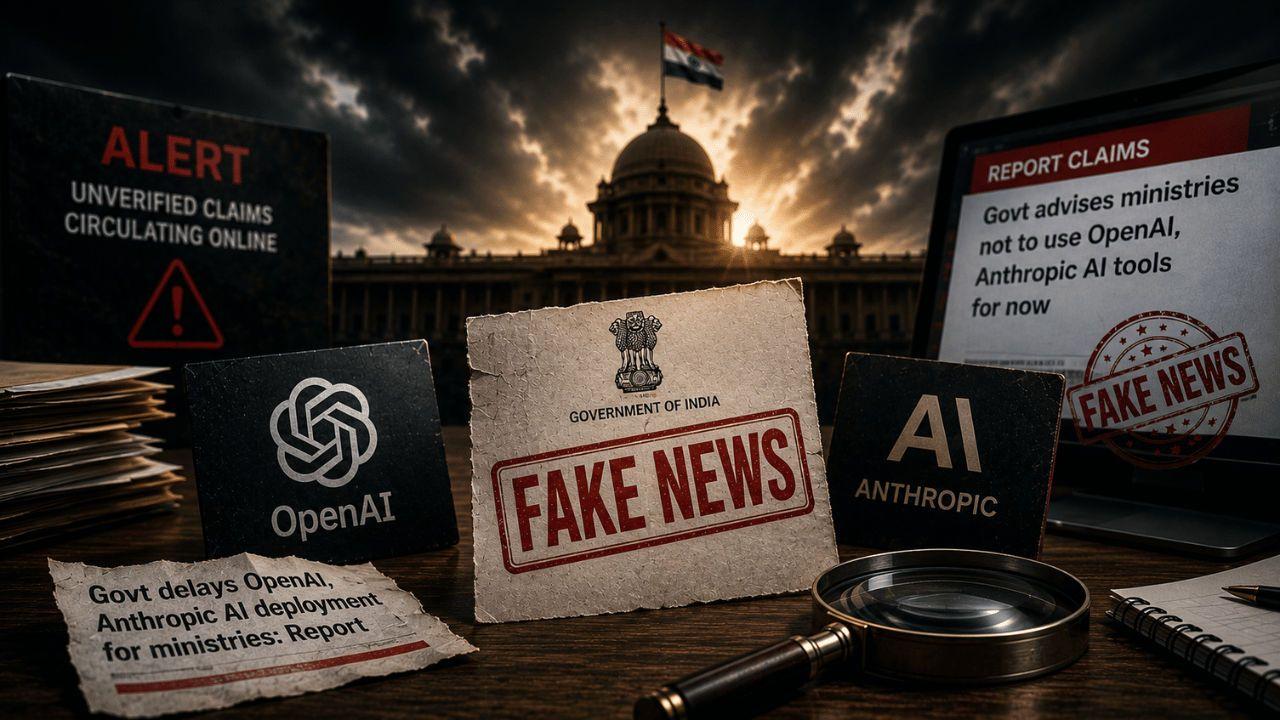
Report claimed a temporary pause, but the government rejected the claim. The Indian government has asked all ministries to prepare a list of the AI tools they need so these tools can be provided to them. A recent report claimed that the Ministry of Electronics and Information Technology (MeitY) advised ministries not to use cybersecurity AI models made by OpenAI and Anthropic for now. The report did not explain the reason for this advice. Furthermore, the report also claimed that the ban is at the timing of deployment and not on the tools. However, the Indian government has denied the report and said no such halt has been ordered. PIB debunks claim The Press Information Bureau (PIB), which is also the official fact-check agency for the Indian government, recently posted on its official X handle and stated that MeitY had not issued any direction or advisory asking ministries to stop the rollout or use of OpenAI or Anthropic's AI models. Furthermore, the agency also urged the citizens to rely only on official government websites and verified sources for authentic information. Also read: OpenAI asks court to make Elon Musk's xAI pay over Rs 9.5 crore after lawsuit dismissal What the report claimed about OpenAI and Anthropic AI tools According to the report, a department under MeitY had circulated an office memorandum asking ministries not to deploy cybersecurity models developed by OpenAI and Anthropic for the time being. It claimed the development came days after representatives of both companies met officials from several ministries to promote their AI tools. However, the report said it could not independently confirm how many ministries were approached or the level of those meetings. Not only that but it also claims that the Ministry of Finance had written to the department seeking approval to explore the use of agentic AI and OpenAI's GPT 5.5 model for cybersecurity work. And the ministry also outlined the possible applications of AI in the letter, including finding software vulnerabilities, strengthening cyber defence and supporting security operations. Also read: Sam Altman pokes fun at Anthropic's Claude commercial, says he thought it was satire The report also claimed that the department responded with a memorandum declining the proposal for now. However, a source quoted in the report said the response should not be considered a permanent ban. Instead, the concern was about deploying the technology too early rather than blocking its use altogether.
Share
Copy Link
Reports claimed India's Ministry of Electronics and IT advised government ministries to pause deploying OpenAI and Anthropic cybersecurity AI models. However, the Press Information Bureau officially denied these claims, stating no such directive was issued. The confusion highlights India's ongoing challenges with AI governance and deployment frameworks.
India finds itself at the center of conflicting narratives regarding the deployment of advanced cybersecurity AI models from OpenAI and Anthropic. Multiple reports suggested that the Ministry of Electronics and IT (MeitY) had advised government ministries to refrain from deploying these AI models for cybersecurity purposes, but the Press Information Bureau (PIB) swiftly denied these claims
3
. The PIB, which serves as the official fact-check agency for the Indian government, stated explicitly that MeitY had not issued any direction or advisory asking ministries to stop the rollout or use of OpenAI or Anthropic's AI models3
.
Source: Digit
According to initial reports, an office memorandum circulated by a department under MeitY asked all ministries to refrain from using the models prematurely
1
2
. The alleged directive came days after representatives of both companies met officials across multiple government departments to propose the use of their AI models for cybersecurity and similar government functions2
.The Finance Ministry reportedly wrote to MeitY seeking approval to examine the use of agentic AI solutions, particularly GPT-5.5, for cybersecurity work
1
. The ministry outlined possible applications including finding software vulnerabilities, strengthening cyber defense, and supporting security operations3
. The two US AI giants have been marketing their frontier models for defensive cybersecurity that includes automatic discovery of zero-day vulnerabilities, where models such as Anthropic's Mythos 5 and Fable 5, as well as GPT-5.6, can scan codebases for flaws, conduct code reviews, and deploy agentic AI when a model executes multi-step tasks with limited human supervision1
.

Source: MediaNama
The confusion reflects India's evolving approach to AI governance. In January 2025, the Finance Ministry asked employees to avoid using AI tools such as ChatGPT and DeepSeek on office devices, citing risks to the confidentiality of government data
2
. Two months later, the Centre told Parliament that there was no blanket ban on AI tools in government offices, stating officials could use AI while ensuring security and following existing cybersecurity rules2
.The government's cautious stance may reflect concerns around shadow AI, the use of unapproved AI tools by employees without organisational oversight
2
. Such use can expose confidential documents when uploaded to public AI platforms, making it harder for departments to monitor data flows and enforce cybersecurity policies. The Indian Computer Emergency Response Team (CERT-In) recently warned government organisations that advanced AI models could enable more sophisticated cyberattacks and significantly reduce the time available to fix security vulnerabilities2
.Related Stories
The timing of these reports coincides with recent US export bans that affected both companies. On June 12, Anthropic's Claude Mythos 5 and Fable 5 were suspended in response to US government orders
1
. The Department of Commerce later allowed these models to be shared with "friendly partners" and lifted controls totally on June 301
. The situation with GPT-5.6 was similar, with the company receiving approvals for global rollout only recently1
.
Source: CXOToday
Zoho founder Sridhar Vembu criticized these actions, calling them a sign that globalisation is dead
1
. Prime Minister Narendra Modi addressed concerns at a global tech forum, warning of an AI-split where the benefits of frontier AI models aren't shared with the Global South1
.The Modi government established the India AI Mission in March 2024 with an outlay of Rs.10,372 crore to deliver compute capacity via indigenous chipmaking and building local foundational models
1
. However, rules around data localisation, cloud empanelment, and data classification of government records remain unclear when it comes to cybersecurity AI models and their AI deployment1
. Google recently confirmed that India data would shift to Indian shores with all compute and inference conducted on Indian soil, while Microsoft and Amazon have committed to building AI infrastructure in the country1
.Summarized by
Navi
30 Apr 2026•Policy and Regulation

22 Apr 2026•Policy and Regulation

14 Jun 2026•Policy and Regulation

1
Technology

2
Business and Economy

3
Technology