Japan and Nvidia build world's first national AI infrastructure with 27,500 GPUs for robotics


8 Sources
[1]
Nvidia and Japan unveil world's first national AI infrastructure -- Noetra consortium to build a 140MW Rubin AI factory with 27,500 GPUs
Nvidia today announced that it's working with Japan's Noetra Corp. to build a 140-megawatt AI factory packing 27,500 Rubin GPUs and 13,750 Vera CPUs, the compute foundation for FRONTia, the Japanese government's state-funded physical AI program. The facility will be built from Vera Rubin NVL72
[2]
Japan is building a 140MW AI factory for robots, and Nvidia is supplying all of it
27,500 Rubin GPUs, 13,750 Vera CPUs, and a consortium owned by SoftBank, NEC, Sony and Honda. Nobody has said what it costs. Nvidia and a Japanese industrial consortium are building what Nvidia calls the world's first national AI infrastructure for physical AI, and the specification is unusually
[3]
Nvidia is building the world's first 'national AI' -- Japan's FRONTia Project could be the next big step forward in global progress, but is this a step too far?
* 13,750 Vera CPUs and 27,500 Rubin GPUs will drive compute at the Nvidia Vera Rubin AI factory * The project will be the world's first national AI infrastructure for physical AI * By partnering with Noetra Corp, Nvidia is providing hardware to drive Japan's FRONTia Project Japan's Ministry of
[4]
Japan Government, Industrial Leaders and NVIDIA Launch the World's First National AI Infrastructure
* NVIDIA to partner with Noetra Corp. to build the NVIDIA Vera Rubin AI factory with 13,750 Vera CPUs and 27,500 Rubin GPUs to deliver 140 megawatts of data center capacity based on the NVIDIA DSX platform. * The initiative, supported by Japan's Ministry of Economy, Trade and Industry (METI), will
[5]

Japan to buy Nvidia Rubin chips to build an AI for robots
Japan is planning to buy 27,500 next-generation Rubin chips from Nvidia to build a homegrown foundational AI model for robots. Newly established Noetra, which has been allocated ¥387.3 billion ($2.4 billion) from government coffers through March of next year, said it will oversee the endeavor and
[6]

Nvidia CEO says it's 'time for Japan AI' with infrastructure pledge
STORY: :: Nvidia CEO Jensen Huang announces a partnership with Japan's government and Noetra Corp to build 'physical AI' infrastructure :: Tokyo, Japan / July 16, 2026 :: Jensen Huang, Nvidia CEO "Japan has been a very close partner and close friend of ours and a very close friend of mine, and
[7]
Japan to Buy Nvidia Chips to Power Its AI Push -- Update
By Yang Jie and Megumi Fujikawa Nvidia chips are set to power Japan's artificial-intelligence push, with the government planning to buy thousands of the company's next-generation semiconductors to build an AI ecosystem on its own soil. Backed by massive government funding, Japan's purchase of
[8]
Nvidia, Noetra to Build AI Factory to Power Japan's AI Ambitions
Nvidia is partnering with Japan's Noetra Corp. to build an AI factory to support the country's artificial-intelligence infrastructure. The U.S. chip giant and Noetra, a new company established by a consortium of Japanese firms, including SoftBank Corp. and Sony Group Corp., will build the AI
Share
Copy Link
Japan unveils the world's first national AI infrastructure through its FRONTia Project, partnering with Nvidia to deploy 27,500 Rubin GPUs in a massive 140-megawatt facility. The Noetra consortium, backed by SoftBank, Sony, NEC, and Honda, received $2.4 billion in first-year funding to develop open multimodal foundation models for AI robotics, digital twins, and industrial automation.
Japan Launches World's First National AI Infrastructure for Physical AI
Japan has announced the world's first national AI infrastructure designed specifically for physical AI, marking a significant shift in how countries approach sovereign AI capabilities
1
. Nvidia is partnering with Japan's Noetra consortium to build a 140-megawatt Vera Rubin AI factory equipped with 27,500 Nvidia Rubin GPUs and 13,750 Vera CPUs, establishing the compute foundation for the country's FRONTia Project4
. The facility will train open multimodal foundation models for AI robotics, digital twins, and industrial automation, with pretrained weights shared broadly with domestic developers1
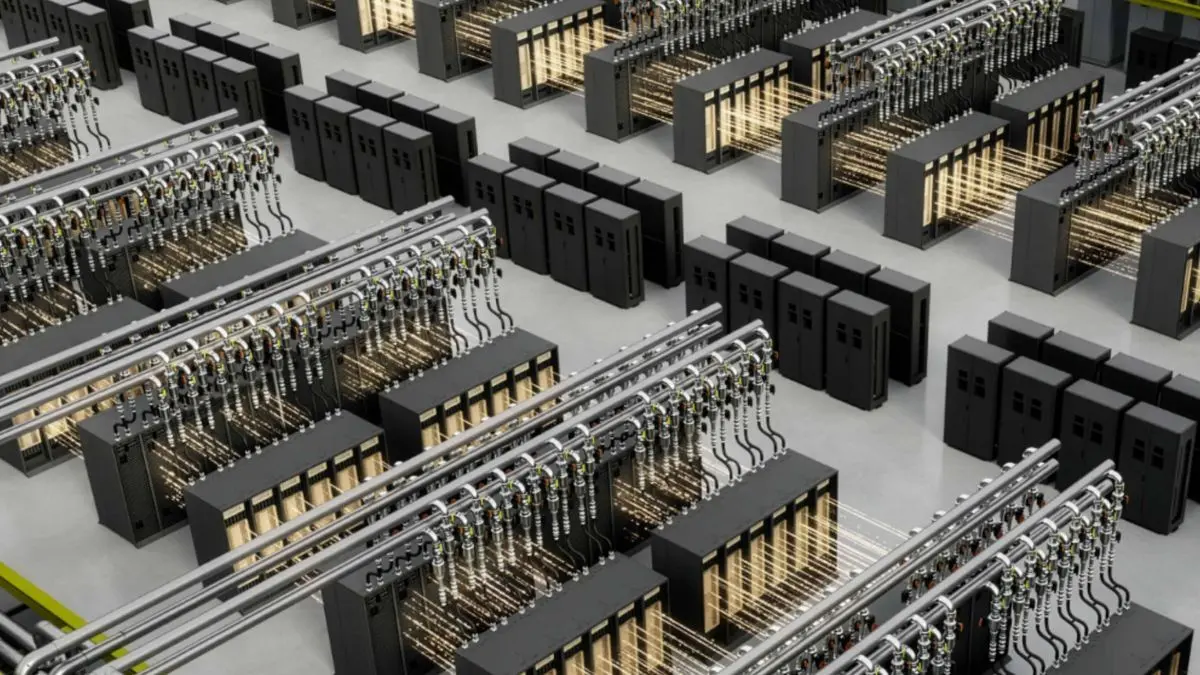
.
Source: Tom's Hardware
Massive Investment Behind the Noetra Consortium
The Noetra consortium represents an unprecedented collaboration between Japan's industrial giants. Founded by SoftBank, Sony, NEC, and Honda, with investment from 44 companies and organizations, Noetra won a public tender from NEDO on June 30 to run the FRONTia Project from fiscal 2026 through fiscal 2030
1
. Japan's Ministry of Economy, Trade and Industry (METI) has committed ¥387.3 billion, roughly $2.4 billion, in first-year funding, with up to ¥1 trillion, approximately $6.1 billion, allocated over five years1
. However, funding beyond the first two years remains subject to annual stage-gate reviews, making the full amount conditional rather than guaranteed2
.Technical Specifications and Hardware Costs
The AI factory for robots will be built from 382 Vera Rubin NVL72 racks on Nvidia's DSX platform, each housing 72 Rubin GPUs and 36 Vera CPUs, connected with Spectrum-X Ethernet networking
1
. While neither company disclosed the project's total cost, VR200 NVL72 systems are currently quoted at $5 million to $7 million apiece, placing rack hardware alone between $1.9 billion and $2.7 billion1
. Morgan Stanley estimates Nvidia will charge $55,000 per Rubin GPU in volume, pricing the GPU silicon at roughly $1.5 billion before memory, networking, and cooling1
. Noetra's data center is slated to go online in June 20285
.Strategic Goals and the AI Robotics Strategy
Japan's AI Robotics Strategy, released in March, targets more than 30% of the global AI robotics market by 2040, an opportunity the government estimates at $133 billion
1
. METI has separately set a target of 10 million AI-equipped robots across 18 sectors by the same year . "Japan invented modern manufacturing. Now, it is building the AI factories that will power the next industrial revolution," said Jensen Huang, founder and CEO of Nvidia4
. Noetra's roadmap targets a reasoning foundation model in fiscal 2026, an omni-modal model processing text, images, video, and audio by fiscal 2028, and "real-world native AI" capable of spatial awareness by fiscal 20301
.Related Stories

Questions About Sovereignty and Transparency
The partnership has drawn scrutiny over what sovereign AI actually means when the entire technology stack comes from a single American vendor . Critics have highlighted the lack of financial transparency from Noetra and the Japanese government, as well as concerns about Nvidia's role as a strategic rival
3
. Japan appears to have defined sovereignty as owning the models and deployment while relying on foreign silicon—a trade Europe has spent two years debating . The comparison is unflattering: while Europe's gigafactory program continues to slip, Japan has a named operator, a named ministry, bond-funded first tranche, and concrete rack count . "Bringing physical AI into the real world requires enormous computing, data and foundational technologies—challenges no single company can solve alone," said Hironobu Tamba, CEO of Noetra4
.Implications for Manufacturing and Workforce
The facility will support training trillion-parameter-scale models as the AI factory expands, giving organizations across Japan access to one of the world's most advanced AI environments
4
. Japan is not attempting to build a frontier lab but rather to integrate intelligence into machines it already manufactures—a narrower bet that may prove more achievable . However, successful physical AI development means increased automation from robots, which will directly impact the workforce and reduce the number of physical jobs3
. The massive energy costs associated with AI installations—140 megawatts in this case—also raise questions about sustainability3
. Ryosei Akazawa, Japan's Minister of Economy, Trade and Industry, emphasized that the initiative combines "Japan's onsite expertise and manufacturing technology infrastructure" with foreign technology to build highly reliable multimodal foundation models4
.References
Summarized by

Navi
[1]
[4]
[5]
Related Stories
Nvidia's Jensen Huang secures sweeping Japan AI deals targeting factory floors and robotics
16 Jul 2026•Technology
NVIDIA Spearheads AI Revolution in Japan: Partnerships, Infrastructure, and Innovation
13 Nov 2024•Technology

Japan's tech giants unite to build trillion-parameter Physical AI model for robots and machines
13 Apr 2026•Business and Economy

Recent Highlights



Recent Highlights
Today's Top Stories





Don’t drown in AI news. We cut through the noise - filtering, ranking and summarizing the most important AI news, breakthroughs and research daily. Follow topics that matter to you and stay ahead.


