13 Sources
[1]
Nvidia partners with Japan robotics firms on AI development
TOKYO, July 16 (Reuters) - Nvidia (NVDA.O), opens new tab said on Thursday it was partnering with Japanese companies including Fanuc (6954.T), opens new tab and Yaskawa Electric (6506.T), opens new tab to advance the development of robotics and AI. "With AI, robots will become smart, easily adaptable and accessible," Nvidia CEO Jensen Huang said at a media event in Tokyo. On Wednesday Huang attended an event held by gaming firm Sega Sammy (6460.T), opens new tab in the Akihabara electronics district and ate dinner at a Japanese "izakaya" pub. Huang has achieved rock star status in Taiwan and his appearances have also generated interest from onlookers in Japan, which boasts leading companies in the chipmaking supply chain. "I think he's the most influential man on Earth," said Chang Hui-Yu, a 57-year-old Taiwanese tourist, speaking outside the Sega event. "It was my first time seeing Jensen Huang in person and I was so excited," said Brian Yang, 37, who is Taiwanese and lives in Tokyo. Huang was pictured last night with executives of leading Japanese supply chain firms including the CEOs of chipmaker Kioxia (285A.T), opens new tab and equipment maker Tokyo Electron (8035.T), opens new tab. Investors are weighing the strength of the AI investment cycle, with chipmaking equipment maker ASML (ASML.AS), opens new tab on Wednesday raising its sales forecast and pledging capacity expansion. TSMC (2330.TW), opens new tab, the world's leading contract chipmaker, is expected to post a fifth consecutive quarter of record earnings on Thursday due to the AI boom. Reporting by Sam Nussey, Irene Wang and Anton Bridge; Editing by Sonali Paul Our Standards: The Thomson Reuters Trust Principles., opens new tab
[2]
Fujitsu and leading Japanese robotics companies to use Nvidia technology in 'physical AI'
TOKYO (AP) -- Japanese communications company Fujitsu is leading a major push in artificial intelligence using Nvidia's technology, bringing together what it said was the best in Japan's manufacturing prowess in robotics with AI. The technology area known as "physical AI" refers to smart, futuristic robots that can think on their own, not just follow programmed directions, to work safely alongside people in factories, homes and hospitals. The initiative was announced in Tokyo on Thursday by Nvidia Corp. Chief Executive Jensen Huang and Fujitsu Chief Executive Takahito Tokita, along with the CEOs of Japan's top makers of industrial robots, Fanuc Corp., Yaskawa Electric Corp. and Kawasaki Heavy Industries. The latest announcement comes on top of a deal announced by Nvidia and Fujitsu last year. The executives expressed hopes that the robots can address the nation's acute labor shortage. Japan is among the most rapidly aging societies in the developed world and the smart robots could help take care of the elderly living alone, they said. Huang said physical AI was a good fit for Japan because of the country's reputation for manufacturing quality because robots that move independently could potentially be dangerous. "Japan's excellence is a philosophy, a way of life. 'Made in Japan' means the highest quality, the highest precision. Japan sets the standard for the state-of-the-art in modern manufacturing," he said. Huang listed Japan's prized concepts in fine manufacturing such as "kaizen," which means "continuous improvement." The companies did not give a specific time frame for the arrival of such robots in daily life. They stressed efforts were underway with what they called the first phase of the collaboration coming later this year. There has been no decision on setting up a joint venture, although that could come later, they said. Japan has acknowledged it has fallen behind some nations, including China and the U.S., in AI, and has been eager to play catch-up. The government of Prime Minister Sanae Takaichi recently announced a plan to drum up more than 370 trillion yen ($2.3 trillion) in public and private investment in various technology fields by 2040, including physical AI, semiconductors and data centers. Silicon Valley-based Nvidia, which offers an open-source technology, has been aggressive in forging various ties in Japan, including with leading banks, automaker Toyota Motor Corp., video game maker Sega and national research institute Riken. ___ Yuri Kageyama is on Threads: https://www.threads.com/@yurikageyama
[3]
Nvidia unveils new AI model and expands Japan's physical AI ecosystem
Nvidia unveiled a new AI model for robots and vision AI agents on Wednesday, deepening its push into the physical AI market in Japan. The company's new model, Cosmos 3 Edge, is a so-called world model, designed to help systems perceive and navigate physical environments in real time. Cosmos 3 edge is a World models are systems that can learn from a wider range of inputs compared to large language models (LLMs). The rollout follows the launch of Cosmos 3 in May. The regional expansion takes center stage during CEO Jensen Huang's two-day visit to Japan, where the Silicon Valley chip giant is expanding its physical AI footprint by forming a coalition that local industrial giants, including Fujitsu, Hitachi, and Kawasaki Heavy Industries, intend to join, according to Nvidia. "The next frontier of AI is in the physical world, and this is a once-in-a-generation opportunity for Japan," Nvidia CEO Jensen Huang said in a Wednesday statement. "Japan invented modern manufacturing. Now, it has the opportunity to reinvent it for the age of intelligent industries." The tech giant's partnership with Japanese firms comes just months after Microsoft's $10 billion investment in the country, which aims to build out AI infrastructure and beef up cybersecurity. Japanese investment giant SoftBank has bet heavily on the boom in AI. It's looking to partner with Microsoft and Sakura Internet to develop AI in Japan. Japan's AI market is expected to reach $27.9 billion by 2029, opening doors for U.S. firms to invest, according to the International Trade Administration. This growth is driven by Tokyo's active push to promote AI adoption across industries, coupled with the eagerness of local firms to forge international partnerships. Ajay Rajadhyaksha, global chairman of research at Barclays, told CNBC last month that the country holds an advantage in Asia, driven by its diverse AI and clean structural growth stories.
[4]
Nvidia signs up Japan's robotics establishment for its open world models
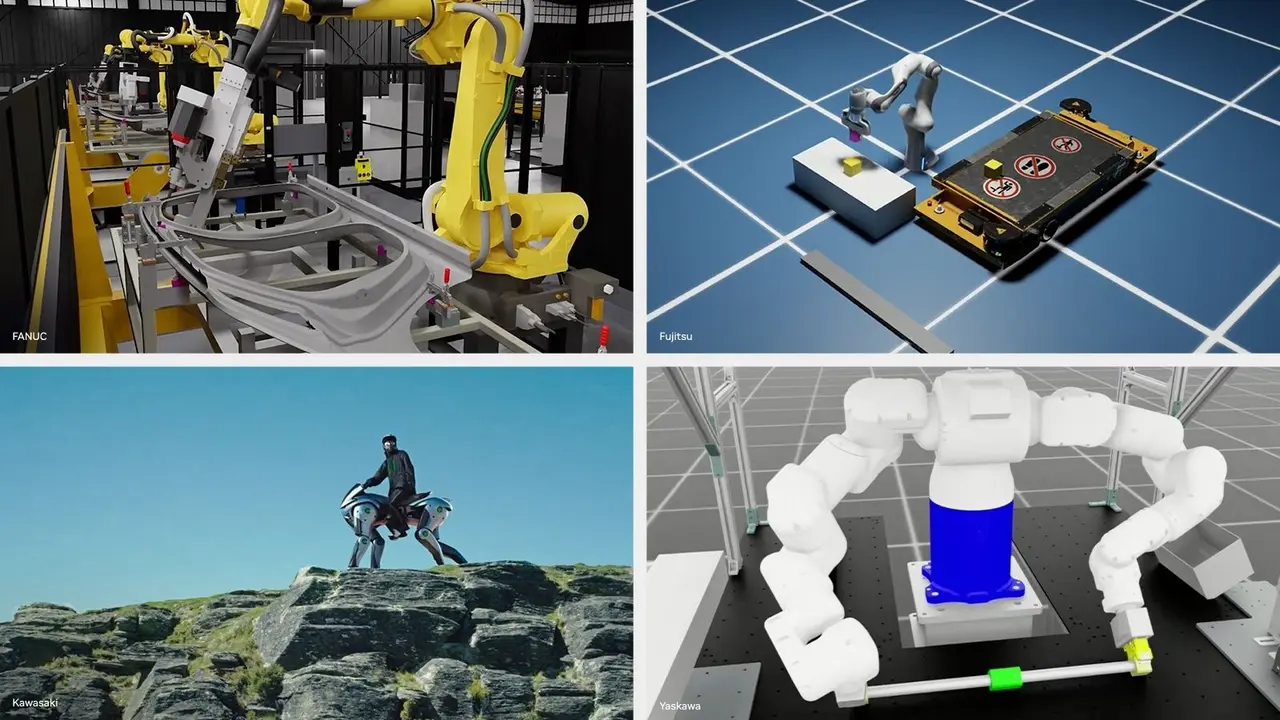
FANUC, Yaskawa, Kawasaki and 19 others intend to join the Cosmos Coalition. Intend is doing a lot of work in that sentence. Nvidia has recruited most of Japan's industrial robotics establishment into the Cosmos Coalition, the open world-model programme it uses to seed its physical AI stack, in announcements timed to Jensen Huang's week in Tokyo. Twenty-two companies are named: AIRoA, classmethod, Enactic, FANUC, Fujitsu, GROOVE X, Hitachi, Honda R&D, Kawasaki Heavy Industries, Kubota, Mitsui & Co., Mitsubishi Corp., Mujin, NEC, Preferred Networks, SoftBank Corp., Sony Group, Telexistence, TIER IV, TRON K.K., Turing, and Yaskawa Electric. All of them, in Nvidia's wording, "intend to join". No binding commitment has been disclosed, and no money has been mentioned in either direction. That roll call is the news. FANUC and Yaskawa are the two largest industrial robot makers on earth by installed base, and they have spent decades running proprietary control stacks. Signing them up to a coalition organised around someone else's open models is not a small thing, even at the level of intent. It is also the same play Nvidia ran with Hyundai around the Atlas humanoid, and is running against Tesla's vertically integrated Optimus programme: supply the stack, let the industrial partner own the deployment. The technical centrepiece is Cosmos 3 Edge, a four-billion-parameter model built on Nvidia's Nemotron family that runs on Jetson edge hardware rather than in a data centre. Nvidia says developers can adapt it to a specific robot, vehicle, or sensor rig in about a day, and that it will deploy across RTX GPUs, DGX systems, and the newly announced Jetson T2000 and T3000 modules. Fujitsu is leading the most concrete piece of the programme, a collaborative control platform being explored with FANUC, Yaskawa, and Kawasaki that would bridge digital and physical operations across industrial sectors. It is built on Cosmos world foundation models, the Isaac robotics platform, Omniverse NuRec libraries, and the Newton physics engine, and is meant to handle digital twins, robot learning, and simulation-to-real validation before anything touches a factory floor. Elsewhere in the announcement the applications get specific in a way these things usually do not. Kubota is looking at Cosmos for autonomous agriculture, and Enactic is fine-tuning Nvidia's Isaac GR00T model for elder-care semi-humanoid robots. Shimizu Corporation is using Metropolis for construction-site safety, GROOVE X is building Jetson-powered companion robots, and Kawasaki is spreading the technology across healthcare, shipbuilding, transportation, aerospace, and energy. "Japan invented modern manufacturing," Huang said in the release. "Now, it has the opportunity to reinvent it for the age of intelligent industries." He called physical AI "a once-in-a-generation opportunity" for the country. A second release the same day covered the language layer. Institute of Science Tokyo built its Swallow open models on Nemotron datasets, and SB Intuitions, SoftBank's generative AI subsidiary, trained its Sarashina series using Nemotron libraries. Sarashina3 mini has since been picked up by Japan's Digital Agency. SoftBank Corp. has deployed a Large Telecom Model for autonomous network operations, and NTT DATA used Nvidia's Japanese personas dataset to augment training for its tsuzumi 2 model. The framing throughout is sovereignty. "Every nation and every company should own and control its intelligence infrastructure," Huang said. "Open models make that possible." It is a pitch that lands differently depending on where you sit, given that the open models in question run best on hardware sold by one company. Nvidia has made the same argument in Europe, where it recently unveiled 35 new AI supercomputers. Japan's interest is less abstract than the rhetoric suggests. Nvidia's release points to the ageing population and workforce transition as the driver, which is the polite version of a labour shortage that Japanese manufacturers have been managing for a decade. Sakana AI, meanwhile, is wiring Nemotron into its Fugu model-routing platform, which picks the best model for each task rather than betting on one. What none of it settles is whether world models actually shorten the road from demonstration to deployment. That question has been sitting unanswered through China's crowded robot boom, and a coalition of intent does not answer it either.
[5]
Japan's Robotics and Manufacturing Leaders Build on NVIDIA Cosmos to Advance Physical AI Frontier
* NVIDIA introduces Cosmos 3 Edge for on-device vision reasoning and robot policy deployment on NVIDIA Jetson Thor platforms, and NVIDIA Metropolis libraries built on NVIDIA Cosmos for agentic vision AI development. * Japan's physical AI ecosystem leaders AIRoA, FANUC, Fujitsu, Hitachi, Kawasaki Heavy Industries, Kubota, NEC, SoftBank Corp., Sony Group Corporation and Yaskawa Electric intend to join the NVIDIA Cosmos Coalition to help build open frontier physical AI models. * Fujitsu is exploring the development of a collaborative control platform for physical AI, with FANUC, Yaskawa Electric and Kawasaki Heavy Industries integrating NVIDIA technologies, while Japanese manufacturers and physical AI leaders including Enactic, Honda R&D, GROOVE X, Mitsui & Co, OMRON, Shimizu Corporation and Telexistence are building on NVIDIA's physical AI stack. NVIDIA today announced that Japan's physical AI leaders are building on the NVIDIA Cosmos™, NVIDIA Isaac™, NVIDIA Metropolis and NVIDIA Jetson™ platforms to accelerate the deployment of intelligent machines across manufacturing, mobility, infrastructure and robotics. NVIDIA also announced Cosmos 3 Edge, a new addition to the NVIDIA Cosmos 3 open world model family, that brings frontier capabilities to NVIDIA Jetson, helping embodied systems see, reason in real time and predict robot actions locally. Physical AI is bringing intelligence into machines, facilities and infrastructure, helping industries automate complex work and extend human expertise. Japan's strengths in robotics, manufacturing, automotive, telecommunications and industrial technology give it a powerful foundation for scaling this next wave of AI. "The next frontier of AI is in the physical world, and this is a once-in-a-generation opportunity for Japan," said Jensen Huang, founder and CEO of NVIDIA. "Japan invented modern manufacturing. Now, it has the opportunity to reinvent it for the age of intelligent industries. By combining its world-leading heritage in manufacturing, precision engineering and robotics with NVIDIA Cosmos, Isaac, Metropolis and Jetson, Japan's innovators are building the next generation of intelligent machines. We are honored to partner with them on this journey." NVIDIA Cosmos 3 Edge Powers On-Device Vision Reasoning and Robot Policy NVIDIA Cosmos 3 Edge is a 4-billion-parameter model built on NVIDIA Nemotron™ that helps robots and vision AI agents understand their surroundings, reason in real time and generate robot actions on NVIDIA edge computers. Using the open NVIDIA Cosmos framework, developers can adapt the model for specific robots, vehicles, sensors and environments in about a day. Lightweight enough to run on edge GPUs and quickly post-train specialized world action models, Cosmos 3 Edge can be deployed across NVIDIA RTX™ GPUs, NVIDIA DGX™ systems and NVIDIA Jetson, including the newly announced T2000 and T3000 modules. To further accelerate the development of vision AI agents, NVIDIA is also announcing new NVIDIA Metropolis libraries and skills that help developers use coding agents to build, train and operate video intelligence systems with Cosmos at least 6x faster. Japan's Physical AI Leaders Intend to Join NVIDIA Cosmos Coalition to Advance Open World Models NVIDIA is expanding the NVIDIA Cosmos Coalition to Japan, bringing together world model builders, AI developers and physical AI leaders to advance open world models with Cosmos technologies. Japan's physical AI ecosystem leaders including AIRoA, classmethod, Enactic, FANUC, Fujitsu, GROOVE X, Hitachi, Honda R&D, Kawasaki Heavy Industries, Kubota, Mitsui & Co., Mitsubishi Corp., Mujin, NEC, Preferred Networks, SoftBank Corp., Sony Group Corporation, Telexistence, TIER IV, TRON K.K., Turing and Yaskawa Electric intend to join the coalition. Coalition members can contribute to and build on the NVIDIA Cosmos platform, which includes open models, data curation libraries, datasets and frameworks. The resulting world models will help Japanese companies test and optimize physical AI systems before deployment, shortening development cycles across factories, logistics networks, farms, construction sites, hospitals, roads and homes. NVIDIA Physical AI Powers Momentum Across Japan's Robotics, Manufacturing and Smart Spaces Ecosystem Fujitsu is exploring business opportunities in physical AI with FANUC, Yaskawa Electric and Kawasaki Heavy Industries. Led by Fujitsu, the initiative aims to build a collaborative control platform integrating NVIDIA's physical AI stack to bridge digital and physical operations across all industrial sectors. Built with Cosmos world foundation models, the open Isaac robotics development platform, NVIDIA Omniverse™ NuRec libraries and the Newton physics engine, the platform will support AI model development, digital twins, robot learning, simulation-to-real workflows and pre-deployment validation. NEC, Hitachi, OMRON and Preferred Networks are using NVIDIA Cosmos and NVIDIA physical AI technologies to advance world models, industrial AI and physical AI R&D. SoftBank Corp. is developing a physical AI development platform built on NVIDIA Cosmos, NVIDIA Omniverse and NVIDIA Isaac Sim™. The company is also advancing AI-RAN initiatives using NVIDIA AI Aerial with the aim of delivering intelligent connectivity for billions of physical AI devices. Mujin is exploring NVIDIA Cosmos for autonomous robotics and intelligent industrial automation powered by MujinOS, while TRON K.K. is developing manufacturing data workflows for task-specific physical AI models in assembly, picking, inspection and material handling, as well as factory 3D digitization workflows. Kawasaki Heavy Industries is applying NVIDIA physical AI technologies across healthcare, shipbuilding, transportation, aerospace and energy; Kubota is exploring Cosmos-based physical AI for autonomous agriculture and smart farming. Enactic is fine-tuning the NVIDIA Isaac GR00T open model for elder-care semi-humanoid robots; GROOVE X is building Jetson-powered companion robots, LOVOT; and Telexistence is applying Isaac and exploring Cosmos for retail automation. Japan's industry leaders are also using NVIDIA Metropolis to bring Cosmos-powered vision AI agents into physical operations: Hitachi for smart-building operations, OMRON for automated inspection and Shimizu Corporation for construction safety.
[6]
Nvidia builds Japan physical AI coalition with Fujitsu, FANUC
Nvidia $NVDA announced on Thursday that a broad group of Japanese industrial and technology companies intend to join its Cosmos Coalition, a collective aimed at building open physical AI models, as chief executive Jensen Huang visited Tokyo. Fujitsu is leading a push to develop a collaborative control platform with FANUC, Yaskawa Electric, and Kawasaki Heavy Industries that would integrate Nvidia's physical AI technology to connect digital and physical industrial operations, the company said. The platform is intended to support AI model development, digital twins, robot simulation, and pre-deployment validation. Other coalition members include Hitachi, NEC, SoftBank Corp., Sony $SONY Group Corporation, Kubota, and AIRoA, among others. According to the Associated Press, Huang appeared at the Tokyo announcement with Fujitsu chief executive Takahito Tokita and the heads of FANUC, Yaskawa Electric, and Kawasaki Heavy Industries. The executives cited Japan's labor shortage as a driving motivation, noting that the first phase of the collaboration is expected to arrive this year; they did not commit to a joint venture or offer a timetable for broader deployment. Alongside the coalition news, Nvidia introduced Cosmos 3 Edge, a 4-billion-parameter model built to operate on Nvidia's Jetson edge computing hardware. The model is built to help robots and vision AI systems perceive their surroundings and generate actions locally, without relying on cloud infrastructure, the company said. Nvidia said the model can be adapted for specific robots or environments in about a day. Nvidia also announced new Metropolis libraries intended to help developers build vision AI systems using Cosmos at least six times faster. Several coalition members are already working with Nvidia's technology stack. SoftBank Corp. is building a physical AI development platform using Cosmos, Omniverse, and Isaac Sim, while also pursuing AI radio access network initiatives. Kawasaki Heavy Industries is applying Nvidia physical AI tools across healthcare, shipbuilding, aerospace, transportation, and energy. Kubota is exploring Cosmos-based tools for autonomous agriculture, and Enactic is fine-tuning Nvidia's Isaac GR00T model for elder-care robots. "Japan invented modern manufacturing. Now, it has the opportunity to reinvent it for the age of intelligent industries," Huang said in a statement. According to the Associated Press, Prime Minister Sanae Takaichi's government has announced a goal of mobilizing more than 370 trillion yen -- about $2.3 trillion -- in combined public and private investment by 2040, spanning fields such as physical AI, semiconductors, and data centers.
[7]
'Japan's excellence is a philosophy, a way of life': Jensen Huang wants robots to take care of an aging society with a labor shortage | Fortune
The technology area known as "physical AI" refers to smart, futuristic robots that can think on their own, not just follow programmed directions, to work safely alongside people in factories, homes and hospitals. The initiative was announced in Tokyo on Thursday by Nvidia Corp. Chief Executive Jensen Huang and Fujitsu Chief Executive Takahito Tokita, along with the CEOs of Japan's top makers of industrial robots, Fanuc Corp., Yaskawa Electric Corp. and Kawasaki Heavy Industries. The latest announcement comes on top of a deal announced by Nvidia and Fujitsu last year. The executives expressed hopes that the robots can address the nation's acute labor shortage. Japan is among the most rapidly aging societies in the developed world and the smart robots could help take care of the elderly living alone, they said. Huang said physical AI was a good fit for Japan because of the country's reputation for manufacturing quality because robots that move independently could potentially be dangerous. "Japan's excellence is a philosophy, a way of life. 'Made in Japan' means the highest quality, the highest precision. Japan sets the standard for the state-of-the-art in modern manufacturing," he said. Huang listed Japan's prized concepts in fine manufacturing such as "kaizen," which means "continuous improvement." The companies did not give a specific time frame for the arrival of such robots in daily life. They stressed efforts were underway with what they called the first phase of the collaboration coming later this year. There has been no decision on setting up a joint venture, although that could come later, they said. Japan has acknowledged it has fallen behind some nations, including China and the U.S., in AI, and has been eager to play catch-up. The government of Prime Minister Sanae Takaichi recently announced a plan to drum up more than 370 trillion yen ($2.3 trillion) in public and private investment in various technology fields by 2040, including physical AI, semiconductors and data centers. Silicon Valley-based Nvidia, which offers an open-source technology, has been aggressive in forging various ties in Japan, including with leading banks, automaker Toyota Motor Corp., video game maker Sega and national research institute Riken.
[8]
Fujitsu and Leading Japanese Robotics Companies to Use Nvidia Technology in 'Physical AI'
TOKYO (AP) -- Japanese communications company Fujitsu is leading a major push in artificial intelligence using Nvidia's technology, bringing together what it said was the best in Japan's manufacturing prowess in robotics with AI. The technology area known as "physical AI" refers to smart, futuristic robots that can think on their own, not just follow programmed directions, to work safely alongside people in factories, homes and hospitals. The initiative was announced in Tokyo on Thursday by Nvidia Corp. Chief Executive Jensen Huang and Fujitsu Chief Executive Takahito Tokita, along with the CEOs of Japan's top makers of industrial robots, Fanuc Corp., Yaskawa Electric Corp. and Kawasaki Heavy Industries. The latest announcement comes on top of a deal announced by Nvidia and Fujitsu last year. The executives expressed hopes that the robots can address the nation's acute labor shortage. Japan is among the most rapidly aging societies in the developed world and the smart robots could help take care of the elderly living alone, they said. Huang said physical AI was a good fit for Japan because of the country's reputation for manufacturing quality because robots that move independently could potentially be dangerous. "Japan's excellence is a philosophy, a way of life. 'Made in Japan' means the highest quality, the highest precision. Japan sets the standard for the state-of-the-art in modern manufacturing," he said. Huang listed Japan's prized concepts in fine manufacturing such as "kaizen," which means "continuous improvement." The companies did not give a specific time frame for the arrival of such robots in daily life. They stressed efforts were underway with what they called the first phase of the collaboration coming later this year. There has been no decision on setting up a joint venture, although that could come later, they said. Japan has acknowledged it has fallen behind some nations, including China and the U.S., in AI, and has been eager to play catch-up. The government of Prime Minister Sanae Takaichi recently announced a plan to drum up more than 370 trillion yen ($2.3 trillion) in public and private investment in various technology fields by 2040, including physical AI, semiconductors and data centers. Silicon Valley-based Nvidia, which offers an open-source technology, has been aggressive in forging various ties in Japan, including with leading banks, automaker Toyota Motor Corp., video game maker Sega and national research institute Riken. ___ Yuri Kageyama is on Threads: https://www.threads.com/@yurikageyama
[9]
Fujitsu and leading Japanese robotics companies to use Nvidia technology in 'physical AI'
Fujitsu and Nvidia are leading a major push in physical AI technology. This initiative aims to integrate Japan's robotics with advanced artificial intelligence. Smart robots will work alongside people in factories, homes, and hospitals. The collaboration seeks to address Japan's acute labor shortage and aging population. This partnership signifies Japan's eagerness to catch up in artificial intelligence development. Japanese communications company Fujitsu is leading a major push in artificial intelligence using Nvidia's technology, bringing together what it said was the best in Japan's manufacturing prowess in robotics with AI. The technology area known as "physical AI" refers to smart, futuristic robots that can think on their own, not just follow programmed directions, to work safely alongside people in factories, homes and hospitals. The initiative was announced in Tokyo on Thursday by Nvidia Corp. Chief Executive Jensen Huang and Fujitsu Chief Executive Takahito Tokita, along with the CEOs of Japan's top makers of industrial robots, Fanuc Corp., Yaskawa Electric Corp. and Kawasaki Heavy Industries. The latest announcement comes on top of a deal announced by Nvidia and Fujitsu last year. The executives expressed hopes that the robots can address the nation's acute labor shortage. Japan is among the most rapidly aging societies in the developed world and the smart robots could help take care of the elderly living alone, they said. Huang said physical AI was a good fit for Japan because of the country's reputation for manufacturing quality because robots that move independently could potentially be dangerous. "Japan's excellence is a philosophy, a way of life. 'Made in Japan' means the highest quality, the highest precision. Japan sets the standard for the state-of-the-art in modern manufacturing," he said. Huang listed Japan's prized concepts in fine manufacturing such as "kaizen," which means "continuous improvement." The companies did not give a specific time frame for the arrival of such robots in daily life. They stressed efforts were underway with what they called the first phase of the collaboration coming later this year. There has been no decision on setting up a joint venture, although that could come later, they said. Japan has acknowledged it has fallen behind some nations, including China and the U.S., in AI, and has been eager to play catch-up. The government of Prime Minister Sanae Takaichi recently announced a plan to drum up more than 370 trillion yen ($2.3 trillion) in public and private investment in various technology fields by 2040, including physical AI, semiconductors and data centers. Silicon Valley-based Nvidia, which offers an open-source technology, has been aggressive in forging various ties in Japan, including with leading banks, automaker Toyota Motor Corp., video game maker Sega and national research institute Riken.
[10]
Nvidia expands Toyota AI partnership for smart cities, factories
Nvidia will supply its artificial intelligence hardware and software to Toyota Motor to power smart cities, traffic intelligence systems and carmaking factories, broadening a decadelong partnership that began with developing autonomous vehicles. The two companies will deepen their collaboration and work on bringing AI into the real world, Nvidia said in a statement on Thursday. The pair had previously also teamed up with U.S.-based Ready Robotics on software to help improve safety and productivity on factory floors. "We are expanding our partnership to advance physical AI across not only automotive but also robotics and smart cities," said Deepu Talla, Nvidia's vice president of robotics and edge AI. Extending the reach of AI beyond the data center and integrating it directly into devices and machines is an industrywide focus this year. Jensen Huang, the U.S. company's co-founder and chief executive officer, is visiting Japan this week to drum up more business and excitement around the potential of the new technology. Earlier in the week, Huang's longtime friend and fellow AI evangelist Masayoshi Son declared questions around overinvestment in AI "foolish" and encouraged Japanese businesses to seize the opportunity ahead of them at his company's SoftBank World event. Toyota will integrate Nvidia's AI platforms into Woven City, its experimental prototype community built on a former factory site in Shizuoka Prefecture. Woven City serves as a real-world laboratory for testing cutting-edge technologies in a live setting. Beyond urban mobility, Toyota will deploy Nvidia's Omniverse to build digital twins of its vehicle assembly lines, where it will be able to virtually model different production methods and optimize efficiency. It will also leverage Nvidia's Isaac robotics platform and Nemotron large language models to accelerate automotive software development. The alliance began in 2017 when Toyota selected the Nvidia Drive PX platform to trial its early automated driving systems. The two extended it last year when Toyota committed to using the Nvidia Drive AGX Orin platform for its upcoming commercial vehicle fleets. Meanwhile, Nvidia also said the company and four of Japan's leading industrial automation companies will expand their collaboration on robot development. Fujitsu, Fanuc, Kawasaki Heavy Industries and Yaskawa Electric will join the Nvidia-led Cosmos Coalition, an alliance of businesses and research institutions working to accelerate the adoption of Nvidia platforms for what the industry calls physical AI. That covers a broad swath of hardware, from humanoid robots and factory automation to self-driving vehicles and smart buildings and rail systems. Hitachi, NEC, Komatsu and Kubota are also joining the coalition. The announcement follows Nvidia's broader rollout this week of technologies aimed at accelerating robotics development. The U.S. chipmaker unveiled Cosmos 3-H, a compact version of its world foundation model for physical AI development designed to run on edge computers, as well as the Jetson T3000 and T2000, robotics computers positioned between the flagship T4000 series and the AGX Orin platform. Nvidia has said Japan is well positioned to lead the next wave of robotics because of its longstanding strengths in industrial automation, precision manufacturing and mechatronics. Even so, Japanese companies have lost ground in a market increasingly led by U.S. and Chinese rivals. Prime Minister Sanae Takaichi has renewed efforts to encourage investment in AI and robotics, with the government aiming for Japanese companies to capture 30% of the global AI robotics market and secure a ¥20 trillion ($123 billion) share of the industry by 2040.
[11]
Nvidia partners with Japan robotics firms on AI development
Nvidia announced a partnership with Japanese companies like Fanuc and Yaskawa Electric. This collaboration aims to advance robotics and artificial intelligence development significantly. Nvidia CEO Jensen Huang attended several events in Tokyo, generating considerable interest. His appearances drew attention from onlookers and industry executives alike. This move highlights the growing strength of the AI investment cycle. Nvidia said on Thursday it was partnering with Japanese companies including Fanuc and Yaskawa Electric to advance the development of robotics and AI. "With AI, robots will become smart, easily adaptable and accessible," Nvidia CEO Jensen Huang said at a media event in Tokyo. On Wednesday Huang attended an event held by gaming firm Sega Sammy in the Akihabara electronics district and ate dinner at a Japanese "izakaya" pub. Huang has achieved rock star status in Taiwan and his appearances have also generated interest from onlookers in Japan, which boasts leading companies in the chipmaking supply chain. "I think he's the most influential man on Earth," said Chang Hui-Yu, a 57-year-old Taiwanese tourist, speaking outside the Sega event. "It was my first time seeing Jensen Huang in person and I was so excited," said Brian Yang, 37, who is Taiwanese and lives in Tokyo. Huang was pictured last night with executives of leading Japanese supply chain firms including the CEOs of chipmaker Kioxia and equipment maker Tokyo Electron. Investors are weighing the strength of the AI investment cycle, with chipmaking equipment maker ASML on Wednesday raising its sales forecast and pledging capacity expansion. TSMC, the world's leading contract chipmaker, is expected to post a fifth consecutive quarter of record earnings on Thursday due to the AI boom.
[12]
Fujitsu and leading Japanese robotics companies to use Nvidia technology in 'physical AI'
TOKYO -- Japanese communications company Fujitsu is leading a major push in artificial intelligence using Nvidia's technology, bringing together what it said was the best in Japan's manufacturing prowess in robotics with AI. The technology area known as "physical AI" refers to smart, futuristic robots that can think on their own, not just follow programmed directions, to work safely alongside people in factories, homes and hospitals. The initiative was announced in Tokyo on Thursday by Nvidia Corp. Chief Executive Jensen Huang and Fujitsu Chief Executive Takahito Tokita, along with the CEOs of Japan's top makers of industrial robots, Fanuc Corp., Yaskawa Electric Corp. and Kawasaki Heavy Industries. The latest announcement comes on top of a deal announced by Nvidia and Fujitsu last year. The executives expressed hopes that the robots can address the nation's acute labor shortage. Japan is among the most rapidly aging societies in the developed world and the smart robots could help take care of the elderly living alone, they said. Huang said physical AI was a good fit for Japan because of the country's reputation for manufacturing quality because robots that move independently could potentially be dangerous. "Japan's excellence is a philosophy, a way of life. 'Made in Japan' means the highest quality, the highest precision. Japan sets the standard for the state-of-the-art in modern manufacturing," he said. Huang listed Japan's prized concepts in fine manufacturing such as "kaizen," which means "continuous improvement." The companies did not give a specific time frame for the arrival of such robots in daily life. They stressed efforts were underway with what they called the first phase of the collaboration coming later this year. There has been no decision on setting up a joint venture, although that could come later, they said. Japan has acknowledged it has fallen behind some nations, including China and the U.S., in AI, and has been eager to play catch-up. The government of Prime Minister Sanae Takaichi recently announced a plan to drum up more than 370 trillion yen ($2.3 trillion) in public and private investment in various technology fields by 2040, including physical AI, semiconductors and data centers. Silicon Valley-based Nvidia, which offers an open-source technology, has been aggressive in forging various ties in Japan, including with leading banks, automaker Toyota Motor Corp., video game maker Sega and national research institute Riken.
[13]
Fujitsu, Japanese Robotics Firms to Explore Physical AI Opportunities
Fujitsu is teaming up with leading Japanese robotics companies on physical artificial-intelligence development and implementation across various industries, a move aimed at strengthening the country's industrial competitiveness. The development comes as Japanese industrial sectors, especially manufacturing, have faced growing challenges in recent years. A falling birthrate and an aging population have led to a severe labor crunch in Japan. The country has also seen a steady decline in the number of skilled technicians, and competition is intensifying globally. "To resolve these challenges and achieve sustainable growth, the promotion of digital transformation is essential," Fujitsu said. "In particular, expectations are rising for physical AI, where AI recognizes and analyzes real-world information and executes it as physical actions." The Japanese information-technology services provider said Thursday that it is exploring business opportunities in physical AI by collaborating with Fanuc, Yaskawa Electric and Kawasaki Heavy Industries and leveraging Nvidia's technology. The initiative seeks to promote the development of a sovereign collaborative control platform by bridging the digital and physical worlds and integrating Nvidia's open physical AI technologies, the company said. Fujitsu said it will lead business discussions with the companies and leverage the AI, world model, simulation, and robotics technologies underpinning Nvidia's physical AI platform. "Physical AI is the next industrial revolution--and it will be made in Japan," Nvidia Chief Executive Jensen Huang said. "With AI, Japan will define its next era."
Share
Copy Link
Nvidia has recruited 22 Japanese companies including Fanuc, Yaskawa Electric, and Fujitsu to join its Cosmos Coalition for physical AI development. The partnership, announced during Jensen Huang's Tokyo visit, aims to address Japan's acute labor shortage by creating autonomous robots that can think independently and work safely alongside humans in factories, homes, and hospitals.
Nvidia announced a sweeping collaboration with Japan's industrial robotics establishment during CEO Jensen Huang's visit to Tokyo this week, bringing together 22 companies to advance physical AI development
1
2
. The initiative centers on Japan robotics leaders Fanuc, Yaskawa Electric, and Kawasaki Heavy Industries—the world's largest industrial robot makers by installed base—who intend to join the NVIDIA Cosmos Coalition alongside Fujitsu, Hitachi, Sony Group Corporation, and others4
5
. "With AI, robots will become smart, easily adaptable and accessible," Jensen Huang said at a media event in Tokyo, calling physical AI "a once-in-a-generation opportunity for Japan"1
3
.
Source: ET
At the heart of this AI-driven robotics development push is the newly unveiled Cosmos 3 Edge model, a four-billion-parameter system built on NVIDIA Nemotron that enables on-device vision reasoning and robot policy deployment
3
5
. The Cosmos 3 Edge model represents a significant advance in creating intelligent machines that can perceive and navigate physical environments in real time, functioning as an open world model that learns from a wider range of inputs compared to large language models3
. Developers can adapt the model for specific robots, vehicles, or sensor configurations in approximately one day, and deploy it across NVIDIA RTX GPUs, DGX systems, and NVIDIA Jetson platforms, including the newly announced T2000 and T3000 modules5
4
.
Source: NVIDIA
The collaboration directly addresses Japan's demographic crisis, with executives expressing hopes that autonomous robots can tackle the nation's acute labor shortage as one of the most rapidly aging societies in the developed world
2
4
. Smart robots could help care for elderly people living alone and fill critical manufacturing gaps, according to company leaders2
. The government of Prime Minister Sanae Takaichi recently announced plans to generate more than 370 trillion yen ($2.3 trillion) in public and private AI investment across technology fields by 2040, including physical AI, semiconductors, and data centers2
. Japan's AI market is expected to reach $27.9 billion by 2029, opening significant doors for collaboration as Tokyo actively promotes AI adoption across industries3
.Related Stories
Fujitsu is spearheading the most concrete initiative within Japan's physical AI ecosystem, exploring a collaborative control platform with Fanuc, Yaskawa Electric, and Kawasaki Heavy Industries that would bridge digital and physical operations across all industrial sectors
5
4
. Built on NVIDIA Cosmos world foundation models, the Isaac robotics platform, Omniverse NuRec libraries, and the Newton physics engine, the platform will handle digital twins, robot learning, and simulation-to-real validation before deployment on factory floors4
5
. "Japan invented modern manufacturing. Now, it has the opportunity to reinvent it for the age of intelligent industries," Huang stated, praising Japan's reputation for quality and concepts like "kaizen" or continuous improvement2
5
.
Source: Reuters
Beyond manufacturing, specific applications are taking shape across multiple sectors within Japan's physical AI ecosystem. Kubota is exploring NVIDIA Cosmos for autonomous agriculture, while Enactic is fine-tuning the Isaac GR00T model for elder-care semi-humanoid robots
4
. Shimizu Corporation is deploying Metropolis for construction-site safety, GROOVE X is building NVIDIA Jetson-powered companion robots, and Kawasaki Heavy Industries is spreading the technology across healthcare, shipbuilding, transportation, aerospace, and energy4
5
. Nvidia also announced new Metropolis libraries and skills that help developers build and operate vision AI agents with coding assistance, accelerating video intelligence systems development by at least 6x5
. The companies emphasized that efforts are underway with the first phase of collaboration coming later this year, though they provided no specific timeline for when such robots will appear in daily life2
.Summarized by
Navi
03 Oct 2025•Technology

13 Nov 2024•Technology

13 Apr 2026•Business and Economy

1
Technology

2
Policy and Regulation

3
Business and Economy