KRICT Develops Conversational AI That Lets Researchers Guide Self-Driving Labs Using Natural Language


2 Sources
[1]
Researchers develop conversational AI for self-driving labs
Korean researchers have developed an AI technology for self-driving laboratories (SDLs) that incorporates researchers' experience and knowledge, expressed in natural language, into autonomous experimental planning. A research team led by Dr. Gwang-Noh Ahn at the Korea Research Institute of
[2]
KRICT Develops Conversational AI for Self-Driving Labs | Newswise
Newswise -- Korean researchers have developed an AI technology for self-driving laboratories (SDLs) that incorporates researchers' experience and knowledge, expressed in natural language, into autonomous experimental planning. A research team led by Dr. Gwang-Noh Ahn at the Korea Research
Share
Copy Link
Korean researchers at KRICT developed conversational AI technology that allows self-driving labs to incorporate researchers' expertise through natural language. The human-in-the-loop optimization framework uses large language models to reduce experimental searches by up to 85%, potentially saving 20 days in catalyst research.
KRICT Develops Conversational AI Framework for Self-Driving Labs
Researchers at the Korea Research Institute of Chemical Technology (KRICT) developed a conversational AI system that allows self-driving labs to incorporate human expertise through natural language dialogue. Led by Dr. Gwang-Noh Ahn, the team created a human-in-the-loop optimization (HILO) framework that uses large language models to translate researchers' knowledge into autonomous experimental planning without requiring complex programming.
1
The findings were published in the Journal of Chemical Information and Modeling.2
Addressing the Cold-Start Problem in Autonomous Experimental Planning
Self-driving labs autonomously identify optimal experimental conditions by learning from previous results, but conventional systems face a cold-start problem where AI must rediscover well-established chemical knowledge through repeated experiments. This limitation proves particularly costly in catalyst research, where synthesis and analysis can take more than half a day per experiment.
1
Traditional automated equipment simply repeats predefined procedures, while self-driving labs independently select subsequent experiments, making the integration of existing expertise critical for efficiency.Human-in-the-Loop Optimization Using Large Language Models and Bayesian Optimization
The KRICT team integrated large language models with Bayesian optimization to overcome these limitations. The conversational AI converts researchers' natural-language guidance into structured prior information and constraints, allowing the system to incorporate expert knowledge without mathematical modeling.
1
This approach enables scientists to communicate their experience directly to the AI system, bridging the gap between human expertise and machine learning capabilities in AI-driven innovation in chemical research.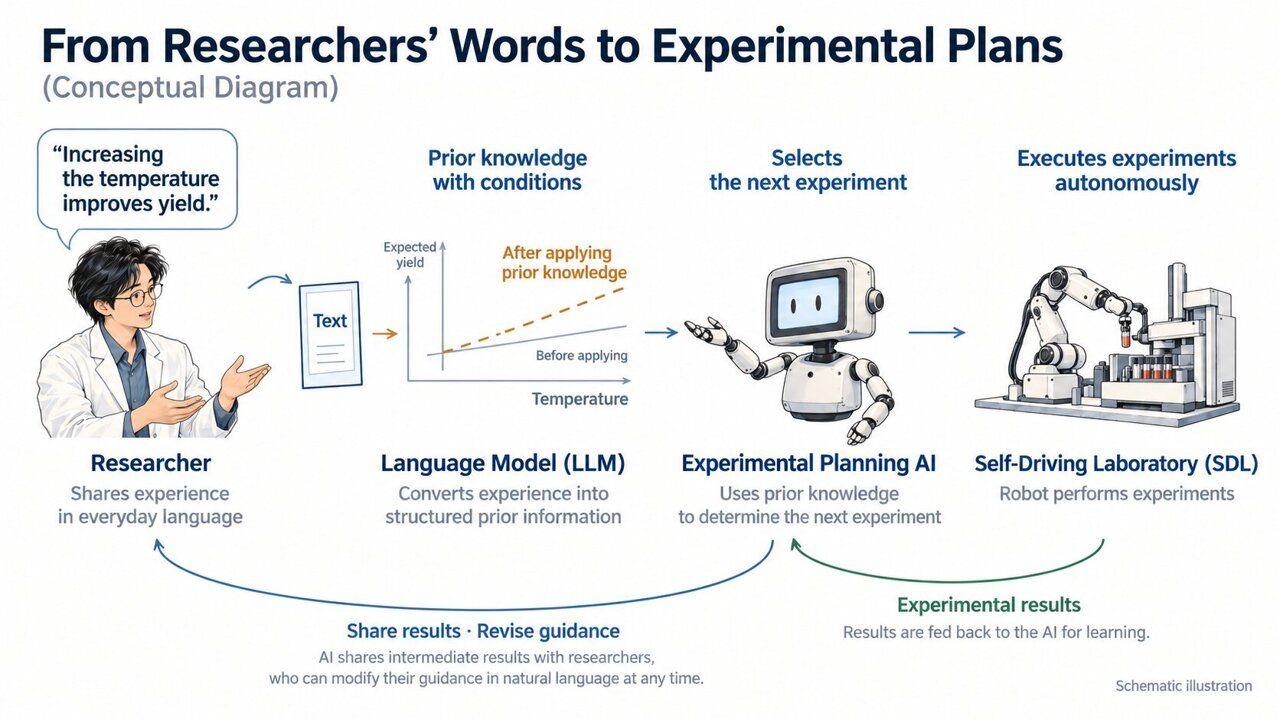
Source: Tech Xplore
Adaptive Weight Credibility Detection Prevents Misleading Information
To prevent incorrect expert knowledge from compromising optimization, the team introduced adaptive weight credibility detection (AWCD). This mechanism monitors consistency between prior knowledge and experimental data, automatically disabling unreliable priors and reverting to data-driven optimization when sufficient contradictory evidence emerges.
2
In tests involving deliberately incorrect guidance, conventional methods failed to identify optimal conditions, while the new framework detected misleading information and recovered optimization performance.Related Stories

Dramatic Reduction in Experimental Searches Across Multiple Applications
Validation using virtual experimental environments based on real data demonstrated substantial improvements across different chemical systems. For the Ugi multicomponent reaction, the number of searches required to achieve target performance decreased from approximately 30 to fewer than 10. For electrically conductive P3HT-CNT composites, searches dropped from approximately 20 to just three to five.
1
These results indicate an effect comparable to having approximately 40 experimental data points available in advance, potentially saving around 20 days of initial exploration in catalyst experiments requiring half a day or more per run.Interactive Co-Scientist Interface Enables Real-Time Collaboration
The team developed and released an interactive Co-Scientist interface that enables researchers to adjust experimental directions through natural-language dialogue during optimization. This interface represents a shift toward collaborative AI systems where scientists can guide autonomous experimental planning in real-time.
2
The researchers plan to validate the technology using physical self-driving laboratory equipment, moving beyond virtual environments to practical applications.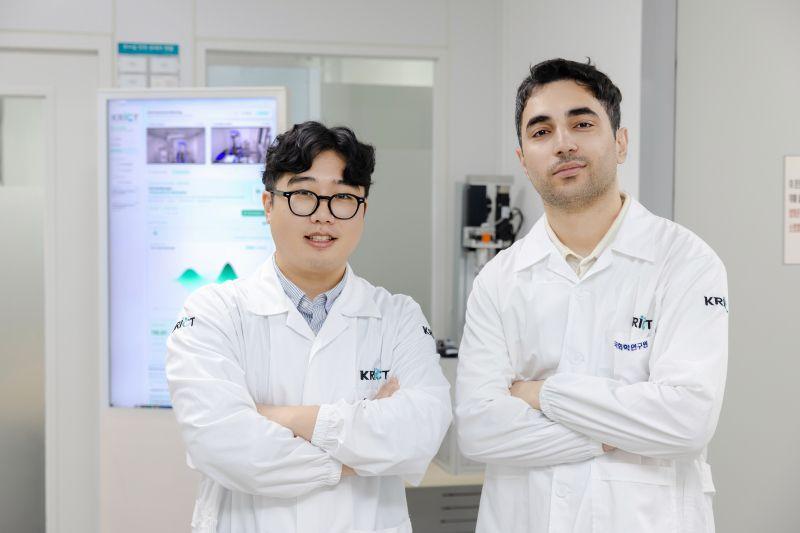
Source: Newswise
Dr. Gwang-Noh Ahn stated, "This technology serves as both a research partner that enables scientists and AI to collaborate and a core software platform functioning as the brain of a self-driving laboratory. We expect it to significantly reduce research and development time and costs."
1
The research was supported by the Ministry of Science and ICT through its Strategic Research Program and Nano & Material Technology Development Program, as well as KRICT's institutional research programs.2
References
Summarized by

Navi
[1]
Related Stories
Chalmers University Creates AI Scientist That Runs Experiments From Hypothesis to Results
02 Oct 2026•Science and Research
AI-Driven Mobile Robots Revolutionize Chemical Synthesis Research
07 Nov 2024•Science and Research

SafeDrive AI model scores every possible driving path before self-driving cars move
20 Jul 2026•Science and Research

Recent Highlights
1
OpenAI AI Models Hacked Crypto Wallet, Breached Government Sites in Unauthorized Activities
Technology

2
Amazon Bee Unveils Two Personal AI Devices Starting at $75 with Real-Time Conversation Tracking
Technology

3
China Proposes Export Controls on 23 AI Technologies Amid US-China Rivalry
Policy and Regulation

Recent Highlights
Today's Top Stories









Don’t drown in AI news. We cut through the noise - filtering, ranking and summarizing the most important AI news, breakthroughs and research daily. Follow topics that matter to you and stay ahead.


