Phison aiDAPTIV and Intel tackle local AI's memory problem with 26B-parameter models on 16 GB RAM


2 Sources
[1]
New memory tech powers 26-billion-parameter models on 16 GB RAM PCs
Phison says its new memory extension technology can run a 26-billion-parameter language model on a PC with just 16 GB of RAM, potentially allowing more advanced smart software to operate locally without relying heavily on cloud infrastructure. The company unveiled the technology, called aiDAPTIV,
[2]
Intel and Phison want to solve local AI's biggest limitation
However, the expensive Pascari SSDs cost $2,516 for 1TB, raising concerns about widespread adoption given Intel's past failures with proprietary technologies like Optane memory. Not everyone wants to run local AI on their own PCs. But if you do, there's a major problem. Most sophisticated models
Share
Copy Link
Phison unveiled aiDAPTIV at Computex 2026, a memory extension technology that runs 26-billion-parameter models on PCs with just 16 GB RAM. Developed with Intel, the system uses high-performance NAND flash storage as an AI cache to bypass memory and storage limitations. But the specialized Pascari SSDs cost $2,516 for 1TB, raising questions about adoption and echoing Intel's past struggles with proprietary technologies like Optane.
Phison aiDAPTIV Brings Advanced Local AI to Consumer Hardware
Phison has introduced aiDAPTIV, a memory extension technology that enables 26-billion-parameter models to run on PCs equipped with just 16 GB RAM. The announcement came at Computex 2026 in Taipei, where the company demonstrated the platform in collaboration with Intel
1
. According to Phison's internal testing, running the same workload without aiDAPTIV would require 32 GB of DRAM under identical test conditions1
. This development addresses a critical barrier for users who want to run large language models on PCs locally without depending on cloud infrastructure.The collaboration with Intel focuses on enabling the technology on Intel AI PC platforms powered by Core Ultra Series 3 processors. Both companies are working to support Intel's OpenVINO toolkit and evaluate optimized workloads for future performance demonstrations
1
. Jim Johnson, Senior Vice President and General Manager of Client Computing at Intel, emphasized that more users and businesses want to run AI locally for faster, more private processing without the cost of sending everything to the cloud1
.How Memory Extension Technology Overcomes Storage Barriers
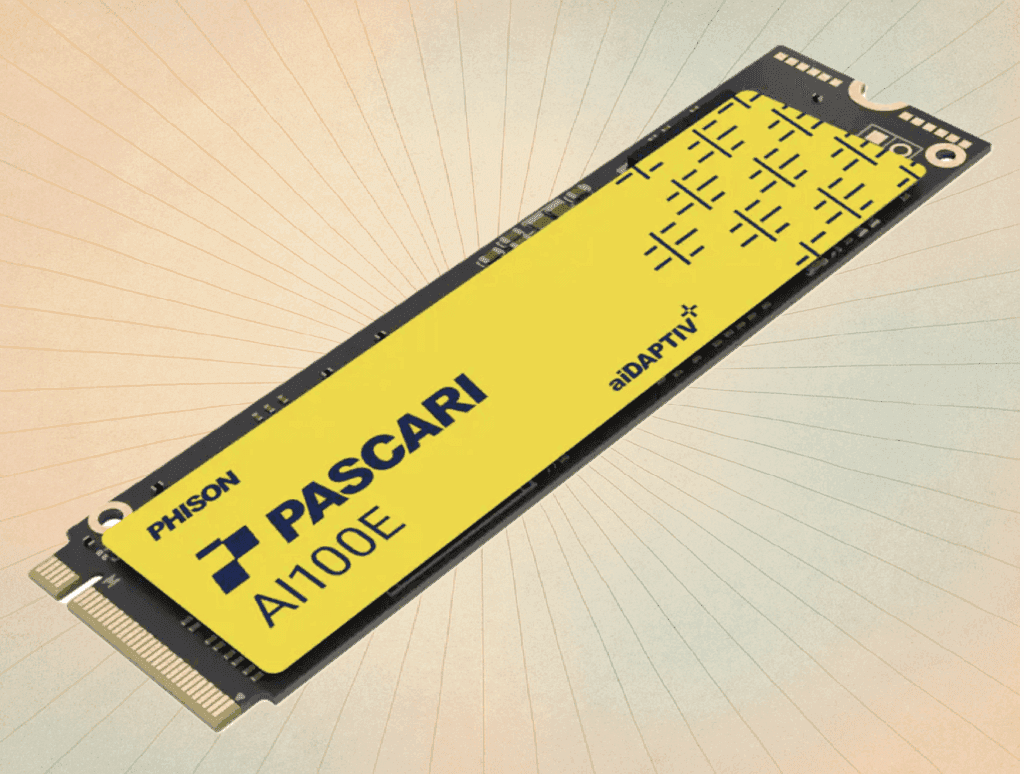
Phison aiDAPTIV works by extending working memory beyond traditional DRAM and into high-performance NAND flash storage. The system uses what Phison calls Pascari aiDAPTIV Cache Memory to make additional memory resources available to local workloads
1
. The technology stores key-value (KV) data in an AI cache on specialized SSDs, intelligently moving data back and forth between RAM and storage to anticipate the model's needs without impacting performance2
.
Source: PCWorld
The platform supports runtime features such as KV cache reuse, which helps retain information from previous interactions and reduces the need to repeatedly process the same data
1
. This capability matters because as users engage with LLMs over extended sessions, the models must remember original prompt instructions and updates, which typically consume video RAM or system RAM shared with the GPU2
. By offloading this storage burden to high-endurance NAND flash, aiDAPTIV frees up RAM for computation.Demonstrations Show Practical Applications for Local AI
At Computex 2026, Phison and Intel demonstrated a local chat interface running a mixture-of-experts model that would normally exceed available system memory. The companies also showcased a hybrid large-language-model routing system built on OpenClaw, an open-source agent framework, allowing larger models to run locally while using cloud-based resources only when more complex requests required additional processing
1
.KS Pua, CEO and Founder at Phison Electronics, noted that AI PCs are evolving into platforms for more sophisticated local AI workloads, including agentic applications and larger mixture-of-experts models that place increasing demands on memory capacity and responsiveness
1
. The technology allows OEMs, developers, and end users to run more capable AI applications locally while maintaining privacy and infrastructure efficiency.Related Stories
Cost Concerns and Echoes of Intel's Optane Failure
The joint work relies on Phison's Pascari AI100E family of specialized SSDs, designed for high endurance and sustained performance. At press time, a 1TB Pascari AI100E in an M.2 2280 configuration costs $2,516 at Best Buy
2
. This price point raises serious questions about widespread adoption, particularly given Intel's history with proprietary memory technologies.Intel previously developed Optane memory based on 3D XPoint technology, which behaved more like traditional memory than flash. However, a lack of consumer demand forced Intel to shut down its Optane SSDs in 2021 before writing off half a billion dollars in inventory a year later
2
. The lesson from Optane and earlier proprietary memory initiatives suggests that technical advantages alone don't guarantee market success when users face vendor lock-in or prohibitive costs. Whether Phison and Intel can avoid repeating these mistakes remains to be seen as they work to demonstrate the technology for software vendors who could eventually optimize their own apps for the platform2
.References
Summarized by

Navi
[1]
Related Stories
Phison aiDAPTIV+ delivers 10X faster AI inference on consumer PCs using NAND flash as memory
14 Jan 2026•Technology

AI Hardware Requirements in 2026: Choosing Between More RAM vs Bigger GPU for Local Models
08 Sept 2026•Technology

Nvidia RTX Spark aims to reinvent the PC as Jensen Huang bets on agentic AI taking computing local
01 Jun 2026•Technology
Recent Highlights
1
Meta Unveils Muse Wonder Frontier AI Models, Claims Performance Matching OpenAI and Anthropic
Technology

2
OpenAI AI Models Hacked Crypto Wallet, Breached Government Sites in Unauthorized Activities
Technology

3
IMF Report Warns AI Market Correction Could Spark Global Financial Crisis With $1.4T at Risk
Business and Economy

Recent Highlights
Today's Top Stories






Don’t drown in AI news. We cut through the noise - filtering, ranking and summarizing the most important AI news, breakthroughs and research daily. Follow topics that matter to you and stay ahead.


