8 Sources
[1]
Samsung's Chip Profit Soars 48-Fold on AI-Fueled Memory Shortage
Samsung Electronics Co.'s semiconductor arm beat expectations with a 48-fold jump in profit after AI's reliance on memory delivered hefty margins. The unit, which competes with SK Hynix Inc. and US-based Micron Technology Inc., reported an operating income of 53.7 trillion won ($36 billion) in the first quarter. The result compares with the average analyst estimate of 35.3 trillion won. Group-wide net income rose to 47.1 trillion won. The results reflect massive spending by hyperscalers including Meta Platforms Inc. and Amazon.com Inc. on artificial intelligence infrastructure. The hundreds of billions of dollars pouring into data centers and other hardware are spurring some investors to bet that memory -- one of the key bottlenecks to AI's rise -- is no longer beholden to boom-and-bust cycles and can tap sustained growth. Accelerators such as those made by Nvidia Corp. are limited by the speed and capacity of memory to supply data, making DRAM a key factor in determining the quality of AI services. That's given rise to the theory of a memory supercycle and helped Samsung's shares climb about 88% this year after more than doubling in 2025. That argument faces persistent concerns about whether the pace of AI spending is sustainable. Meta shares sank overnight on fears that the big sums committed to AI won't pay off. Earlier this week, stocks linked to OpenAI slumped after it reportedly failed to meet sales and user targets, rekindling doubts AI will deliver sufficient profits anytime soon. Still, analysts expect Samsung's chip division to build on its record-breaking profit over the next several quarters as contract prices continue their steep upward trajectory amid limited supply. They point to a more than 180% rise in Korea's semiconductor exports during the first 20 days of April as a sign of continued momentum for both Samsung and SK Hynix. Counterpoint Research expects a 60% quarter-on-quarter rise in average DRAM contract prices in the April-June period, analyst Tom Kang said. Average contract prices for DRAM rose 42% in March from February, according to the research firm's monthly memory price tracker. Samsung -- the world's largest memory maker -- is considering a shift toward multiyear contracts with the aim to stabilize supply and ease concerns about shortages, co-Chief Executive Officer Jun Young-hyun told shareholders at an annual general meeting last month. Such a move would further bolster prices and provide a buffer against cyclical downturns. The profits generated by the AI boom are also prompting Samsung employees to demand a bigger share, with workers threatening an 18-day general strike in May. Last week, more than 30,000 workers gathered outside Samsung's main chip hub in Korea's southern city of Pyeongtaek. Analysts are divided on whether a prolonged stoppage would materially dent chip output or simply create short-term volatility, since Samsung's operations are highly automated. "A strike could exacerbate the memory shortage further, potentially driving prices even higher," said Greg Roh, an analyst with Hyundai Motor Securities Co. "The bigger worry may be customer confidence, as any sense of instability could be damaging."
[2]
Samsung Electronics sees robust AI demand after Q1 profit surges eightfold to set record
SEOUL, April 30 (Reuters) - Samsung Electronics (005930.KS), opens new tab said on Thursday its operating profit jumped eightfold to a record in the first quarter, underpinned by higher chip prices as an artificial intelligence boom led to a supply crunch. Samsung expects earnings to improve further in the second quarter, saying investment in AI infrastructure would continue to expand, driving up memory chip prices. The world's top memory chipmaker posted 57.2 trillion won ($38.43 billion) in operating profit for the January-to-March period, in line with its estimate of 57.2 trillion won and up from 6.69 trillion won a year earlier. The South Korean company's revenue rose 69% to 133.9 trillion won in the quarter from a year earlier. The AI data centre boom has spurred chipmakers to shift capacity to making advanced chips used in Nvidia's (NVDA.O), opens new tab AI accelerators, squeezing supply of traditional chips and driving up prices. Operating profit at Samsung's chip business, its main cash cow, surged to a record 53.7 trillion won in the first quarter, accounting for 94% of its total profit. Its mobile and network division profit declined by 30% to 3 trillion won, squeezed by surging chip prices. Samsung Electronics shares rose 1.3% after the earnings announcement. Shares of Samsung Electronics, Asia's second-most valuable company after Taiwan's TSMC (2330.TW), opens new tab, have surged 88% this year, outstripping the wider market's 59% gain. ($1 = 1,488.2900 won) Reporting by Hyunjoo Jin, Heekyong Yang and Joyce Lee; Editing by Muralikumar Anantharaman and Christopher Cushing Our Standards: The Thomson Reuters Trust Principles., opens new tab
[3]
Samsung profit surges over eight-fold to beat estimates as AI boom fuels memory chip crunch
The Samsung exhibition stand features the prominent ''A new era of mobile agentic AI'' slogan by the South Korean company Samsung Electronics. Samsung Electronics reported an over eight-fold increase in first-quarter operating profits on Thursday, hitting a new record and beating analysts' estimates, as demand for artificial intelligence servers and a memory chip shortage boosted earnings. Here are Samsung's first-quarter results compared with LSEG SmartEstimate, which is weighted toward forecasts from analysts who are more consistently accurate: The South Korean technology giant's quarterly profit climbed more than 750% from a year earlier to a fresh record. The company also posted record revenue, up about 70% year over year. The profits came in line with Samsung's own estimates of 57.2 trillion won, and were more than its full-year 2025 profits of 43.6 trillion won. The earnings extend momentum from the final quarter of last year, when Samsung surpassed its prior record of 17.6 trillion won set in the third quarter of 2018. Samsung's record earnings came on the strength of its chip business. South Korea's largest company by market capitalization is a major producer of memory chips, semiconductor foundry services and smartphones. The electronics and memory giant has emerged as a major beneficiary of the global AI data center boom, which has constrained the supply of memory chips used in devices such as smartphones, PCs and game consoles. In an earnings report, Samsung said that its memory business "surpassed its quarterly sales record by addressing high-value-added AI demand despite limited supply availability, with industry-wide memory price increases also a contributing factor." The company expects server memory demand to remain strong into the second half of the year as hyperscalers continue to accommodate AI adoption and demand for agentic AI accelerates. The strong performance comes as Samsung expands its high-bandwidth memory, or HBM, business, a key component in AI data center chips. Chipmakers such as Nvidia -- the world's most valuable company -- have driven demand for HBM, amid limited supplies. As manufacturers prioritize production for higher-margin AI applications, supply constraints have pushed up prices for memory used in consumer electronics.
[4]
Samsung Electronics posts record quarterly profit on AI boom
Seoul (AFP) - Samsung Electronics said on Thursday its quarterly operating profit had jumped 750 percent year-on-year to a record 57.2 trillion won ($38.4 billion) on the back of strong sales of chips crucial for artificial intelligence. The South Korean technology giant has emerged as a key player -- along with rival SK hynix -- in the supply of high-performing chips in demand from companies racing to keep up with the fast-evolving AI industry. Their strong performance has come as the South Korean government has pledged to make the country one of the world's top three AI powers alongside the United States and China. Samsung said in its earnings report on Thursday it had "achieved record quarterly revenue and operating profit through AI technology innovations and proactive market response". It had already said this month that it expected profit to reach a quarterly record. Net profit was 47.1 trillion won, beating forecasts by a Bloomberg survey of analysts. Sales hit 133.9 trillion won, an all-time quarterly high. Its chips division also beat expectations with a huge rise in profit to 53.7 trillion won, accounting for the bulk of the unit's total. The company said its memory arm "surpassed its quarterly sales record by addressing high-value-added AI demand despite limited supply availability, with industry-wide memory price increases also a contributing factor". It added that it expected "strong memory demand to continue" through the second quarter as the buildout of AI infrastructure continues apace. South Korea's benchmark Kospi stock index opened at a fresh high of over 6,700 on Thursday following strong earnings figures from Samsung and US technology giants. Samsung's shares have risen by around 300 percent over the past year as the AI boom boosts South Korean growth and pushes the stock market to new records. The company has seen strong orders from major technology firms for high-bandwidth memory -- a type of chip that is used in data centres and AI "accelerators", which are useful in carrying out demanding tasks and computation. That is also pushing up the cost of less flashy chips used in consumer electronics -- threatening higher prices for phones, laptops and other devices worldwide.
[5]
Samsung Electronics posts record quarterly profit on AI boom - The Economic Times
Samsung Electronics posted a record quarterly profit on Thursday, driven by strong sales of chips crucial for artificial intelligence. South Korea's benchmark Kospi stock index opened at a fresh high of over 6,700 on Thursday following strong earnings figures from Samsung and US technology giants. South Korean tech giant Samsung Electronics posted a record quarterly profit on Thursday, driven by strong sales of chips crucial for artificial intelligence. Operating profit for the first quarter rose over 750 percent year-on-year to 57.2 trillion won ($38.4 billion), the company said in an earnings release. Net profit attributable to shareholders was 47.1 trillion won, beating forecasts by a Bloomberg survey of analysts. Sales hit 133.9 trillion won, an all-time quarterly high. The company said it had "achieved record quarterly revenue and operating profit through AI technology innovations and proactive market response". Its semiconductor division posted 53.7 trillion won in operating profit, accounting for the bulk of the total. The company said its memory arm "surpassed its quarterly sales record by addressing high-value-added AI demand despite limited supply availability, with industry-wide memory price increases also a contributing factor". Samsung Electronics had said this month that it expected its first-quarter operating profit to hit a record. The South Korean government has pledged to make the country one of the world's top three AI powers alongside the United States and China. Samsung has emerged as a key player -- along with rival SK hynix -- in the supply of high-performing chips in demand from companies racing to keep up with the fast-evolving AI industry. South Korea's benchmark Kospi stock index opened at a fresh high of over 6,700 on Thursday following strong earnings figures from Samsung and US technology giants.
[6]
Samsung Posts Record Profit As AI Memory Boom Drives Chip Surge - Samsung Electronics Co (OTC:SSNLF)
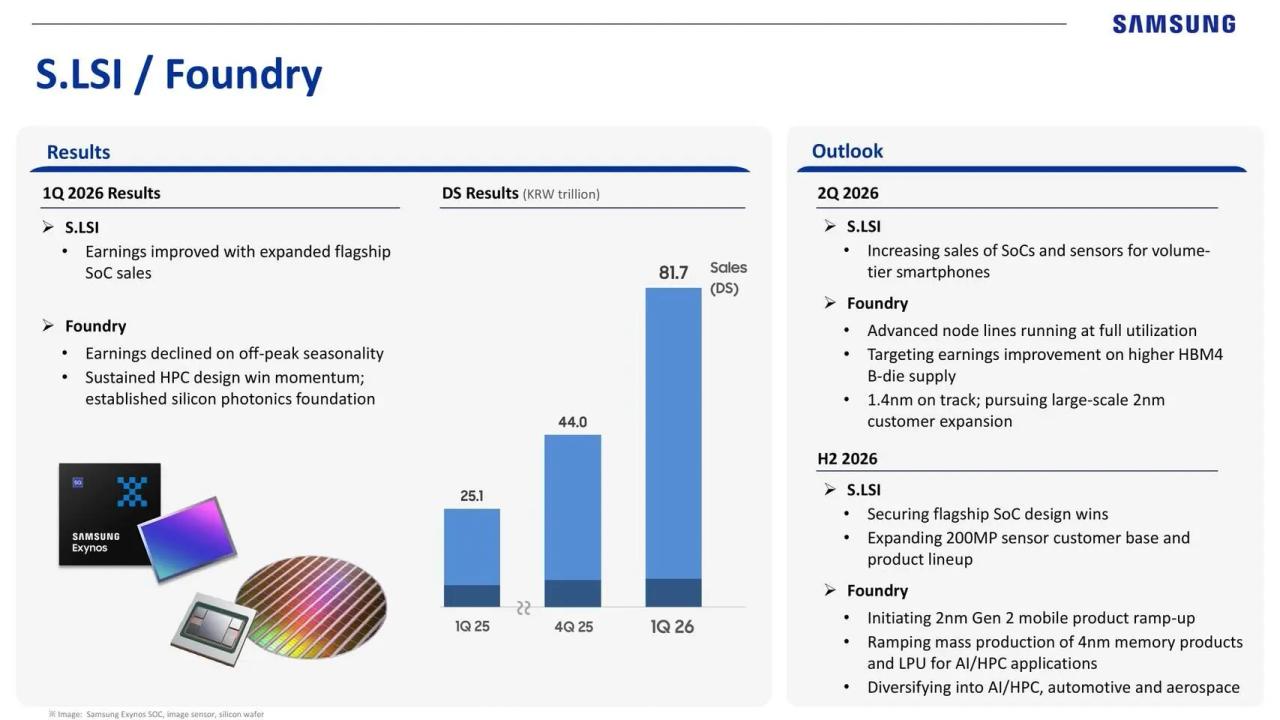
AI Memory Boom Powers Samsung's Historic Earnings Growth The South Korean tech giant reported first-quarter revenue of 133.9 trillion won ($89.96 billion), surpassing LSEG estimates of 132.69 trillion won, while operating profit reached a record 57.2 trillion won, topping forecasts of 55.28 trillion won. Operating profit surged more than 750% from a year earlier, exceeding Samsung's entire full-year 2025 profit of 43.6 trillion won, CNBC reported. Revenue climbed about 70% year over year, marking the company's highest-ever quarterly sales. Samsung's semiconductor division was the primary driver, generating 53.7 trillion won in operating profit, up sharply from roughly 1 trillion won in the same period last year. Chip sales soared 225% to 81.7 trillion won, accounting for more than 90% of Samsung's total earnings. "The Memory Business surpassed its quarterly sales record by addressing high-value-added AI demand despite limited supply availability, with industry-wide memory price increases also a contributing factor," the company said in a statement. Global Memory Shortages and AI Data Centers Fuel Chip Price Surge The company benefited from surging demand for advanced memory chips used in AI servers and hyperscale data centers, where supply shortages have significantly raised prices. Samsung said its memory business achieved record quarterly sales by capitalizing on demand for premium AI products, particularly high-bandwidth memory, or HBM, despite industrywide supply constraints. Samsung Expands HBM4 Push Amid Rivalry With SK Hynix Samsung is aggressively expanding production of next-generation HBM4 chips to narrow the gap with competitor SK Hynix, which currently leads the HBM market. While analysts say Samsung has improved significantly in HBM4, SK Hynix remains ahead in market share. According to data from Benzinga Edge, Samsung ranks in the 77th percentile for Growth, highlighting solid performance across short, medium and long-term metrics. Disclaimer: This content was partially produced with the help of AI tools and was reviewed and published by Benzinga editors. Photo courtesy: Sybillla via Shutterstock Market News and Data brought to you by Benzinga APIs To add Benzinga News as your preferred source on Google, click here.
[7]
Samsung's Net Profit Soars as AI Demand Fuels Record Chip Earnings
Samsung Electronics posted a nearly sixfold surge in first-quarter net profit, on record earnings in its core semiconductor business driven by explosive demand for advanced chips amid the artificial-intelligence boom. The world's largest memory-chip maker is widely expected to continue benefiting from tight supply and strong prices of memory products as the global AI-infrastructure buildout continues. Net profit for the three months ended March reached a record 47.225 trillion won, equivalent to $31.72 billion, a 474% increase from the year earlier, the South Korean technology company said Thursday. That beat a FactSet-compiled consensus estimate of 40.591 trillion won. Revenue also hit a record, jumping 69% to 133.873 trillion won. Operating profit increased more than eightfold to an all-time high of 57.233 trillion won. Both figures were largely in line with the company's preliminary estimates. Samsung's chip-making division drove the stellar earnings growth, posting a record operating profit of 53.7 trillion won. That accounted for more than 90% of the company's total earnings for the quarter, outweighing the sluggish performance in other segments. Higher prices of DRAM and NAND--the two main types of memory chips widely used in electronic goods--pressured Samsung's smartphone and home-appliance businesses by making key inputs and finished products pricier. Analysts largely see Samsung, along with other memory-chip makers, extending record earnings through 2026. Meritz Securities analysts Kim Sun-woo and Woo Seo-hyun said earlier this month that Samsung's operating profit could rise to 73 trillion won in the second quarter, 90 trillion won in the third quarter and 104 trillion won in the fourth quarter. Samsung is set to benefit from sustained AI inference memory demand, with prices of its DDR5 RDIMM--a high-capacity, high-speed module designed for AI servers--likely to accelerate in the second half, Citigroup's Peter Lee and Jayden Oh said in a recent note. The company's stock rose 0.9% after the earnings results, bringing its year-to-date gains to around 90%. Samsung in February said it became the first in the world to mass-produce the most advanced high-bandwidth memory chips, known as HBM4, for AI applications. It plans to provide upgraded HBM4E samples later this year. It is also manufacturing Groq 3 language processing units--the latest AI inference chips--for Nvidia, with shipments due to start in the second half of 2026.
[8]
Samsung Electronics sees robust AI demand after Q1 profit surges eightfold to set record
SEOUL, April 30 (Reuters) - Samsung Electronics said on Thursday its operating profit jumped eightfold to a record in the first quarter, underpinned by higher chip prices as an artificial intelligence boom led to a supply crunch. Samsung expects earnings to improve further in the second quarter, saying investment in AI infrastructure would continue to expand, driving up memory chip prices. The world's top memory chipmaker posted 57.2 trillion won ($38.43 billion) in operating profit for the January-to-March period, in line with its estimate of 57.2 trillion won and up from 6.69 trillion won a year earlier. The South Korean company's revenue rose 69% to 133.9 trillion won in the quarter from a year earlier. The AI data centre boom has spurred chipmakers to shift capacity to making advanced chips used in Nvidia's AI accelerators, squeezing supply of traditional chips and driving up prices. Operating profit at Samsung's chip business, its main cash cow, surged to a record 53.7 trillion won in the first quarter, accounting for 94% of its total profit. Its mobile and network division profit declined by 30% to 3 trillion won, squeezed by surging chip prices. Samsung Electronics shares rose 1.3% after the earnings announcement. Shares of Samsung Electronics, Asia's second-most valuable company after Taiwan's TSMC, have surged 88% this year, outstripping the wider market's 59% gain. ($1 = 1,488.2900 won) (Reporting by Hyunjoo Jin, Heekyong Yang and Joyce Lee; Editing by Muralikumar Anantharaman and Christopher Cushing)
Share
Copy Link
Samsung Electronics reported a record quarterly operating profit of $38.4 billion in Q1 2026, marking a 750% year-over-year surge driven by the AI boom. The semiconductor division alone generated $36 billion as memory chip shortage and rising prices from robust AI demand pushed earnings beyond expectations. The company expects continued momentum as hyperscalers expand artificial intelligence infrastructure.
Samsung Electronics posted a record quarterly profit of 57.2 trillion won ($38.4 billion) for the first quarter of 2026, representing a staggering 750% year-over-year increase driven by the AI boom and unprecedented demand for memory chips
1
2
. The South Korean technology giant's operating profit came in line with its own estimates and exceeded the average analyst estimate of 35.3 trillion won, with net profit reaching 47.1 trillion won1
4
. Revenue surged approximately 70% to 133.9 trillion won, marking an all-time quarterly high for the world's largest memory chipmaker2
4
.
Source: Benzinga
The semiconductor division profit reached a record 53.7 trillion won ($36 billion) in the first quarter, accounting for 94% of Samsung Electronics' total operating profit
1
2
. This performance reflects the company's ability to address high-value-added AI demand despite limited supply availability, with industry-wide rising memory prices also contributing to the exceptional results3
5
. The unit, which competes with SK Hynix and Micron Technology, has emerged as a major beneficiary of the global data centers expansion and the memory chip shortage that has constrained supply across the industry1
3
.
Source: Reuters
The results reflect massive spending by hyperscalers including Meta Platforms Inc. and Amazon.com Inc. on artificial intelligence infrastructure, with hundreds of billions of dollars pouring into AI hardware
1
. Accelerators such as those made by Nvidia are limited by the speed and capacity of memory to supply data, making DRAM a key factor in determining the quality of AI services1
. This supply crunch has given rise to the theory of a memory supercycle and helped Samsung's shares climb about 88% this year after more than doubling in 20251
2
. Counterpoint Research expects a 60% quarter-on-quarter rise in average DRAM contract prices in the April-June period, with average contract prices for DRAM rising 42% in March from February1
.Samsung Electronics has expanded its high-bandwidth memory (HBM) business, a key component in AI data center chips, positioning itself as a critical supplier alongside rival SK Hynix
3
4
. Strong sales of semiconductor chips used in AI accelerators have driven demand for HBM amid limited supplies, with chipmakers like Nvidia creating sustained pressure on production capacity3
4
. As manufacturers prioritize production for higher-margin AI applications, supply constraints have pushed up prices for memory chips used in consumer electronics, potentially threatening higher costs for phones, laptops and other devices worldwide3
4
.Related Stories
Samsung Electronics expects earnings to improve further in the second quarter, stating that investment in artificial intelligence infrastructure would continue to expand, driving up memory chip prices
2
. The company anticipates strong memory demand to continue as the buildout of AI infrastructure proceeds, with server memory demand expected to remain strong into the second half of the year as hyperscalers accommodate AI adoption and demand for agentic AI accelerates3
4
. Analysts point to a more than 180% rise in Korea's semiconductor exports during the first 20 days of April as a sign of continued momentum for both Samsung and SK Hynix1
. However, persistent concerns remain about whether the pace of AI spending is sustainable, with Meta shares declining on fears that large AI commitments won't pay off1
.The profits generated by the AI boom are prompting Samsung employees to demand a bigger share, with workers threatening an 18-day general strike in May and more than 30,000 workers gathering outside Samsung's main chip hub in Korea's southern city of Pyeongtaek
1
. Analysts are divided on whether labor disputes would materially impact chip output or create short-term volatility, given Samsung's highly automated operations1
. "A strike could exacerbate the memory shortage further, potentially driving prices even higher," said Greg Roh, an analyst with Hyundai Motor Securities Co. "The bigger worry may be customer confidence, as any sense of instability could be damaging"1
. Samsung is considering a shift toward multiyear contracts to stabilize supply and ease concerns about shortages, which would further bolster prices and provide a buffer against cyclical downturns1
.Summarized by
Navi
31 Jul 2024

30 Oct 2025•Business and Economy

07 Apr 2026•Business and Economy

1
Policy and Regulation

2
Science and Research

3
Entertainment and Society