The Bank of England is worried about how AI pays for itself


5 Sources
[1]
Bank of England sees $305bn in hyperscaler bonds as AI financing grows
Hyperscalers are on course to issue more than $305bn of bonds this year, the Bank says. Citi and JPMorgan are already marketing AI loans to investors as AI financing grows, Semafor reports. The Bank of England says the way the AI boom is financed is making the global financial system more fragile.
[2]
Bank of England sees growing financial risks as AI borrowing surges
The Bank of England has expressed concerns about escalating risks within the global financial landscape due to surging borrowing costs. Influential factors include ongoing instability in the Middle East and the intricacies of AI financing strategies. Furthermore, major corporations have witnessed a
[3]
Bank of England sees growing financial risks as AI borrowing surges
LONDON, Nov 26 (Reuters) - The Bank of England said on Thursday that risks in the global financial system had intensified in recent months as the conflict in the Middle East dragged on, pushing up inflation and interest rates against a backdrop of heavy borrowing by AI companies and
[4]
BofE says firms need to invest to keep pace with AI threat
This content has been selected, created and edited by the Finextra editorial team based upon its relevance and interest to our community. Financial services firms need to make significant investments to take on the growing scale and sophistication of cyber threats in the era of AI while also
[5]

Andrew Bailey says unreleased AI models have raised encryption concerns
Breakthroughs in mathematics have stoked fears that data across financial systems is under threat The governor of the Bank of England has sounded the alarm over recent AI-driven breakthroughs in mathematics that have stoked fears that the encryption used to safeguard data across the financial
Share
Copy Link
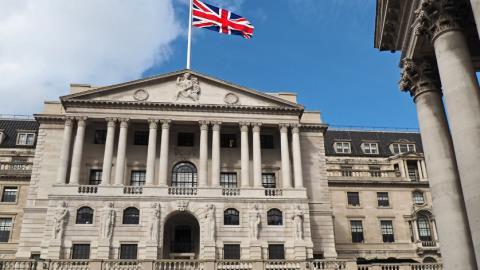
The Bank of England has warned that the way AI is being financed is making the world's financial system more fragile.

Source: ET
The warning sits in the UK central bank's half-yearly Financial Stability Report, published on Thursday, which finds that risks have grown in recent months
2
1
.
Source: Finextra Research
The numbers behind the worry
Hyperscalers, the big tech companies building out data centres, are on track to issue more than $305 billion of bonds this year, about 8% of global investment-grade issuance
1
. Bloomberg's reporting on the review puts the sector's links to the financial system at around $4 trillion1
.
Source: The Next Web
The Bank's worry is the shape of the borrowing: some AI companies are financing other firms in the sector against future revenue commitments
1
. That circularity, it says, makes it harder to see where the risks actually sit1
. The IMF raised the same concern in October1
. The report's own words: "The very rapid expansion and broadening of its financing - in a form that is increasingly complex, circular and opaque - is... making it increasingly likely for stress in one area to propagate to another"2
.Markets have started pricing the doubts. Major indices fell around 4-6% over the past three months on concerns about AI and tech companies' prospects
2
. But the Bank itself notes that spillovers into other markets have so far been limited2
. It also says the correction may not have gone far: valuations still look stretched on some measures2
. They depend heavily on tech companies delivering the profits AI is supposed to bring2
.Banks are joining in
The off-balance-sheet habit is spreading beyond the tech companies themselves. Per Semafor's reporting, Citi and JPMorgan are shopping portfolios of AI-linked loans to investors
1
. Some deals use synthetic risk transfers, which keep the loans on the bank's books while handing the risk of losses to investors1
. Hyperscalers already move debt off their balance sheets this way, per Semafor; the banks are joining them1
. The banks' motives vary, per Semafor's sources: some want to manage risk, others want room to lend more1
.The borrowing looks set to keep growing either way: JPMorgan's strategists expect investment-grade AI debt to reach $450 billion next year, up from $368 billion in 2026, per Bloomberg
1
.Related Stories

The Bank's other hands
The report landed days after the Bank's first rate rise in more than three years
2
. Markets price an 80% chance of another rise next month, and two more in 2027, when the Bank expects inflation to near 5%2
. Rising borrowing costs are one of the pressures the report cites2
. The Bank says around 6.5 million British households face bigger monthly mortgage payments over the next three years, a median rise of £100, less than in 2023 and 20242
.The Bank also used Thursday to complete its review of bank capital rules
1
. Tier 1 requirements for major UK banks will fall by roughly 50 basis points of risk-weighted assets1
. The committee said: "Reducing capital requirements much further would risk financial instability."1
The Bank still judges UK banks well capitalised, and able to keep lending even in a far worse downturn1
.The same report flags cyber risk from frontier AI: open-weight models' safeguards could be easier for attackers to remove
1
. It also cites recent Google Cloud and Microsoft outages as showing how one provider's failure hits many firms1
. And, per Bloomberg, a Systemic Resilience Council is being set up1
.Katharine Braddick, who heads the Bank's regulatory arm, told reporters that supervisors aim to stop any fall in AI values washing back into the banking system
1
. The Bank's Financial Policy Committee put it plainly: "Taken together, these developments heighten the risk that multiple vulnerabilities crystallise simultaneously."1
References
Summarized by

Navi
[4]
Related Stories
Bank of England flags AI risks as threat to financial stability amid investor speculation
07 Jul 2026•Policy and Regulation

Bank of England warns AI risk and $450 billion debt surge threaten financial stability
30 Sept 2026•Policy and Regulation
Bank of England Warns of AI-Driven Market Volatility and Manipulation Risks
10 Apr 2025•Business and Economy

Recent Highlights
1
Anthropic mathematician says Claude helped him prove math's most famous problem
Science and Research

2
Two states sue SpaceX, saying weak Grok safeguards were no accident
Policy and Regulation

3
Jensen Huang is back at Nvidia 11 days after quitting, and the scrutiny came back with him
Business and Economy

Recent Highlights
Today's Top Stories








Don’t drown in AI news. We cut through the noise - filtering, ranking and summarizing the most important AI news, breakthroughs and research daily. Follow topics that matter to you and stay ahead.


