The economist who says future-proofing your kids is a mistake


2 Sources
[1]
AI may eliminate jobs, but today's children can still thrive in an uncertain future
Many tech leaders assert that artificial intelligence will be able outperform humans at everything that is economically useful within the next decade. That's Daniel Susskind's warning in his new book, "What Should My Children Do? A Human's Guide to the Age of AI." Whether or not that happens, as
[2]
These are the three things your kids actually need to thrive in the AI revolution
Forget trying to pick an AI-proof career for your kids. Instead, make sure they can still do math with a pencil and paper and introduce them to artificial intelligence early on. That's the advice of British economist Daniel Susskind, a senior research associate at Oxford University's Institute for
Share
Copy Link
Daniel Susskind, a British economist who studies work and technology, has written a book of advice for parents raising children in the age of AI, and it opens by telling parents to stop trying to pick an AI-proof career. What Should My Children Do? A Human's Guide to the Age of AI is out now from Penguin Press
2
1
.The skill that did not last
His reason is that the age of AI is fundamentally an age of uncertainty, and the job is preparing children for a future nobody knows much about rather than guessing at it
1
. "The advice that makes me wince is anything that draws on the idea of 'future-proofing'"2
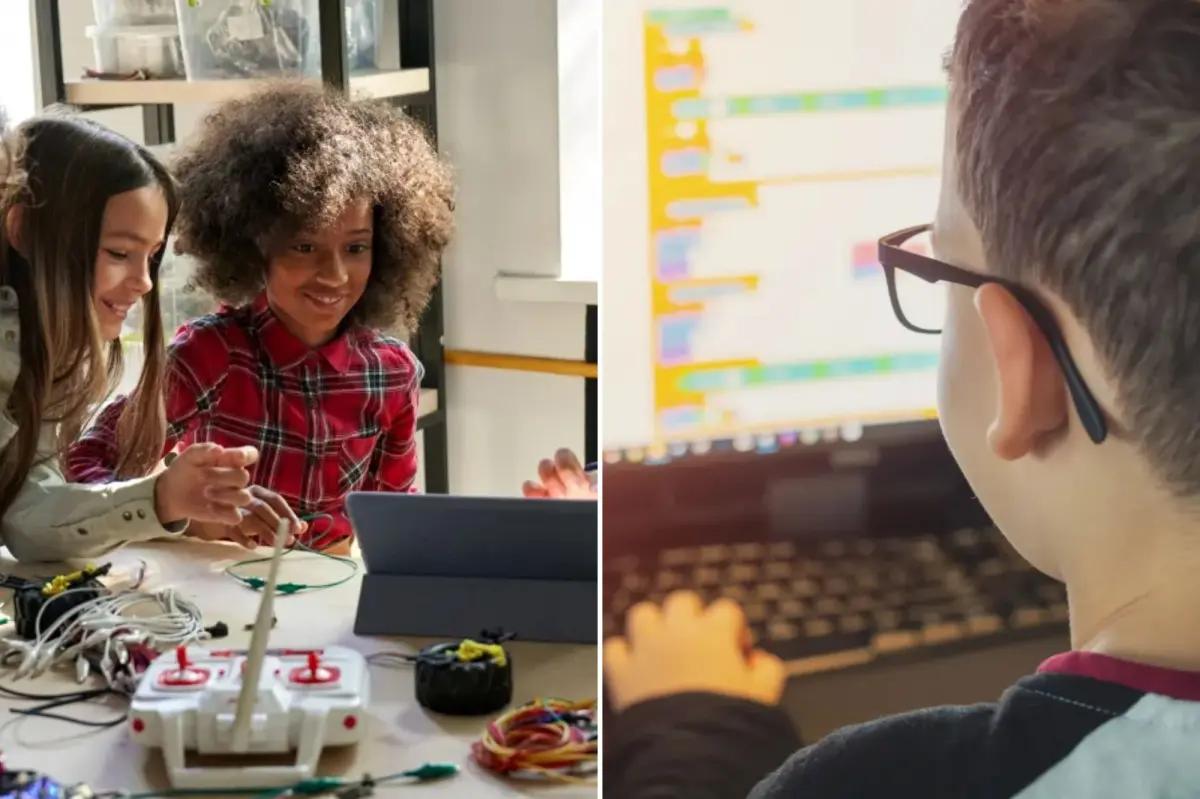
.His main evidence is England's own recent experience. Around 2013-2014, England decided schoolchildren should learn to code, and other countries followed
2
1
. By January 2023, ChatGPT had proved among the best at writing code, so the skill many countries had rushed into classrooms around that time would barely outlast the schooling. "A set of skills that were meant to future-proof the careers of the next generation barely lasted until they'd finished school," Susskind says1
.
Source: New York Post
Back to basics, with AI alongside
What replaces prediction is the unglamorous stuff: literacy, numeracy and critical thinking, so children can catch AI errors, spot invented facts and still build an argument a machine might otherwise write for them
2
1
. The reason for the checking habit is the machines themselves: he quotes AI pioneer Geoffrey Hinton calling AI programs "idiot savants," brilliant at times and idiotic at others1
.For schools, he proposes teaching and testing every subject both with and without AI, with roughly a third of teaching time using it, modeled on the calculator debate. In 1982, a British government report by mathematician Wilfred Halliday Cockcroft proposed exactly that for math. US math teachers protested the idea in Washington a few years later
2
1
. In his telling, the calculator approach became the gold standard of math education, and the same structure should apply to AI in every subject1
.He also wants children introduced to AI early, while still in elementary school, with guardrails against distraction
2
1
. The affirmative case is personalized learning: he cites research showing one-to-one tutoring outperforms classroom teaching but is unaffordable for most families, and argues AI can offer similar personalization at far lower cost1
.Related Stories
The school ban he calls a big mistake
He has taken that advice into policy. He called the one-year ban Mayor Zohran Mamdani announced in September on student-facing generative AI in classrooms up to eighth grade a big mistake. In his words, it is "letting down the next generation if we do not prepare them for the world in which they will actually live, coddling them in an artificially tech-free environment that doesn't reflect their future." He added, "I do hope the ban does not extend beyond a year"
2
.The objection is specific to AI: he supports keeping smartphones away until 14 and social media until 16, but warns against letting those worries "morph into a general technological conservatism and knee-jerk bans on AI"
2
.On the question at the heart of the book, his answer is oddly reassuring. He still advises a 15-year-old to take the traditional route through medical or law school for now, on his reasoning that pairing AI with deep domain expertise is where the promise lies. The open-mindedness is about what the job and the employer look like over a career
2
. Adults get advice too: treat education as lifelong and reskill later in life as seriously as at the start, which he argues is the best response to uncertainty1
. Children choosing a direction should ask what problems they want to spend their lives solving. He predicts the work that holds its value will be jobs where the process matters, not just the outcome, such as care, teaching and art1
.He practices the early exposure at home. He had ChatGPT build a multiplication game his 6-year-old daughter invented, complete with a rainbow, flying unicorns and gold nuggets, and uses AI to make tailored reading books for his 5-year-old son, one themed on Lego, another on a warship. "What seemed remarkable to me felt commonplace to her. And why would it not? This powerful technology is just another part of the furniture of her childhood"
2
.
Source: CNN
References
Summarized by

Navi
Related Stories
Soft Skills in the Age of AI: Reshaping Education for the Future Workforce
15 Aug 2025•Technology

AI forces skills reset across workforce as job security shifts from degrees to adaptability
02 Mar 2026•Business and Economy

AI and automation will eliminate 6% of US jobs by 2030, but the real story is more complex
13 Jan 2026•Business and Economy

Recent Highlights


Recent Highlights
Today's Top Stories





Don’t drown in AI news. We cut through the noise - filtering, ranking and summarizing the most important AI news, breakthroughs and research daily. Follow topics that matter to you and stay ahead.


