The Senate passed a permitting bill more Democrats voted against than for


5 Sources
[1]
Senate passes BAAJA permitting reform bill backed by AI, energy sectors
* The Senate on Thursday passed a bill to reform the nation's environmental permitting and electrical transmission laws. * The bill, the Bipartisan American Affordability and Jobs Act, split Democrats after their midterm election romp and now heads to the House for approval. * Congress has long
[2]
Senate passes bipartisan energy bill amid environmental concerns
As Americans struggle with rising energy costs and increased demand driven by artificial intelligence, the Senate on Thursday passed a bipartisan bill that will speed up the approval process for data centers and power plants. The Bipartisan American Affordability and Jobs Act, passed 62-33.
[3]
Senate OKs bill to speed energy projects, make data centers pay their way
The painstakingly negotiated bill would smooth over regulations for energy projects, including wind and solar, while putting rules on data centers. WASHINGTON -- The U.S. Senate on Nov. 19 passed a massive bill to ease rules on energy project development, weakening environmental rules, while
[4]
'Bullshit': The Very Wonky Bill That Sparked A Brawl Among Democrats
The Bipartisan American Affordability And Jobs Act has Democrats fighting over data centers, tribal sovereignty and green energy. WASHINGTON -- Changing how the government handles infrastructure permitting would seem an unlikely issue to start an intra-Democratic flame war. But a bill passed by
[5]

Chris Wright Hails 'Home Run for America' As Senate Advances Trump-Backed Permitting Bill, But Adam Schif
The Senate advanced a major permitting bill on Thursday, sending legislation designed to speed U.S. energy and infrastructure projects to the House amid debate over environmental safeguards. Senators approved the Bipartisan American Affordability and Jobs Act (BAAJA) by a 62-33 vote. The
Share
Copy Link
The Senate passed the Bipartisan American Affordability and Jobs Act on Thursday in a 62-33 vote, with more Democrats voting against the bill than for it, and it now heads to a House that must decide its fate before a new Congress takes over in January.
1
The bill was written by two Democrats and two Republicans and introduced in late September.
1
5
4
Most Republicans backed it, joined by 15 Democratic-aligned senators, while only two Republicans voted no.4
More than a dozen Democrats voted yes anyway, including Minority Leader Chuck Schumer.1
The split runs through the party's future leadership too. Jon Ossoff and Raphael Warnock voted no; Elissa Slotkin and Ruben Gallego voted yes. All four are mentioned as possible 2028 candidates.4
USA Today called it the most significant permitting reform Congress has passed in years.3
Source: HuffPost
What the bill changes
The bill shortens federal approval timelines for energy and infrastructure projects, narrows some environmental reviews, requires lawsuits against approved projects to be filed within 150 days, and lets federal regulators approve transmission lines when states fail to act.
5
The provision driving the Democratic fight covers data centers. It requires them to pay the full cost of the grid upgrades they need and charges extra for grid access, instead of letting those costs land on household bills.
3
2
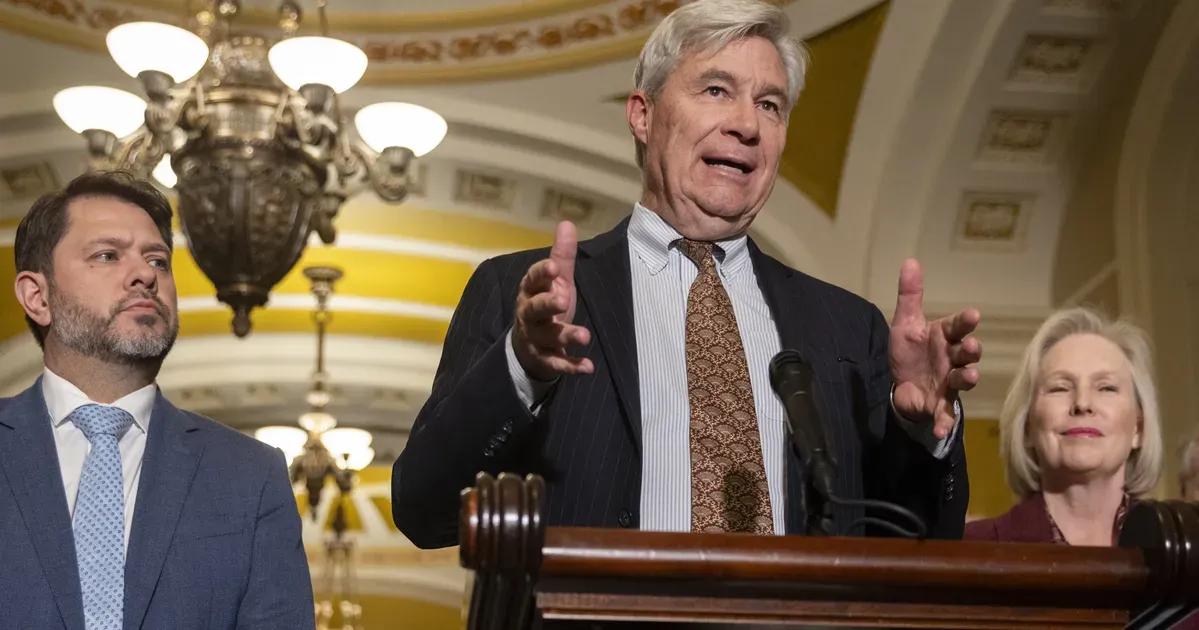
Co-author Sheldon Whitehouse called it "the first bill to take away the ability of data centers to freeload on the public," and when asked about the claim that the bill benefits data centers, his answer was "It's bullshit."4

Source: NPR
Critics disagree. Ro Khanna said the cost provisions are not enough because data centers would still benefit from upgraded transmission and still bring water, noise and light pollution with them.
4
Merkley says the bill would let a flood of natural gas reach data centers while renewable transmission stays subject to Trump's obstruction.2
The politics are raw in a specific way. Per National Public Radio, electricity prices rose faster than overall inflation, up more than 6% in the past year and 39% over five years.2
Dozens of local data center moratoriums passed in the November midterms.3
Sen. Ed Markey told the Senate that AI companies are projected to spend $10 trillion on data centers over the next eight years. In his words, the bill "doesn't just roll out the red carpet for data center developers; it puts them on a greased-up slide into towns across America."4
The tribal provisions that fell out
The bill passed without any amendments. Sen. Lisa Murkowski had negotiated tribal-protective changes with the authors, but Ron Wyden and Jeff Merkley blocked the amendment process on Thursday, which killed her language along with Wyden's proposal to ban data centers on federal public lands.
1
4
"While not perfect, we had a bipartisan agreement that would have made this legislation better for Tribes. Ninety-eight members agreed; two blocked it," Murkowski said, and she voted yes anyway while pledging to pursue the changes separately.4
Tribal groups including the National Congress of American Indians had urged full removal of the bill's section weakening historic preservation laws.4
Sen. Ruben Gallego publicly accused Merkley of sabotage.1
Who likes it, and who doesn't
President Trump urged senators to pass the bill earlier in November and the White House officially supports it.
1
5
2
Energy Secretary Chris Wright called it a "home run for America."5
Both the renewables trade group American Clean Power and the oil and gas lobby American Petroleum Institute praised the passage.1
3
The bill also aims to keep Trump from revoking permits that wind and solar projects already hold.1
The climate math is genuinely uncertain. Rhodium Group estimates it could allow up to 249 additional gigawatts of clean energy by 2040, with ranges so wide that the bill's net climate effect is genuinely unclear.
1
Majority Leader John Thune estimated savings of hundreds of dollars per household per year.3
2
Opposition comes from the Sierra Club, the National Wildlife Federation, Oil Change International, which called the bill a "fossil fuel giveaway," and 17 Democratic state attorneys general.3
2
4
Yet one analysis, by a researcher at a group that supports the bill, found that about 70% of the 100 largest land, water and wildlife groups have stayed silent on it.4
Related Stories

The House's choice
The bill faces an uncertain House future with a shrinking legislative window. If it does not pass both chambers this Congress, it must be reintroduced in January under the new one.
1
3
4
Republican leadership is expected to try, and Trump supports the deal, but House Democrats are expected to be divided.1
5

Source: Benzinga
That division is the same argument the Senate just had. Ocasio-Cortez said a bill negotiated under a Republican trifecta is worse than one a Democratic Congress could write next year.
1
4
Rep. Jared Huffman, one of the House Democrats who intends to fight it, put it this way: "Don't believe the lie that this terrible bill, exactly as drafted, is the last, best and only chance to ever do permitting reform."1
Rep. Scott Peters, a supporter, said the chance should be used before this Congress ends.1
References
Summarized by

Navi
Related Stories
Senate nears vote on permitting bill that would make data centers pay for their power
Yesterday•Policy and Regulation

House Passes Bill to Make AI Data Centers Pay for Grid Upgrades as Utility Costs Spark Voter Backlash
16 Sept 2026•Policy and Regulation
House advances SPEED Act to fast-track permits for AI data centers and chip manufacturing
17 Dec 2025•Policy and Regulation

Recent Highlights


Recent Highlights
Today's Top Stories










Don’t drown in AI news. We cut through the noise - filtering, ranking and summarizing the most important AI news, breakthroughs and research daily. Follow topics that matter to you and stay ahead.


