UK Met 137 Businesses on AI Data Centres But Zero Environmental Groups, Investigation Reveals


5 Sources
[1]
UK ministers had plenty of time for AI datacenter bosses, but none for environmental groups
Investigation finds businesses dominated govt meetings while communities were left out of decisions about AI Growth Zones The British government has been busy courting AI datacenter companies while apparently finding little time to speak to the people who will have to live next door to their
[2]
UK considers forcing data centres to invest locally to meet new AI 'covenant'
Burnham government looks at fresh requirements for developers as it seeks to head off public opposition to infrastructure build-out The UK government is considering new requirements for data centre developers to invest in local communities as ministers seek to head off public opposition to new AI
[3]
AI data centres could undermine UK's net zero goals
The UK government's ambition of achieving net zero carbon emissions by 2050 could be undermined by its new deal on AI data centres, according to BBC research. During Wednesday's Budget speech, Chancellor John Healey said data centres would be allowed to build onsite power generation while they
[4]
UK considering forcing data centers to invest in local communities as part of AI "covenant" -- and it shows getting angry at developers can massively benefit working people
* Data center developers could be required to invest in local communities as part of new UK government plans for an AI "covenant" * This could come in the form of payments to residents or investment plans for local infrastructure * Multiple sites in AI Growth Zones have seen widespread opposition
[5]

UK government met 137 businesses over AI datacentres - but no environmental groups
Investigation finds dozens of ministers and civil servants moved into AI roles as government developed datacentre expansion plans The UK's policy on datacentres and AI was developed without any meetings with environmental groups, an investigation has found. The nonprofit organisation Spotlight on
Share
Copy Link
An investigation by Spotlight on Corruption reveals the UK government met 137 businesses while developing AI data centre policy between July 2024 and June 2026, but held zero meetings with environmental groups. The findings raise concerns about who influences Britain's AI Growth Zones as the country pursues ambitious infrastructure expansion while facing mounting local opposition and potential conflicts with net zero goals.
UK Government Policy Shaped by Business, Not Communities
The UK government's approach to AI data centres has come under scrutiny after an investigation by Spotlight on Corruption revealed that 84 percent of stakeholders ministers met with between July 2024 and June 2026 were businesses or private-sector trade associations
1
. Environmental groups received zero meetings with ministers or senior officials during this critical policy development period5
. The findings expose a significant imbalance in how the government's AI infrastructure expansion strategy was formed, with 137 different businesses gaining access to policymakers while local communities were largely excluded from decisions about AI Growth Zones1
.
Source: TechRadar
Lack of Public Consultation Raises Democratic Concerns
The government failed to conduct a national public consultation on its AI Growth Zone strategy, despite potential consequences for electricity supplies, water usage, and local communities
1
. Ministers met just two community groups during the entire period, and both meetings occurred after decisions had already been made to designate their areas as zones. In one case, the meeting took place on the very day the designation was announced1
. Local authorities struggled equally to secure access. Of the ten local councils and devolved governments affected by the five announced zones, half reported no communication with ministers or senior DSIT officials beyond their applications1
. This stands in stark contrast to countries including Germany, Canada, and Ireland, which conducted national consultations on their data centre strategies1
.Data Centre Covenant Proposed to Address Growing Opposition
Facing mounting public backlash, the UK government is now considering new requirements for AI data centres through a proposed data centre covenant
2
. This covenant would require developers to meet conditions including sustainability requirements, specific agreements on energy consumption, and local community investment in exchange for priority access to the electricity grid or accelerated planning approval2
. AI minister Kanishka Narayan emphasized the government would not leave the technology to "foreign firms and foreign billionaires" and promised a "distinctly Labour approach to British AI" that would use state power to shape technology in line with public interest2
. The form of local community investment requirements has not been finalized but could include direct cash payments or infrastructure development2
.Net Zero Goals Under Threat from Gas-Powered Infrastructure
The UK government's ambition of achieving net zero goals by 2050 faces potential undermining from AI infrastructure expansion
3
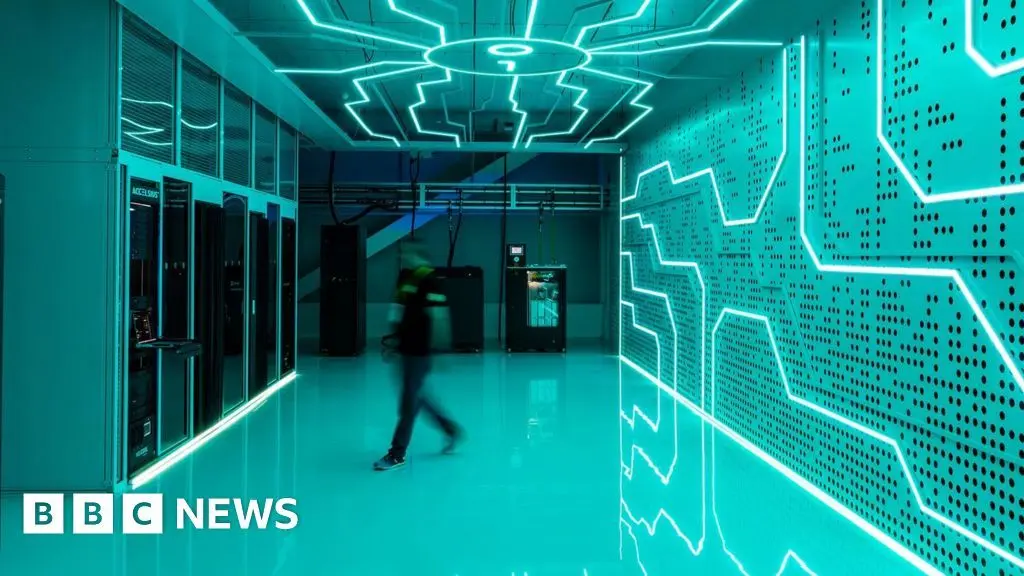
. BBC research discovered that four planned hyperscale data centres are considering using gas-fired power to meet electricity needs while waiting for grid connections3
. If running continuously at full capacity, these facilities would require 1.3 gigawatts of power and could produce an estimated 4.1 million tonnes of carbon emissions annually—more than the cities of Manchester, Liverpool and Southampton combined3
. During the Budget speech, Chancellor John Healey announced that AI data centres would be allowed to build onsite power generation while waiting for grid connections3
. Labour MP Toby Perkins, who chairs the Environmental Audit Select Committee, warned that substantial increases in natural gas use "can't be the future"3
.Grid Connection Crisis Drives Controversial Energy Solutions
Data centre developers are seeking grid connections totalling 72 gigawatts, while the peak electricity demand across the entire country last year was just 45 gigawatts
3
. Some developers have been told they could wait up to 10 years for the system to be upgraded to provide connections3
. At Acre Slough west of London, developers say they could use gas engines with generating capacity up to 49.5 megawatts while waiting for a National Grid connection, expected to take at least 10 years3
. At Wapsey's Wood in Buckinghamshire, a proposed 200-megawatt gas power station could operate until sufficient grid capacity becomes available, currently not expected until 20403
. The government has been consulting on proposals that could allow strategically important AI data centres to jump the electricity grid connection queue, potentially ahead of housing developments already waiting for power1
.
Source: BBC
Related Stories

Revolving Door Between Government and AI Industry
Spotlight on Corruption identified 38 appointments of former ministers and senior civil servants by AI companies between July 2024 and September 2026, including nine people who previously worked at DSIT
1
. These included a former minister for AI and intellectual property, a former AI adviser to the prime minister, a former director of AI opportunities, a deputy director of AI international policy and a head of AI engineering5
. The government's AI Energy Council includes representatives from Microsoft, Google, and Amazon Web Services but no environmental NGOs1
. Its Sustainability Working Group managed just one meeting between April 2025 and July 20261
.Local Opposition Intensifies Across Multiple Sites
Widespread opposition to AI data centres has emerged across the UK. A data centre planned for Auchertool in Fife, Scotland, with 600MW capacity that would make it the second largest in the world, has attracted over 1,600 objections
4
. Plans for a 450MW data centre in North Wales are being opposed by local residents and an online petition exceeding 26,000 signatures4
. The Scottish Parliament backed a de facto moratorium on hyperscale data centres in September4
. This mirrors concerns in the US, where roughly $200 billion worth of data centre development has been disrupted or delayed this year amid public backlash2
. Chi Onwurah MP warned that the growing backlash represents a critical warning that the government needs greater community input, noting the US opposition is already influencing midterm elections5
.
Source: The Register
References
Summarized by

Navi
[1]
Related Stories
Scotland votes to freeze datacentres as UK AI strategy faces scrutiny over phantom investments
04 Jul 2026•Policy and Regulation

Construction delays hit 40% of AI data centers as power infrastructure and labor shortages stall expansion
17 Apr 2026•Business and Economy
UK government admits AI data centres could emit 100 times more carbon than previously forecast
24 Apr 2026•Policy and Regulation

Recent Highlights


Recent Highlights
Today's Top Stories









Don’t drown in AI news. We cut through the noise - filtering, ranking and summarizing the most important AI news, breakthroughs and research daily. Follow topics that matter to you and stay ahead.


