3 Sources
[1]
UPI, Aadhaar banking drive 61% of MSME transactions; AI adoption rises: Report
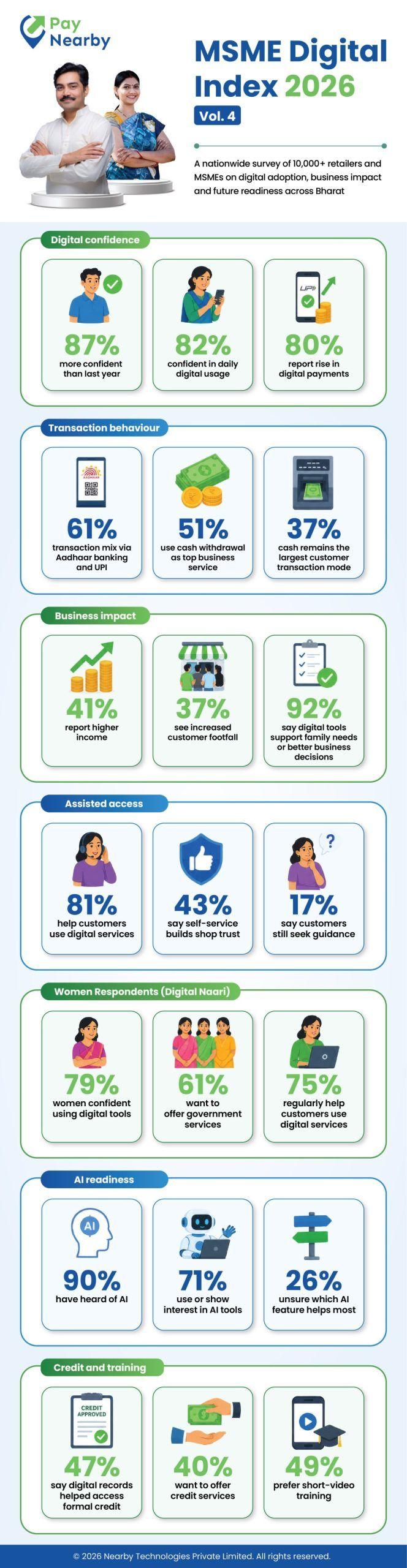
A significant majority of retailers now feel more confident using digital platforms for daily operations, leading to increased digital payment usage. AI is also gaining attention, with many retailers already employing it to enhance their businesses, signaling a strong move towards regular digital adoption. Digital tools are gaining traction among India's MSMEs, with UPI and Aadhaar-enabled banking accounting for 61 per cent of transactions at semi-urban and rural MSME retail stores, while 71 per cent of retailers use AI tools to improve daily business operations, according to PayNearby's MSME Digital Index Report 2026. According to the report, 87 per cent of respondents feel more confident using digital tools than last year, while 82 per cent are comfortable using them for daily business activities. The shift is reflected in payment behaviour, with 80 per cent reporting increased digital payment usage at their stores over the past year. AI is also emerging as an area of interest among last-mile MSMEs, though adoption remains at an early stage. As per the survey, "90 per cent of respondents have heard of AI in some form, while 71 per cent have used AI tools to automate and improve business operations." However, 26 per cent remain unsure about which AI features could best support their businesses. "Together, these findings indicate that MSMEs are moving beyond first-time adoption towards more regular and confident use of digital platforms," the report added. While digital payments continue to gain traction at the last mile, India's transaction ecosystem remains a mix of cash and digital modes. "While cash continues to be the single largest dominant customer transaction mode at 37%, Aadhaar banking and UPI together account for 61% of the reported dominant transaction mix," the report said. As per the report, "cash withdrawal emerged as the leading service at 51 per cent, followed by Aadhaar banking at 22 per cent and UPI at 12 per cent." The report further added that "41 per cent respondents said digital tools have helped increase income, while 37 per cent said they helped bring more customers." Moreover, this shift is strengthening retailers' role in the MSME sphere. The MSME Digital Index 2026 tracks digital adoption, payment trends, business impact, customer support practices, trust barriers, AI readiness, training needs and future service expectations among retailers and Digital Naaris in PayNearby's network. The survey covered 10,000 retailers and MSMEs, including kirana stores, customer service points, mobile recharge outlets, digital service providers and other neighbourhood businesses.
[2]
UPI, Aadhaar Banking Account for 61% of Transactions at Semi-urban and Rural MSME Stores
71% of semi-urban and rural MSME retailers use AI tools to improve day-to-day business operations The fourth edition of the MSME Digital Index Report 2026, released today by PayNearby, reveals that digital tools are no longer just an add-on for small retailers and micro-entrepreneurs. UPI and Aadhaar Banking Account for 61% of Transactions at Semi-urban and Rural MSME Retail Stores. The report shows that 87% respondents feel more confident using digital tools than last year, while 82% said they are confident using digital tools for day-to-day business activities. This shift is also visible in transaction behaviour, with 80% of respondents reporting an increase in digital payment usage at their stores over the last year. AI is emerging as an area of curiosity at the last mile, though adoption is still early. The survey found that 90% of respondents have heard of AI in some form, while 71% have used AI tools to automate and improve business operations. At the same time, 26% are unsure which AI features would help their business most. This shows that awareness of AI is higher than clarity on use cases, and adoption will depend on simple design, clear benefits, local language support and human assistance when needed. Together, these findings indicate that MSMEs are moving beyond first-time adoption towards more regular and confident use of digital platforms. The MSME Digital Index 2026 captures digital adoption, payment behaviour, business impact, customer assistance patterns, trust barriers, AI readiness, training needs, and future service aspirations among retailers and Digital Naaris across PayNearby's network. The survey was conducted among 10,000 retailers and MSMEs, including kirana stores, customer service points, mobile recharge outlets, digital service providers, and other neighbourhood businesses. Digital payments continue to gain momentum at the last mile, but India's transaction economy remains hybrid. While cash continues to be the single largest dominant customer transaction mode at 37%, Aadhaar banking and UPI together account for 61% of the reported dominant transaction mix. This highlights a shift not just from cash to digital, but towards a cash-assisted, account-linked, and digitally enabled ecosystem where local retailers continue to support customers across multiple transaction modes. This hybrid behaviour is also reflected in the services retailers use most for business. Cash withdrawal emerged as the leading service at 51%, followed by Aadhaar banking at 22% and UPI at 12%. The findings highlight the continued relevance of assisted banking and digital services at the last mile, with retailers serving as trusted access points for customers seeking support with everyday financial and digital needs. The business impact of digital tools is also becoming more visible. Around 41% respondents said digital tools have helped increase income, while 37% said they helped bring more customers. Faster service, improved customer trust, increased sales and the ability to offer more services were also cited as key benefits. Importantly, 92% respondents said digital tools have helped them support family needs or make better business decisions, indicating that digitisation is influencing how small retailers manage both their business and day-to-day financial responsibilities. As retailers become more digitally confident, their role in the local ecosystem is also changing. Around 81% of respondents help customers understand or use digital services. This shows that even as customers become more comfortable with digital tools, local support and handholding still matters. Retailers are moving from being only transaction points to digital guides who help customers use services with trust and familiarity. This shift is not replacing the retailer's role but strengthening it. When customers use digital services on their own, 43% respondents say it builds trust in their shop, while 17% say customers still seek their guidance. This reflects a behavioural shift where self-service and retailer-assisted services are growing together, strengthening neighbourhood retailers as trusted local access points. Commenting on the findings, Anand Kumar Bajaj, Founder, MD & CEO, PayNearby, said, "The MSME Digital Index 2026 highlights how Bharat's small businesses are moving beyond digital adoption to digital confidence. Retailers are increasingly leveraging technology not just for payments, but to build trust, improve customer experience and drive business growth. At PayNearby, our focus remains on making technology simple, accessible and relevant for the last mile. As confidence in digital tools grows, neighbourhood retailers will play an even greater role in expanding access to banking, credit, insurance, commerce, government services and other essential services across Bharat." The confidence shift is also seen among women respondents known as Digital Naaris within the PayNearby ecosystem. Among them, 79% feel confident using digital tools for business and 90% are more confident than last year. 39% report higher income and 36% see more customers after digital adoption. 75% regularly help customers use digital services. Looking ahead, 61% want to offer government services, followed by credit, insurance and health services. 72% show interest in AI or automation tools. Women micro-entrepreneurs want simple, trusted digital tools to grow, support their families and serve their communities. Commenting on the Digital Naari insights, Jayatri Dasgupta, CMO, PayNearby and Program Director, Digital Naari, said, "The findings reaffirm that Women micro-entrepreneurs are no longer just adopting digital tools, they are becoming trusted access points for their communities. For many households, having a Digital Naari nearby makes the real difference between knowing about a service and using it. But technology alone cannot be inclusive. It must be simple, local and backed by real human support. Through Digital Naari, we want to equip women with the tools, training and confidence to grow their businesses and strengthen the communities they serve" Trust and safety remain an important factor in deeper digital adoption. Fear of fraud is a top concern for 33% of respondents, followed by lack of training at 30% and poor internet connectivity at 23%. This shows that MSME digitisation will depend not only on access to technology but also on reliable transactions, fraud awareness, training and quick support. Human support is still preferred, with 61% choosing phone calls as their preferred support channel. The report also shows a strong formal credit readiness signal. Nearly 47% respondents said digital transaction records have already helped them access formal credit, and another 22% are planning to use these records for exactly that purpose. Together, this indicates that digital transaction history is beginning to be seen as a pathway to formal credit access. At the same time, 40% of respondents want to offer credit in the future, indicating that credit is emerging both as a funding need and a service opportunity at the last mile. Training continues to be a major enabler of deeper adoption. Short videos are the preferred format for 49% of respondents, followed by in-person training, phone support and WhatsApp tutorials. Respondents are also looking to expand their service offerings, with government services emerging as the top preference, followed by credit, education, insurance, healthcare, and e-commerce. Over the next year, their key priorities include increasing income, attracting more customers, expanding services, and strengthening business stability. The MSME Digital Index 2026 reaffirms a clear message. Bharat's MSMEs are no longer just adopting digital tools, they are growing with them. From exploring AI to using digital records for credit access, these businesses are becoming trusted pillars of their communities. Now the focus must shift to making digital simpler, safer, and more local so every last-mile business can earn more, serve better, and belong fully to Bharat's digital future.
[3]
UPI and Aadhaar banking account for 61% of transactions at semi-urban and rural MSME retail stores
71% of semi-urban and rural MSME retailers use AI tools to improve day-to-day business operations Bharat's MSMEs are moving from digital adoption to digital confidence. The fourth edition of the MSME Digital Index Report 2026, released today by PayNearby, Bharat's leading branchless banking and digital financial services network, reveals that digital tools are no longer just an add-on for small retailers and micro-entrepreneurs. UPI and Aadhaar Banking Account for 61% of Transactions at Semi-urban and Rural MSME Retail Stores The report shows that 87% respondents feel more confident using digital tools than last year, while 82% said they are confident using digital tools for day-to-day business activities. This shift is also visible in transaction behaviour, with 80% of respondents reporting an increase in digital payment usage at their stores over the last year. AI is emerging as an area of curiosity at the last mile, though adoption is still early. The survey found that 90% of respondents have heard of AI in some form, while 71% have used AI tools to automate and improve business operations. At the same time, 26% are unsure which AI features would help their business most. This shows that awareness of AI is higher than clarity on use cases, and adoption will depend on simple design, clear benefits, local language support and human assistance when needed. Together, these findings indicate that MSMEs are moving beyond first-time adoption towards more regular and confident use of digital platforms. The MSME Digital Index 2026 captures digital adoption, payment behaviour, business impact, customer assistance patterns, trust barriers, AI readiness, training needs, and future service aspirations among retailers and Digital Naaris across PayNearby's network. The survey was conducted among 10,000 retailers and MSMEs, including kirana stores, customer service points, mobile recharge outlets, digital service providers, and other neighbourhood businesses. Digital payments continue to gain momentum at the last mile, but Bharat's transaction economy remains hybrid. While cash continues to be the single largest dominant customer transaction mode at 37%, Aadhaar banking and UPI together account for 61% of the reported dominant transaction mix. This highlights a shift not just from cash to digital, but towards a cash-assisted, account-linked, and digitally enabled ecosystem where local retailers continue to support customers across multiple transaction modes. This hybrid behaviour is also reflected in the services retailers use most for business. Cash withdrawal emerged as the leading service at 51%, followed by Aadhaar banking at 22% and UPI at 12%. The findings highlight the continued relevance of assisted banking and digital services at the last mile, with retailers serving as trusted access points for customers seeking support with everyday financial and digital needs. The business impact of digital tools is also becoming more visible. Around 41% respondents said digital tools have helped increase income, while 37% said they helped bring more customers. Faster service, improved customer trust, increased sales and the ability to offer more services were also cited as key benefits. Importantly, 92% respondents said digital tools have helped them support family needs or make better business decisions, indicating that digitisation is influencing how small retailers manage both their business and day-to-day financial responsibilities. As retailers become more digitally confident, their role in the local ecosystem is also changing. Around 81% of respondents help customers understand or use digital services. This shows that even as customers become more comfortable with digital tools, local support and handholding still matters. Retailers are moving from being only transaction points to digital guides who help customers use services with trust and familiarity. This shift is not replacing the retailer's role but strengthening it. When customers use digital services on their own, 43% respondents say it builds trust in their shop, while 17% say customers still seek their guidance. This reflects a behavioural shift where self-service and retailer-assisted services are growing together, strengthening neighbourhood retailers as trusted local access points. Commenting on the findings, Anand Kumar Bajaj, Founder, MD & CEO, PayNearby, said, "The MSME Digital Index 2026 highlights how Bharat's small businesses are moving beyond digital adoption to digital confidence. Retailers are increasingly leveraging technology not just for payments, but to build trust, improve customer experience and drive business growth. At PayNearby, our focus remains on making technology simple, accessible and relevant for the last mile. As confidence in digital tools grows, neighbourhood retailers will play an even greater role in expanding access to banking, credit, insurance, commerce, government services and other essential services across Bharat." The confidence shift is also seen among women respondents known as Digital Naaris within the PayNearby ecosystem. Among them, 79% feel confident using digital tools for business and 90% are more confident than last year. 39% report higher income and 36% see more customers after digital adoption. 75% regularly help customers use digital services. Looking ahead, 61% want to offer government services, followed by credit, insurance and health services. 72% show interest in AI or automation tools. Women micro-entrepreneurs want simple, trusted digital tools to grow, support their families and serve their communities. Commenting on the Digital Naari insights, Jayatri Dasgupta, CMO, PayNearby and Program Director, Digital Naari, said, "The findings reaffirm that Women micro-entrepreneurs are no longer just adopting digital tools, they are becoming trusted access points for their communities. For many households, having a Digital Naari nearby makes the real difference between knowing about a service and using it. But technology alone cannot be inclusive. It must be simple, local and backed by real human support. Through Digital Naari, we want to equip women with the tools, training and confidence to grow their businesses and strengthen the communities they serve" Trust and safety remain an important factor in deeper digital adoption. Fear of fraud is a top concern for 33% of respondents, followed by lack of training at 30% and poor internet connectivity at 23%. This shows that MSME digitisation will depend not only on access to technology but also on reliable transactions, fraud awareness, training and quick support. Human support is still preferred, with 61% choosing phone calls as their preferred support channel. The report also shows a strong formal credit readiness signal. Nearly 47% respondents said digital transaction records have already helped them access formal credit, and another 22% are planning to use these records for exactly that purpose. Together, this indicates that digital transaction history is beginning to be seen as a pathway to formal credit access. At the same time, 40% of respondents want to offer credit in the future, indicating that credit is emerging both as a funding need and a service opportunity at the last mile. Training continues to be a major enabler of deeper adoption. Short videos are the preferred format for 49% of respondents, followed by in-person training, phone support and WhatsApp tutorials. Respondents are also looking to expand their service offerings, with government services emerging as the top preference, followed by credit, education, insurance, healthcare, and e-commerce. Over the next year, their key priorities include increasing income, attracting more customers, expanding services, and strengthening business stability. The MSME Digital Index 2026 reaffirms a clear message. Bharat's MSMEs are no longer just adopting digital tools, they are growing with them. From exploring AI to using digital records for credit access, these businesses are becoming trusted pillars of their communities. Now the focus must shift to making digital simpler, safer, and more local so every last-mile business can earn more, serve better, and belong fully to Bharat's digital future.
Share
Copy Link
A new report reveals that UPI and Aadhaar banking now power 61% of transactions at semi-urban and rural MSME retail stores in India. Digital confidence is rising sharply, with 87% of retailers feeling more comfortable with digital tools than last year. AI adoption is also gaining ground, as 71% of MSME retailers now use AI tools to automate and improve daily business operations.
MSME digital adoption has reached a critical inflection point in India's semi-urban and rural markets. According to the MSME Digital Index Report 2026 released by PayNearby, UPI and Aadhaar banking now account for 61% of transactions at semi-urban and rural MSME stores, marking a significant shift in how small businesses handle payments
1
. The survey, which covered 10,000 retailers and MSMEs including kirana stores, customer service points, and mobile recharge outlets, reveals that digital tools for MSMEs are no longer optional add-ons but essential infrastructure for daily operations2
.
Source: CXOToday
The shift toward digital confidence is evident in the numbers. A striking 87% of respondents feel more confident using digital platforms than last year, while 82% are comfortable using them for daily business activities
1
. This growing comfort translates directly into behavior, with 80% reporting increased digital payment usage at their stores over the past year3
.AI adoption is gaining traction among India's MSME retailers, though implementation remains in early stages. The PayNearby report found that 90% of respondents have heard of AI in some form, while 71% have already used AI tools for business operations to automate and improve daily tasks
1
. However, 26% remain unsure about which AI features could best support their businesses, indicating that awareness exceeds clarity on practical use cases2
.This gap between awareness and application suggests that future AI adoption will depend heavily on simple design, clear benefits, local language support, and human assistance when needed
3
. For MSMEs operating in semi-urban and rural areas, the ability to access AI tools in regional languages with guided support could determine whether these technologies move from experimental to essential.Despite the surge in digital payment usage, India's transaction economy remains distinctly hybrid. Cash continues as the single largest dominant customer transaction mode at 37%, even as digital methods gain ground
1
. This hybrid behavior extends to the services retailers use most for business operations. Cash withdrawal emerged as the leading service at 51%, followed by Aadhaar banking at 22% and UPI at 12%2
.
Source: CXOToday
The findings highlight a shift not just from cash to digital, but toward a cash-assisted, account-linked, and digitally enabled ecosystem where local retailers support customers across multiple transaction modes
3
. This positions retailers as critical bridges in India's financial inclusion journey, serving as trusted access points for customers navigating both traditional and digital financial services.Related Stories
The business impact of digital tools is becoming increasingly tangible for MSME retailers. Around 41% of respondents said digital tools have helped increase income growth, while 37% reported they helped with customer acquisition
2
. Faster service, improved customer trust, increased sales, and the ability to offer more services were cited as key benefits3
.
Source: ET
Crucially, 92% of respondents said digital tools have helped them support family needs or make better business decisions, indicating that digitization influences how small retailers manage both business and day-to-day financial responsibilities
2
. This broader impact suggests that MSME digital adoption extends beyond transactional efficiency to reshape household economics and business planning capabilities.As digital confidence grows, retailers are transforming from transaction points into digital guides. Around 81% of respondents help customers understand or use digital services, demonstrating that local support and handholding remain critical even as customers become more comfortable with technology
3
. When customers use digital services independently, 43% of respondents say it builds trust in their shop, while 17% report customers still seek their guidance2
.Anand Kumar Bajaj, Founder, MD & CEO of PayNearby, commented on the findings: "The MSME Digital Index 2026 highlights how Bharat's small businesses are moving beyond digital adoption to digital confidence. Retailers are increasingly leveraging technology not just for payments, but to build trust, improve customer experience and drive business growth"
3
. This evolution positions neighbourhood retailers to play an even greater role in expanding access to banking, credit, insurance, commerce, and government services across India's hinterlands.Summarized by
Navi
[2]
17 Dec 2024•Business and Economy

11 Jun 2026•Business and Economy

17 Nov 2025•Business and Economy

1
Policy and Regulation

2
Policy and Regulation

3
Policy and Regulation