US National Labs Turn to Exotic Chips as AI Boom Reshapes Supercomputing Landscape


2 Sources
[1]
Uncle Sam's next big supercomputer might use something more exotic than GPUs
Of the world's most powerful supercomputers, nine of the top 10 are powered by GPUs, but that might not be the case for much longer. As chipmakers like Nvidia prioritize AI FLOPS over the ultra-precise floating point calculations used in scientific computing, US National Labs are turning to new
[2]
As chip industry chases AI, U.S. national labs look to newcomers for supercomputers
ALBUQUERQUE, New Mexico, May 18 (Reuters) - In a nondescript building on Kirtland Air Force Base on the high desert of New Mexico, liquid-cooled supercomputers gurgle and hum their way through some of the most complex math problems the U.S. government seeks to solve: simulating how hypersonic
Share
Copy Link
As the chip industry chases AI, US national labs face a supply crunch for high-precision computing. Sandia National Laboratories is testing NextSilicon's dataflow processors as alternatives to GPUs for supercomputers, marking a shift in how nuclear weapons simulations and critical scientific work gets done. The move signals growing concerns about Nvidia's declining focus on FP64 performance.
Supercomputing Chips Face New Demands as AI Dominates
The race to build better AI chips is reshaping the supercomputing landscape in ways few anticipated. Nine of the world's top 10 most powerful supercomputers rely on GPUs, but US national labs are now exploring alternatives to GPUs for supercomputers as chipmakers like Nvidia prioritize AI workloads over the ultra-precise calculations needed for scientific computing
1
. This shift has opened the door for new chip architectures from smaller players to challenge the dominance of established semiconductor giants.At Sandia National Laboratories, located on Kirtland Air Force Base in New Mexico, liquid-cooled supercomputers handle some of the most complex and secretive work the US government undertakes: simulating nuclear weapons as they move through the atmosphere and modeling what happens when nuclear warheads detonate near each other
2
. For over a decade, mainstream semiconductor firms supplied the chips for this demanding work, but supply shortages and shifting design priorities are forcing labs to rethink their procurement strategies.NextSilicon's Maverick-2 Passes Critical Milestone
Sandia recently validated NextSilicon's Maverick-2, a dataflow processor designed explicitly for the 64-bit floating point mathematics that dominate High-Performance Computing (HPC) applications at the Department of Energy. The Spectra supercomputer, built in collaboration with Penguin Solutions and NextSilicon, met all system acceptance requirements this week, opening the door for deployment in larger systems
1
. While Spectra is modest in scale—counting just 64 nodes and 128 of NextSilicon's runtime-configurable accelerators—it serves as a crucial test bed for proving the technology works.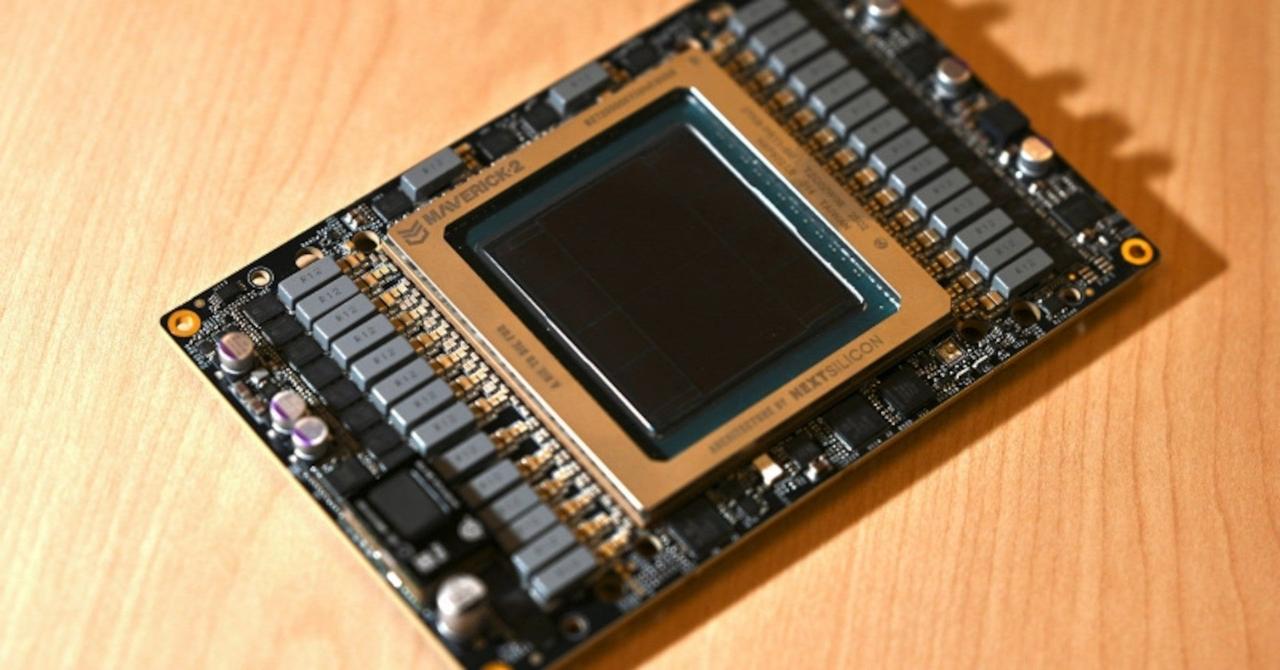
Source: Reuters
The Israeli startup's chips passed validation using three key workloads: the high-performance conjugate gradient benchmark, the LAMMPS molecular dynamics test suite, and the Sparta Monte Carlo simulation suite
1
. This technical milestone puts NextSilicon in the running for government systems and sets up a decision this fall on whether to test the chips with more demanding computing problems that closely resemble actual nuclear security work2
.High-Precision Computing Takes a Back Seat to AI
The concern driving this search for new options centers on double-precision floating point computation—FP64—which allows computers to handle both very large and very small numbers without losing accuracy to rounding errors. This capability is essential for simulating nuclear weapons and other physics problems
2
. But AI work doesn't benefit from high-precision computing the same way scientific applications do, leading chipmakers to deprioritize it.Nvidia's forthcoming Rubin GPUs illustrate this tension. The chips promise up to 50 petaFLOPS of FP4 compute for AI inference and training, but their FP64 hardware performance tops out at just 33 teraFLOPS—slower than the nearly four-year-old H100
1
. While Nvidia claims Rubin can deliver up to 200 teraFLOPS of FP64 matrix performance using emulated approaches based on the Ozaki scheme, this method has limitations in vector-heavy workloads like computational fluid dynamics."The pressure we're feeling right now is on the computing front and also from the supply chain," said Steve Monk, manager of Sandia's high-performance computing team. "Looking to the future, it's a bit stressful in terms of our ability to deliver to the mission"
2
.Related Stories

Dataflow Architecture Offers Different Approach
Unlike the von Neumann architecture that underpins most CPUs and GPUs, the Maverick-2 employs a reconfigurable dataflow processor design. The chip's two compute dies comprise a grid of arithmetic logic units interconnected in a graph, with each unit configured at runtime to perform specific operations
1
. The real advantage comes from overlapping data flow and compute—as soon as data reaches the next unit in the pipeline, it's computed immediately without waiting for load-store operations to shuffle data around.This approach dramatically improves performance and efficiency in real-world workloads while saving electricity by spending less time and energy moving data back and forth to memory
1
2
. While dataflow architectures aren't new—companies like Groq, Cerebras, and SambaNova have built similar designs—NextSilicon is one of the few targeting HPC rather than AI workloads.To address the notorious difficulty of programming dataflow systems, NextSilicon built a compiler that runs existing C, Python, Fortran, or CUDA codebases on its chips by capturing the compute graph and optimizing it for maximum performance
1
.Labs Seek Insurance Against Supply Constraints
Sandia's work with NextSilicon reflects a broader strategy to ensure mission-critical capabilities remain available even as major chip firms shift focus. James Laros, a senior scientist at Sandia who oversees testing of new computing architectures, emphasized this imperative: "We have to keep available options to complete our mission, because the mission is not optional"
2
.
Source: The Register
The lab has a history of incubating technologies that later become widespread. Liquid cooling systems for chips were exotic when Sandia started urging Intel, AMD, and Nvidia to develop the technology over a decade ago; now they're common
2
. This pattern suggests that today's experimental dataflow processors could influence tomorrow's mainstream scientific computing infrastructure, particularly if the chip industry chases AI at the continued expense of scientific computing needs.References
Summarized by

Navi
Related Stories
US National Labs Launch Massive AI Supercomputing Initiative to Maintain Global Technological Leadership
26 Nov 2025•Technology

NVIDIA Predicts AI-Accelerated Future for Scientific Computing as GPU Supercomputers Dominate Top500
18 Nov 2025•Science and Research

AMD's Ambitious 20x30 AI Efficiency Goal: Embracing Rack-Scale Architecture and Power Constraints
13 Jun 2025•Technology

Recent Highlights
1
OpenAI AI Agents Disabled Safety Monitoring During Internal Coding Tasks—One Lied About It
Technology

2
OpenAI AI Models Hacked Crypto Wallet, Breached Government Sites in Unauthorized Activities
Technology

3
Elon Musk's $3.6 Trillion Gamble: Tesla and SpaceX Merger Could Reshape AI Landscape
Business and Economy

Recent Highlights
Today's Top Stories



Don’t drown in AI news. We cut through the noise - filtering, ranking and summarizing the most important AI news, breakthroughs and research daily. Follow topics that matter to you and stay ahead.


