VLC creator Jean-Baptiste Kempf raises $5M to build infrastructure for millions of robots


2 Sources
[1]
He made your free video player run smoothly. Now he's doing that for robots.
You've probably used VLC Media Player, the free video player with the orange traffic-cone icon -- it's been downloaded more than 6 billion times. But according to its lead developer, Jean-Baptiste Kempf, robots will soon be almost as ubiquitous as his open source video software. Convinced that
[2]
The developer behind VLC's 6 billion downloads now wants to connect hundreds of millions of robots
VLC developer Jean-Baptiste Kempf raised $5M led by Lightspeed for Kyber, an open-source SDK that controls remote machines with ultra-low latency. Jean-Baptiste Kempf, the lead developer of VLC Media Player, has raised $5 million for his startup Kyber, an infrastructure layer for controlling
Share
Copy Link
Jean-Baptiste Kempf, the developer behind VLC Media Player's 6 billion downloads, has raised $5 million for Kyber, a startup building real-time infrastructure for robots and drones. The Paris-based company secured funding from Lightspeed Ventures, which also backed Anthropic and Mistral AI. Kyber's open-source SDK synchronizes video, audio, and sensor data with ultra-low latency to control remote machines.
VLC Developer Launches Kyber to Control Remote Devices
Jean-Baptiste Kempf, the lead developer behind VLC Media Player's 6 billion downloads, has raised $5 million for Kyber, a Paris-based startup building an infrastructure layer for real-time control of remote devices
1
. The round was led by Lightspeed Ventures, which has also backed Anthropic and Mistral AI, with participation from OVNI Capital and Kima Ventures2
. Kempf believes hundreds of millions of robots and drones will soon operate globally, requiring sophisticated control systems that don't exist at scale today.
Source: TechCrunch
Kyber's core product is an open-source SDK that synchronizes video, audio, sensor data, and control inputs with what the company claims is the lowest achievable latency. At a February 2025 demonstration at the Mile High Video conference, Kempf showed Kyber achieving 8 milliseconds of glass-to-glass latency—the time required for a video frame to be captured, encoded, transmitted, decoded, and displayed
2
. The platform builds on FFmpeg and VLC, the open-source projects Kempf has contributed to for two decades.Physical AI Infrastructure Demands Speed and Scale
The startup addresses a critical challenge as physical AI systems proliferate: controlling machines when operators, compute resources, and actions occur in different locations
1
. Speed matters immensely in real-world applications—the startup's name references lightsaber crystals from Star Wars to emphasize this ultra-low latency focus. Kempf explained that while companies with substantial resources have built similar systems for specific use cases like remote driving, current fleets typically manage only 2,000 to 3,000 vehicles. Scaling to millions requires fundamentally different infrastructure.Lightspeed Ventures framed its investment as a bet on the systems beneath physical AI. "Physical AI is only as good as the underlying systems running it," the firm wrote when announcing the deal
1
. Global investment in robotics and physical AI reached $27.6 billion in 2025, more than double the previous year, and most of those robots will require control and observability infrastructure2
.From Cloud Gaming to Robotics Industry Applications
Kempf developed Kyber as a side project while serving as CTO at Shadow, a French cloud gaming company, before spinning it out as an independent venture
2
. The video-streaming expertise from his VLC work provides Kyber's technical foundation, but IoT optimization—tuning performance to available compute at scale—forms the other essential component. The company now employs 25 full-time staff, with a significant portion serving as forward-deployed engineers who handle custom integrations similar to Palantir's model.Kyber is already in commercial deployment with customers across the defense industry, telecom industry, robotics industry, and AI industry
1
. The startup prioritizes three segments: robotics, drones of all types, and remote IT access, where demand has proven particularly strong. In the remote IT access segment, Kempf positions Kyber as more than a Citrix challenger, pointing to a substantial addressable market even before the robotics opportunity fully materializes.Related Stories
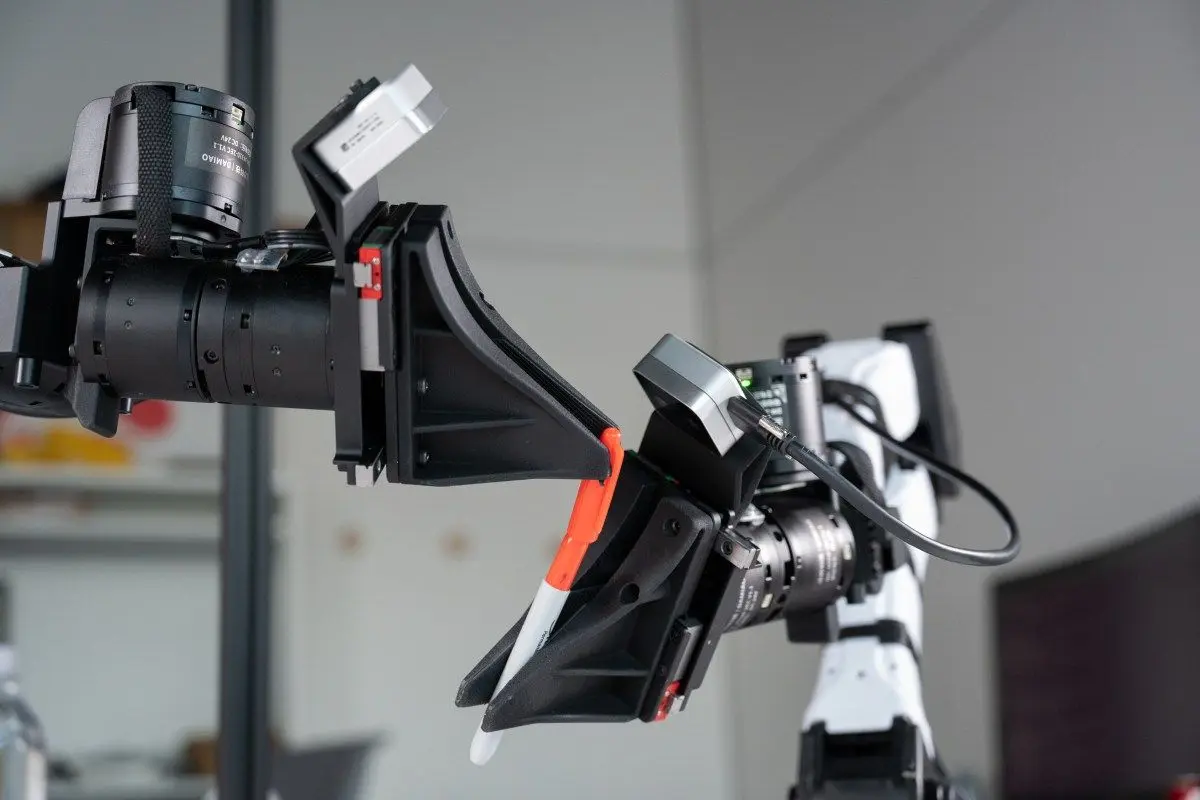
Open-Source Roots Meet Enterprise Scale
True to Kempf's background, the core Kyber project remains open source under a dual license, while the company sells a productized version to enterprise customers who need control remote machines at scale
2
. This approach allows Kyber's user base to span far more organizations than will become paying customers, similar to VLC Media Player's massive adoption. The platform's range—from managing a handful of devices to millions—delivers immediate value: operators no longer need physical access to every device just to push software updates.Observability becomes increasingly critical as scale increases. When AI agent management systems, rather than human operators, oversee entire fleets and networks, knowing systems function correctly matters even more
1
. Kyber's careers page captures the startup's mission: "The companies that tried to solve it spent years and tens of millions building custom solutions they'll never share. We're building the version everyone else can use."With headquarters in Paris and offices in San Francisco and Singapore, Kyber positions itself to serve a global client base across multiple sectors. The same SDK that enables a technician to remotely update a device can also let an AI agent manage an entire drone fleet—a versatility that could define infrastructure requirements as autonomous systems become commonplace.
References
Summarized by

Navi
Related Stories
Former F1 Aerodynamicist Raises $55M to Solve Robot Training Crisis With Human Footage
16 Jul 2026•Startups

Antioch raises $8.5 million to build simulation tools that accelerate physical AI development
17 Apr 2026•Startups

Ray Kurzweil's Beyond Imagination Secures $100 Million for Humanoid Robot Development
20 May 2025•Technology

Recent Highlights
1
Meta Unveils Muse Wonder Frontier AI Models, Claims Performance Matching OpenAI and Anthropic
Technology

2
IMF Report Warns AI Market Correction Could Spark Global Financial Crisis With $1.4T at Risk
Business and Economy

3
OpenAI Releases 722 AI-Generated Math Solutions, Triggering Existential Crisis in Mathematics
Technology

Recent Highlights
Today's Top Stories






Don’t drown in AI news. We cut through the noise - filtering, ranking and summarizing the most important AI news, breakthroughs and research daily. Follow topics that matter to you and stay ahead.


