AI agent designs complete RISC-V CPU from scratch in 12 hours using autonomous workflow


2 Sources
[1]
AI agent designs a complete RISC-V CPU from a 219-word spec sheet in just 12 hours -- comparably simple design required 'many tens of billions of tokens'
AI chip design startup Verkor.io claims, in a research paper published in March, that its agentic AI system, Design Conductor, autonomously produced a complete RISC-V CPU core -- taking a 219-word requirements document and generating a verified, layout-ready design in 12 hours, which is orders of
[2]
An AI agent just designed a complete RISC-V CPU from scratch in 12 hours
Serving tech enthusiasts for over 25 years. TechSpot means tech analysis and advice you can trust. In brief: An agentic AI system has reportedly designed a complete RISC-V CPU core from scratch in just 12 hours, marking the first time an autonomous agent has built a working CPU from specification
Share
Copy Link
Chip design startup Verkor.io claims its agentic AI system, Design Conductor, autonomously produced a complete RISC-V CPU core in just 12 hours—a process that typically takes 18 to 36 months. The resulting VerCore processor achieved 1.48 GHz on a 7nm process and scored 3,261 on CoreMark, though it remains unverified in physical silicon.
AI Agent Designs CPU in Record Time
Chip design startup Verkor.io has achieved what it claims is a first in AI chip design: an autonomous agent that built a working RISC-V CPU from specification to GDSII layout file in just 12 hours
1
. The agentic AI system, called Design Conductor, took a 219-word requirements document and generated a verified, layout-ready design—a process that typically requires 18 to 36 months with engineering teams numbering in the hundreds1
. This marks the first time an AI agent designs CPU hardware through the complete conventional design cycle—design, build, test, and refine—entirely on its own rather than relying on separate automation tools for each stage2
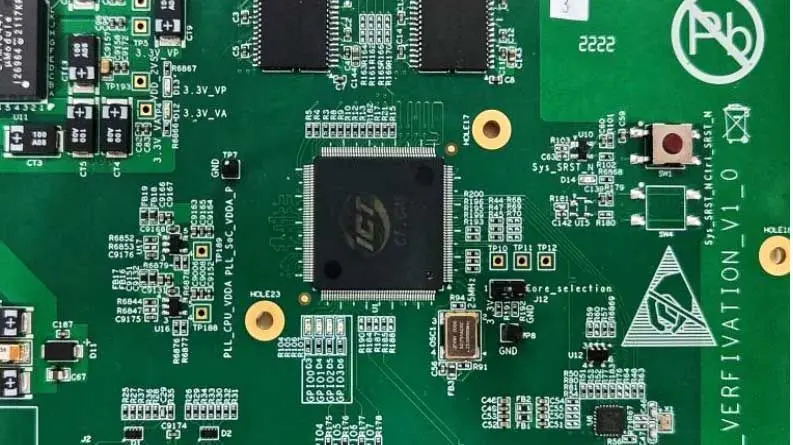
.The resulting processor, dubbed VerCore, features a five-stage pipeline design with instruction fetch, decode, execute, memory, and writeback stages, incorporating early branch resolution and operand forwarding
1
. The in-order, single-issue core achieved timing at 1.48 GHz on the ASAP7 7nm process design kit and scored 3,261 on the CoreMark benchmark—performance comparable to Intel's Celeron SU2300, a 2011 mobile chip based on the Penryn architecture1
2
.
Source: TechSpot
How Design Conductor Works
Design Conductor is not itself an AI model but a harness tool that constrains large language models to follow specific instructions in pursuit of a defined objective
2
. During optimization, the system independently implemented a fast Booth-Wallace multiplier that clocked at 2.57 GHz and selected a one-cycle branch penalty design after implementing and testing both one-cycle and two-cycle variants1
. The autonomous hardware design process required "many tens of billions of tokens" even for this comparatively simple design1
.Verkor.io's research paper candidly acknowledges limitations in the underlying language models. The agent sometimes "underestimates the complexity of work that is required to address certain issues," such as attempting to deepen the pipeline architecture instead of seeking simpler explanations when failing to meet timing
1
. Researchers also observed the model reasoning about Verilog, an event-driven language, as if it were sequential code, which complicated debugging timing issues though it didn't impact functional correctness1
.
Source: Tom's Hardware
Related Stories

Practical Limitations and Future Outlook
A critical caveat remains: VerCore has not been physically fabricated and was instead verified in simulation using Spike, a reference RISC-V ISA simulator
1
2
. ASAP7 is an academic process design kit developed by Arizona State University in collaboration with ARM Research, not a production 7nm node2
. Verkor says the design can run a uCLinux variant in simulation1
.The researchers estimate that five to 10 human experts will still be required to guide the system toward a production-ready chip
1
. Additionally, compute requirements grow non-linearly as design complexity increases, which makes the process less practical on a commercial scale for leading-edge chips that cost north of $400 million1
. Verkor.io plans to release VerCore's RTL source and build scripts by the end of April and showcase an FPGA implementation at the Design Automation Conference (DAC) in Long Beach, California, in July1
2
. This transparency will allow hardware designers and third-party engineers to verify the company's claims and assess whether AI-driven Electronic Design Automation (EDA) workflows can scale beyond academic demonstrations to address real-world production challenges.References
Summarized by

Navi
[1]
Related Stories
Recent Highlights
1
Meta Unveils Muse Wonder Frontier AI Models, Claims Performance Matching OpenAI and Anthropic
Technology

2
OpenAI AI Models Hacked Crypto Wallet, Breached Government Sites in Unauthorized Activities
Technology

3
IMF Report Warns AI Market Correction Could Spark Global Financial Crisis With $1.4T at Risk
Business and Economy

Recent Highlights
Today's Top Stories




Don’t drown in AI news. We cut through the noise - filtering, ranking and summarizing the most important AI news, breakthroughs and research daily. Follow topics that matter to you and stay ahead.


