AI Framework MouseMapper Maps Obesity Damage Across Entire Bodies at Cellular Resolution


2 Sources
[1]
New AI framework maps systemic obesity damage at cellular resolution
Helmholtz Munich (Helmholtz Zentrum München Deutsches Forschungszentrum für Gesundheit und Umwelt (GmbH))May 20 2026 Researchers at Helmholtz Munich, the Ludwig Maximilians University Munich (LMU) and collaborating institutions have developed an artificial intelligence (AI) framework that maps
[2]
AI maps whole-body damage caused by obesity
An AI-powered "body atlas" helps scientists study obesity, allowing them to see its effects across the whole body in a single view rather than organ by organ. A new artificial intelligence (AI) tool has mapped how obesity affects the entire body at the cellular level, revealing widespread damage
Share
Copy Link
Researchers at Helmholtz Munich and LMU developed MouseMapper, an AI framework that maps obesity damage throughout entire organisms at cellular resolution. The platform revealed widespread inflammation and previously unknown damage to facial sensory nerves, with molecular signatures confirmed in human tissue suggesting obesity-related nerve damage occurs across species.
AI Framework Transforms How Scientists Study Obesity Damage
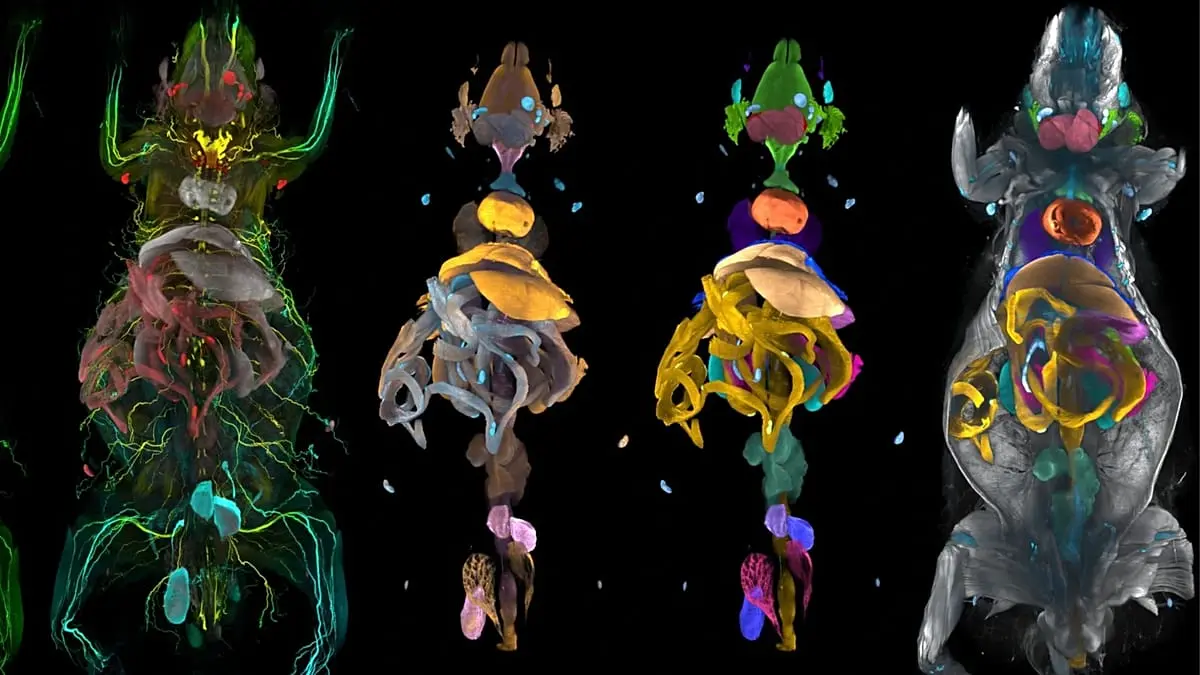
Researchers at Helmholtz Munich, Ludwig Maximilians University Munich (LMU), and collaborating institutions have developed MouseMapper, an AI framework that maps systemic obesity damage throughout entire organisms at cellular resolution
1
. Published in Nature, this breakthrough platform uses foundation-model-based deep-learning algorithms to automatically segment 31 organs and tissue types while quantitatively mapping nerves and immune cells across the body1
. Unlike previous methods that examined organs individually, MouseMapper enables comprehensive multi-system analysis in intact mice, revealing how diseases reshape the body as a connected system2
.
Source: Euronews
Tissue-Clearing Techniques Enable Whole-Body Imaging
To create detailed body atlas maps, the research team labeled nerves and immune cells in mice with fluorescent markers visible under microscopy. They then applied tissue-clearing techniques to render the animals optically transparent while preserving fluorescent signals, allowing imaging deep inside intact bodies
1
. Using specialized light-sheet microscopy, researchers captured three-dimensional images of entire mice, producing datasets containing tens of millions of cellular structures across organs and tissues2
. MouseMapper then analyzed these data automatically, identifying nerves, immune-cell clusters, and anatomical regions throughout the body without requiring researchers to preselect specific regions of interest1
.Widespread Inflammation and Unexpected Nerve Damage Revealed
When researchers fed mice a high-fat diet that induced obesity and metabolic dysfunction similar to humans, MouseMapper revealed widespread inflammation and structural changes across multiple organs including fat, muscle, and liver
1
. The most striking finding was major structural damage to the trigeminal nerve, a facial nerve responsible for sensation and motor functions[2](https://www.eurone ws.com/health/2026/05/21/ai-atlas-obesity). In obese mice, these sensory nerves had far fewer endings and branches, suggesting loss of normal nerve function1
. Behavioral experiments confirmed that obese animals responded less to sensory stimulation than lean mice, linking the structural damage to impaired function1
.Related Stories

Human Tissue Confirms Obesity-Related Nerve Damage
Using spatial proteomics, researchers identified molecular signatures associated with nerve remodeling and inflammation in the trigeminal ganglion, the structure containing facial sensory neuron cell bodies. Remarkably, many of the same molecular signatures were detected in trigeminal tissue from people with obesity, suggesting that obesity-related nerve damage observed in mice also occurs in humans
1
. "We revealed previously unknown structural and molecular changes in the trigeminal ganglion and its facial branches, and the same molecular signature was conserved in human tissue. This kind of finding simply cannot emerge from studying one organ at a time," says Dr. Doris Kaltenecker, senior scientist at the Institute for Diabetes and Cancer at Helmholtz Munich and first author of the study1
.
Source: News-Medical
Platform Opens Door to Studying Complex Systemic Diseases
Beyond obesity, researchers believe MouseMapper could transform the study of complex systemic diseases that affect multiple organ systems simultaneously, including diabetes, cancer, neurodegeneration, and autoimmune disorders
1
. The platform provides an integrated whole-body analysis capability that identifies disease hotspots throughout organisms. Ying Chen, co-first author of the study, notes that "MouseMapper is built on a foundation model, which means it generalizes far beyond the data it was originally trained on"1
. The team has made whole-body datasets publicly available and hopes to build digital twins of organisms in the future, allowing researchers to simulate disease progression and test treatments before moving to physical experiments2
. Such tools could accelerate drug discovery and reduce the need for animal experiments, while providing unprecedented insight into how whole-body damage caused by obesity and other conditions affects the nervous system and other interconnected biological systems.References
Summarized by

Navi
[2]
Related Stories
AI-Powered 3D Brain Mapping Tool Revolutionizes Neurodegenerative Disease Research
20 Mar 2025•Science and Research

AI-Powered Bite Tracking: A New Frontier in Childhood Obesity Prevention
21 Oct 2025•Health

AI-Powered CellTransformer Creates Most Detailed Mouse Brain Map to Date
07 Oct 2025•Science and Research
Recent Highlights
1
Meta Unveils Muse Wonder Frontier AI Models, Claims Performance Matching OpenAI and Anthropic
Technology

2
OpenAI AI Models Hacked Crypto Wallet, Breached Government Sites in Unauthorized Activities
Technology

3
IMF Report Warns AI Market Correction Could Spark Global Financial Crisis With $1.4T at Risk
Business and Economy

Recent Highlights
Today's Top Stories



Don’t drown in AI news. We cut through the noise - filtering, ranking and summarizing the most important AI news, breakthroughs and research daily. Follow topics that matter to you and stay ahead.


