China extends critical mineral reprieve for US buyers days after new American chip curbs


2 Sources
[1]
China extends pause in controls on critical mineral exports to US
Beijing's dominance of supply chains has given it leverage against Washington China is to extend a pause on curbs on some critical mineral exports to the US, an apparent concession to Washington to extend a tenuous trade war truce following last week's summit between Presidents Xi Jinping and
[2]
China Extends Suspension of Critical Mineral Export Curbs On US by 2 Months As Trump-Xi Trade Truce Holds
China will extend the suspension of certain U.S.-specific export restrictions, preserving American access to critical minerals while Washington and Beijing continue efforts to ease trade tensions. China's Ministry of Commerce said on Tuesday that the second clause of its dual-use export controls
Share
Copy Link
China's commerce ministry said on Tuesday that it is extending a suspension of its export controls on critical minerals sold to the United States until January 27, 2027
1
2
. The previous deadline had been due to expire that Friday1
. The extension landed days after Washington imposed new export controls aimed at slowing China's AI development, controls Beijing's foreign ministry had threatened to answer with countermeasures1
.The minerals covered include germanium, gallium and antimony, which China classifies as dual-use, meaning they serve both civilian and military purposes
1
2
. They feed semiconductor and defence supply chains1
2
. One outlet citing the South China Morning Post adds that graphite stays under stricter end-user-based reviews2
.A concession analysts did not expect
The extension was described by the FT as a surprise: analysts had expected escalation after the new American restrictions, yet Beijing did not escalate
1
. Taiwanese and South Korean chipmakers reportedly suspended some shipments to Chinese customers after the new controls1
. Last week, China's foreign ministry warned: "if the US side insists on going its own way, China will take countermeasures to resolutely safeguard its national sovereignty, security and development interests"1
. The commerce ministry gave no reason for the extension1
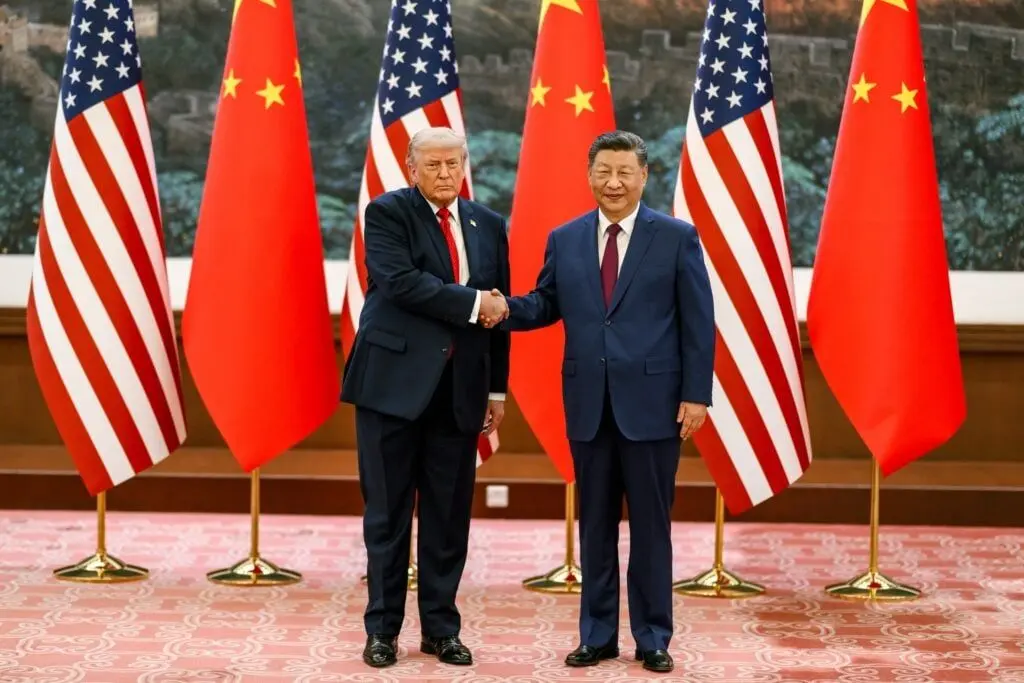
.It followed Friday's summit between Xi Jinping and Donald Trump at an Asia-Pacific leaders' meeting in China, their third meeting of the year
1
2
. There the two agreed to hold their trade truce until January 10, 20271
2
. Another meeting is due at the Group of 20 gathering in Miami in December1
2
.
Source: Benzinga
Why the deadlines matter
China dominates that supply: it produces about 98% of the world's primary gallium and 68% of germanium supply, per figures from the Centre for Strategic and International Studies cited by the South China Morning Post
2
. That dominance, on the same figures, is the bargaining power that made each suspension deadline economically consequential for Washington1
2
. The FT described it as a key source of China's position in last year's tariff standoff that produced the truce1
.China imposed the controls in late 2024, according to the reports, amid semiconductor tensions, and first suspended them in November 2025 under a trade agreement with Washington
1
2
. Before this month's summit, Washington had accused China of falling short on agreed terms, including rare earth exports1
. China's separate rare earth controls, introduced in October 2025 and paused a month later, were extended earlier this month1
. The broader truce, agreed in South Korea last year, expires at the same time1
.Japan gets no such reprieve
Beijing's reprieve does not extend to Japan, as far as the reports say
1
. Japanese officials told the Financial Times that the leader meetings did little to reverse China's halt of key rare earth exports to Japan, and that enforcement had, if anything, tightened1
. They warned that yttrium, used in jet engines, gas turbines, semiconductors and catalytic converters, could run out within months without collective action outside China1
. Tensions with Beijing have simmered for a year over Prime Minister Sanae Takaichi's comments about a possible Taiwan emergency, and it is unclear whether Japan will get a similar suspension1
.Related Stories

The US tries to build its way out
Washington is pursuing its own diversification. On November 17, at a Quad meeting in Manila, Trump announced critical-minerals agreements he claimed would stop any single foreign supplier from coercing others
2
. "We are making rare earth at a level that we've never made before. We're going to catch them [China] within 10 months," he said2
. The 10-month timeline is his own claim2
.The rare earth pause and the wider truce both expire on January 10; the mineral suspension runs seventeen days beyond that.
References
Summarized by

Navi
Related Stories
Trump Extends China Tariff Deadline, Eases AI Chip Export Restrictions Amid Ongoing Trade Talks
12 Aug 2025•Business and Economy
Trump Administration Pauses Tech Export Controls to China, Sparking AI Security Concerns
28 Jul 2025•Policy and Regulation
Trump heads into Xi talks still short of the minerals he needs
15 Nov 2026•Business and Economy
Recent Highlights
1
Anthropic mathematician says Claude helped him prove math's most famous problem
Science and Research

2
Two states sue SpaceX, saying weak Grok safeguards were no accident
Policy and Regulation

3
Jensen Huang is back at Nvidia 11 days after quitting, and the scrutiny came back with him
Business and Economy
Recent Highlights
Today's Top Stories











Don’t drown in AI news. We cut through the noise - filtering, ranking and summarizing the most important AI news, breakthroughs and research daily. Follow topics that matter to you and stay ahead.


