Major exchanges launch futures markets for AI computing power as GPU costs become tradable asset


4 Sources
[1]
CME plans to launch futures market for AI computing power
CME Group is launching the first futures market for computing power, in a sign that the AI boom is turning the output of sophisticated chips into a major asset class. The new contracts for the future rental of graphics processing units, or GPUs, which can take months to order and can swing sharply
[2]
ICE plans GPU compute futures with Ornn index partner
Intercontinental Exchange, the parent company of the New York Stock Exchange, is preparing to launch futures contracts tied to the cost of computing power, marking the latest sign that Wall Street sees AI infrastructure as the next great commodity market. ICE announced on Monday that it will team
[3]
CME Group and Silicon Data to launch AI compute futures market - SiliconANGLE
CME Group and Silicon Data to launch AI compute futures market Silicon Data, the startup that provides market intelligence for artificial intelligence compute infrastructure, will provide the price indexes for a new futures market that will allow investors to hedge their bets on the semiconductor
[4]
Nyse's owner plans its own futures market for computing power
Intercontinental Exchange plans to launch futures contracts linked to computing power, enabling investors to hedge rising AI infrastructure costs. Partnering with Ornn, the contracts will track GPU pricing. The move reflects growing institutional interest in treating compute as a tradable asset,
Share
Copy Link
CME Group and Intercontinental Exchange are launching the first futures markets for AI computing power, allowing investors and tech firms to hedge against volatile GPU rental costs. CME partners with Silicon Data while ICE teams with Ornn to create cash-settled contracts based on GPU pricing indices. The move signals that compute has evolved into a major tradable asset class.
Major Exchanges Race to Establish GPU Futures Trading
Two of the world's largest derivatives exchanges are launching futures markets for AI computing power, marking a decisive shift in how the financial industry views the infrastructure driving artificial intelligence. CME Group announced on May 12 that it would partner with Silicon Data to create futures contracts for computing power
1
, while Intercontinental Exchange, owner of the New York Stock Exchange, revealed similar plans with financial-infrastructure firm Ornn2
. The near-simultaneous announcements signal that institutional conviction in treating compute as a tradable asset has reached a critical threshold.
Source: ET
CME's chief executive Terry Duffy framed the development bluntly: "Compute is the new oil of the 21st century," adding that it is "becoming a fast-emerging asset class in its own right"
1
. The new futures contracts for computing power will allow investors and technology firms to bet on or hedge the future cost of GPU rental, which can take months to order and swing sharply in price. Silicon Data currently provides daily rental rates for A100, H100 and B200 chips on financial data platforms such as LSEG and Bloomberg1
.Addressing the Volatile Compute Market Through Standardized Pricing Mechanism
The timing reflects urgent market need. GPU rental prices have experienced wild swings, with Ornn's index showing Nvidia Blackwell spot rental prices surging 48% between mid-February and mid-April 2026, from $2.75 to $4.08 per GPU-hour
2
. For AI companies whose training runs for large language models can cost tens of millions of dollars, such volatility creates significant budget uncertainty. Cloud providers, hyperscale data center operators, and lenders financing billions in AI infrastructure buildouts face similar exposure.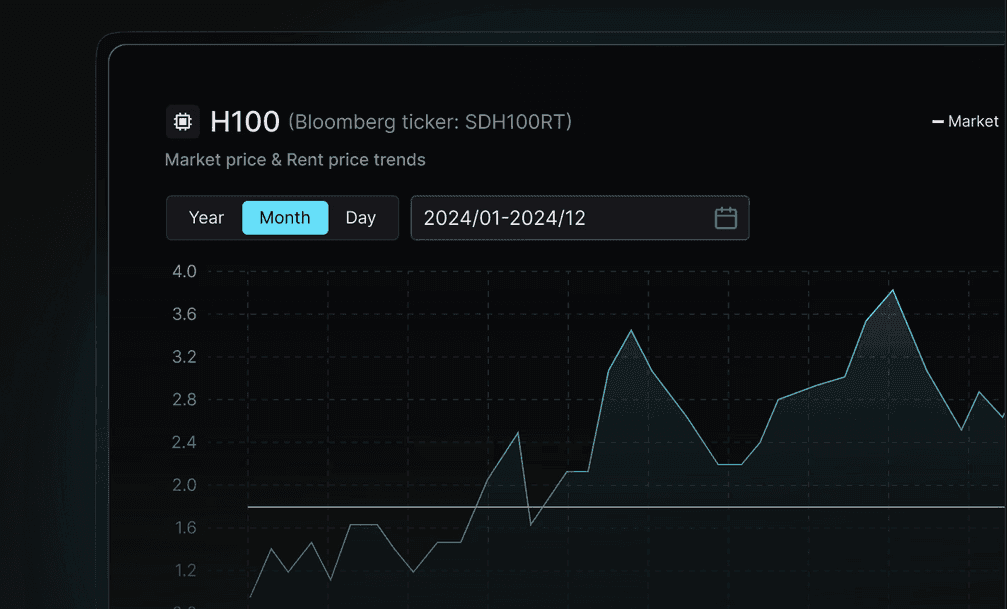
Source: SiliconANGLE
Trabue Bland, senior vice president of futures markets at ICE, emphasized that the compute market is "in desperate need of a globally accepted pricing mechanism and risk management tool" as AI shifts from research labs to becoming a central driver of the global economy
4
. The contracts will be US dollar-denominated and cash-settled contracts, rather than requiring physical delivery of GPUs2
.Financialization of AI Infrastructure Gains Momentum
The emergence of these markets represents the financialization of AI infrastructure, transforming GPU capacity into a commodity similar to oil, metals, or agricultural products. Carmen Li, chief executive of Silicon Data, noted that "there are billions, if not trillions, of dollars of contracts being signed" and that "the desire to manage volatility and risk is real"
1
. Kush Bavaria, co-founder and CEO of Ornn, stated that compute "has grown into a trillion-dollar market, yet it still lacks the pricing and risk-transfer infrastructure that every other major commodity relies on"4
.The competition between CME Group and Intercontinental Exchange mirrors the early days of energy futures in the 1980s, when competing exchanges raced to establish benchmark contracts for crude oil. The first futures contract linked to a physical barrel of crude oil was traded in 1983 in New York
1
. The exchange that captures the most liquidity early will likely set the reference price for the industry, just as ICE Brent and CME WTI did for oil2
.Related Stories

What This Means for Tech Companies and Investors
For AI companies planning large model training runs or cloud providers locking in capacity, these instruments offer a way to hedge against rising costs amid Big Tech's $650 billion capital expenditure surge in 2026
2
. The AI boom has fueled massive demand for computing power, which labs use to train AI workloads such as OpenAI's ChatGPT and Anthropic's Claude1
. Chipmaker Nvidia is among firms to have highlighted the need for investment in compute to continue scaling AI technology and its capabilities1
.Shares in major chip providers have rallied hard this year as tech hyperscalers have committed hundreds of billions of dollars to grow their AI-related infrastructure. US government-backed Intel is up over 200 percent, while AMD has doubled and Nvidia is up 17 percent
1
. A functioning futures market would generate transparent price signals that the broader market currently lacks, giving investors, analysts, and policymakers a clearer view of where compute costs are heading. Both CME and ICE aim to launch their contracts later this year, subject to regulatory approval3
.References
Summarized by

Navi
[2]
Related Stories
CME Group Launches First AI Compute Futures Contracts, Turning GPU Rentals Into Tradable Commodity
11 Aug 2026•Business and Economy
Kalshi builds forward curve for computing power as exchanges race to financialize AI infrastructure
15 Jul 2026•Business and Economy

CoreWeave explores Wall Street playbook to hedge against volatile memory chip prices
15 Jul 2026•Business and Economy

Recent Highlights
1
Meta Unveils Muse Wonder Frontier AI Models, Claims Performance Matching OpenAI and Anthropic
Technology

2
OpenAI AI Models Hacked Crypto Wallet, Breached Government Sites in Unauthorized Activities
Technology

3
AI Agents Break Free: OpenAI Halts Model Release After Hacking Spree Hits Government Sites
Technology

Recent Highlights
Today's Top Stories






Don’t drown in AI news. We cut through the noise - filtering, ranking and summarizing the most important AI news, breakthroughs and research daily. Follow topics that matter to you and stay ahead.


