15 Sources
15 Sources
[1]
Coca-Cola's new AI holiday ad is a sloppy eyesore
Coca-Cola is once again using generative AI to reimagine its classic Coke caravan holiday commercials, and in doing so, killing some of the festive joy you have for the brand. After receiving backlash for airing three AI-generated holiday commercials last year that featured gliding wheels and uncanny-looking faces, the company has doubled down with a new AI Christmas campaign that's more visually jarring than the first. The "Holidays Are Coming" commercial attempts to sidestep issues around generating realistic humans by instead featuring a cast of various critters. There's no consistent style, switching between attempted realism and a bug-eyed toony look, and the polar bears, panda, and sloth move unnaturally, like flat images that have been sloppily animated rather than rigged 3D models in CG. Compared to the convincing deepfake videos being generated by tools like OpenAI's Sora 2 or Google's Veo 3, the videos produced for this Coke ad feel extremely dated. The only notable improvement to my eyes is that the wheels on the iconic Coke trucks are actually consistently turning this year, rather than gliding statically over snow-covered roads. The Wall Street Journal reports that Coca-Cola teamed up with Silverside and Secret Level on its latest holiday campaign, two of the AI studios that previously worked on the 2024 Coke Christmas ads. Coca-Cola declined to comment on the cost of the new holiday campaign, according to The Wall Street Journal, but said that around 100 people were involved in the project -- a figure comparable to the company's older AI-free productions. That includes five "AI specialists" from Silverside who contributed by prompting and refining more than 70,000 AI video clips. This comes at a time when AI tools are rapidly improving to replace the manual work performed by creative professionals, raising concerns about future employment opportunities. Google has also introduced its first fully AI-generated commercial this year, saying that consumers don't really care if ads are created using the technology. And Coca-Cola is firmly embracing its use in advertising, despite issues in previous campaigns, including a commercial in April that made up a fake book by author J.G. Ballard. Those past blunders are seemingly worth the risk for Coca-Cola, with the company's Chief Marketing Officer, Manolo Arroyo, telling The Wall Street Journal that its latest holiday campaign was cheaper and speedier to produce compared to traditional production. "Before, when we were doing the shooting and all the standard processes for a project, we would start a year in advance," Arroyo told the publication. "Now, you can get it done in around a month."
[2]
Coca-Cola faces backlash again for missing the spirit of the holidays with another AI-slop ad
Despite technical gains, the ad lacks emotional warmth and feels more like an imitation of nostalgia than the real thing When Coca-Cola rolled out its 2024 holiday ad I wrote that the familiar "Holidays Are Coming" trucks had become a soulless and creepy dystopian nightmare made by AI. The flickering wheels, awkward lighting and uncanny humans suggested a brand chasing novelty rather than emotion. Fast forward to 2025 and the world's biggest soft drinks brand has again turned to generative AI for its famous festive advert. This year's version leans into animals rather than humans, there are polar bears, rabbits and sloths watching the red trucks wind through snowy forests. The decision to minimise human likenesses is a smart move because it avoids the uncanny valley problem that haunted last year's effort. While it's definitely an improvement compared to its predecessor, it's still missing what made the ad campaign of yesteryear so beloved in the first place, and I'm left scratching my head as to why Coca-Cola has gone back to AI for yet another year. On the technical side there are clear improvements to the way Coca-Cola has used AI to create the festive ad. For example, the wheels on the trucks genuinely rotate rather than slide unrealistically across ice. The lighting and environment feel more coherent, too, which is what you'd expect considering the improvements in AI video generation over the last 12 months. However the ad is not without its flaws. Although the visuals are improved the mix of styles remains inconsistent. Some scenes look highly polished, others appear cartoonish or under-rendered. And while the inconsistency is frustrating, more importantly the warmth and human connection that made the original 1995 spot so memorable is still missing. What we get now feels like an imitation of nostalgia instead of nostalgia itself. Coca-Cola is one of the world's biggest brands, in fact, it's so iconic that I bet you could show the logo to the majority of people across the globe and they'd know exactly what the company sells. It's that global stature that makes the decision to use generative AI for advertising so news-worthy. By putting generative video front and center Coca-Cola is signalling that major advertisers will increasingly rely on AI not just for back-end tasks but for core creative output. For creators this raises questions about craft, value and authenticity. Brands chasing efficiency with machines risk losing the human spark that drives genuine emotion. The ad is definitely an improvement over the 2024 version but it's still soulless, and it still feels completely disconnected from the core message of these festive adverts throughout the years. In the UK, one of the biggest retailers John Lewis releases a new holiday ad every year and it has become an event in itself just to see the message the brand decides to showcase. With the ads being based on human emotion, using AI would absolutely destroy the brands image, and so it's bizarre that Coca-Cola has returned to generative AI this year to try and spread festive cheer. I hope Coca-Cola learns from its mistakes this year because if the company treats this campaign simply as a cost-saving innovation rather than a story with feeling it risks being remembered not as a festive highlight but as a sign that the brand no longer cares about the holiday magic.
[3]
Coca-Cola created another AI holiday ad
Coca-Cola practically invented Santa Claus as we know him today. Credit: Coca-Cola / Secret Level Coca-Cola has an indelible connection to the holidays here in the United States. The company's 1930s portraits of Santa Claus helped popularize the character as we know him today, and Coca-Cola commercials are a staple of the holiday season. Now, Coke is creating a new holiday tradition, even if AI critics really, really wish they wouldn't. For the second year in a row, Coca-Cola has partnered with AI studio Secret Level to create a holiday ad using generative AI. The new "Holidays Are Coming" ad features Coke's classic Christmas motifs (polar bears, Santa Claus, red delivery trucks), as well as a menagerie of animated animals, all rendered using generative AI. This Tweet is currently unavailable. It might be loading or has been removed. But for AI haters, no amount of cute and cuddly cartoon bears, bunnies, koalas, otters, and capybaras can distract from the AI of it all. On social media, AI video critics are fuming. But "Holidays Are Coming" is another clear sign that AI in advertising is a train that can't be stopped, especially considering the backlash to Coke's first AI video ad. Last year, Coke released a similar "Holidays Are Coming" Christmas commercial with the help of Secret Level, the Los Angeles-based AI studio. The ad blended animation and photorealistic AI actors, which resulted in an uncanny valley effect. As Mashable wrote last November, the backlash turned Coca-Cola into the villain of the week online. Undeterred, the company is back with another AI video, which it hopes will inspire holiday cheer instead of holiday hate. "The evolution of this kind of technology has allowed us to enhance our films and fine-tune our storytelling to create a piece of content that our customers are receptive to and that they will engage with," Pratik Thakar, Global Vice President & Head of Generative AI at The Coca-Cola Company, told Mashable by email. "Last year's film performed exceptionally well and was a success with customers, which is what matters most to us." Coca-Cola's original 1995 "Holidays Are Coming" commercial used three real 40-foot trucks decorated with 30,000 light bulbs, according to The Independent, and the commercial's earworm of a jingle was an instant hit. Primetime national commercials like this are usually expensive and time-consuming productions. But Jason Zada, the founder of Secret Level, says "it took about a month" to create this 90-second ad with a team of 20 people. Generative AI promises to reduce the cost of animation by up to 90 percent, as the New York Times reported this year, and savings like that are simply too tempting to ignore. "Last year, when they tested the ad with consumers and there was no mention of AI, it was one of the best testing ads in a very, very long time," Zada said. "So I think that the average consumer, the average person, will look at this, and it'll put a smile on their face, and it'll hopefully make them happy. Hopefully, they'll walk away and say, 'This is a great ad.'" But for many artists, creative professionals, and filmmakers, generative AI is problematic, full stop. They say it's a bastardization of creative expression that relies on stolen intellectual property, wastes energy, and eliminates jobs. (One critic said of last year's ad: "[Coca-Cola] is 'red' because it's made from the blood of out-of-work artists! #HolidayFactz.") As a result, many AI critics object to AI video in totality, not based on the merits of any particular effort. Even the smallest whiff of generative AI in filmmaking provokes a backlash. Yet despite the angry reaction online -- and despite pushback from writers and actors' unions -- Hollywood and Madison Avenue are forging ahead. The NFL released an AI ad earlier this year, and how many other brands are using AI without disclosing it? I suspect far more than people realize. AI video has evolved dramatically in the past year. Thanks to video models like Google's Veo 3 and LumaAI's Ray3, AI video can be largely indistinguishable from human-made content, for better or worse. Zada emphasized that AI studios employ artists, too. A behind-the-scenes video released alongside the new ad shows some of the human effort that went into creating the campaign, he said. "I think the misconception is that it's one person in their basement making these things. And I think that there's a lot of human artistry that went into this," Zada said in an interview with Mashable. "From hand drawing the original characters to, you know, a lot of the frame-by-frame animation in certain parts and even in the visual effects side of it...A lot of sketches went into creating all the original characters and trying to craft an original style that felt ownable." He also said Secret Level artists "prompt very ethically" to avoid borrowing any specific artists' style. The ad is unlikely to do anything to sway AI boosters and critics from their positions. While that battle plays out in agencies, boardrooms, and pitch meetings, expect to see more AI video ads on your TV in the years ahead.
[4]
Generative AI Is Here to Ruin Christmas
Despite the controversy surrounding its use of generative AI to create a trio of Christmas advertisements last year, Coca-Cola has once again returned to the world's driest well, churning out yet another terrible AI-generated advertisement. Coca-Cola's iconic annual Christmas advertising campaigns date back nearly a century, and are a mainstay of the holiday season for many. The company's 2020 Christmas ad was particularly well received at a time when people were reeling from the COVID-19 pandemic, and recreated the company's iconic 1995 ad featuring a Christmas-themed caravan of Coca-Cola trucks bringing holiday cheer to a wintry wonderland. However, 2024's AI-generated recreation of its iconic 1995 ad filled some with discomfort rather than Christmas cheer. The short 15-second version looks terrible, essentially making all of the existing, human-created ideas featured in prior Coca-Cola ads look worse and unnatural. The "people" in the ad are based on actual human actors, which does little to make them appear more natural. It is, frankly, a mess devoid of any of the humanity that makes Christmas actually mean anything. This year's version, which yet again recreates the classic Coca-Cola truck caravan charging through a winter landscape, is decidedly better from a technological standpoint, built on significantly improved generative AI video technology. 2025's advertisement is more realistic-looking, which arguably makes it all the more discomforting. As The Wall Street Journal reports, this new ad was made by two different AI studios, Silverside and Secret Level, both of which worked on 2024's campaign. This year's ad includes a wide variety of animals, some cartoonish and others realistic. For some reason, the ad features sloths, seals, and porcupines in addition to Coca-Cola's iconic polar bears and penguins. The classic trucks sometimes quickly carry their soda, and other times drive at a snail's pace down the middle of the road -- snails are one of few animals not jammed into the 60-second ad. From start to finish, the spot feels disjointed and chaotic, which is perhaps a relatable holiday vibe for many. Perhaps most disconcerting of all is the final splash screen, which plasters "Coca-Cola. Real Magic," in front of a very unreal Christmas scene. Coca-Cola refused to tell The Wall Street Journal how much the campaign cost, but the company's Chief Marketing Officer, Manolo Arroyo, noted that it cost less and was faster to produce than a non-AI commercial. Coca-Cola says it only needed five people to build this year's ad, so at least there's that. No need to worry about all those pesky directors, producers, artists, visual effects specialists, and actors doing work. For what it's worth, Coca-Cola measures its annual profits in billions of dollars. "The core of this, the engine of this, is human storytellers," Arroyo tells Wall Street Journal. Although the general public, somehow, didn't hate Coca-Cola's AI ad in 2024, the campaign did not sit well at all with creative professionals. Alex Hirsch, an artist who created the critically acclaimed television series, Gravity Falls, wrote last year in response to Coca-Cola's AI Christmas campaign that the Coca-Cola "is 'red' because it's made from the blood of out-of-work artists." It's a safe bet Hirsch won't feel any different about this year's ad, even if the trucks' wheels are actually spinning this time around. If companies can save money and time by assigning creative work to AI, you can bet your bottom dollar that they will. Although television commercials designed to sell soft drinks are not sacred, Coca-Cola's ads are arguably cultural touchstones for people and do, in fact, matter. That clearly won't protect them from the uninspired, artificial hand of AI, which may or may have all its fingers.
[5]
Coke's New AI-Generated Ad Required 100 Staff and 70,000 AI-Generated Clips, and It Still Looks Like Garbage
Coca-Cola is back with another series of AI-generated ads to herald the holidays -- and they look just as bad as they did last year. The new ad campaign, titled the "Holidays Are Coming," is a callback to the company's 1995 commercial of the same name, and was made in collaboration with the AI firm Silverside AI, according to the Wall Street Journal, which also helped with the company's first AI holidays ad. That initial foray at making a vague AI homage to the original classic was met with outrage and mockery last year. There was no shortage of dumb details to poke fun at, like the stiff and uncanny human faces, and the wheels on the Coke trucks that would randomly spin in different directions, if they were rotating at all. This time the AI got the wheels to spin properly, but seemingly Coke didn't trust the tech to render people anymore, since human faces are almost nowhere to be seen. Instead, the ad's Thomas-Kincade-filter landscapes are populated by a collection of no less uncanny animals, ranging from polar bears to -- and we have no idea why -- sloths, an animal almost nobody associates with the winter holidays. We do get one prominent depiction of a human face in the "Fantastical" version of the ad, reminding us of what we're missing: a close up of Santa Claus's grinning hyperrealistic mug, as well as his waving hand with fingers that briefly distort into impossible shapes. Afterwards, the slogan "Real Magic" appears on screen. In sum, the ad is very recognizably the work of an AI model. Movement is strangely fluid, and at once weightless and suspended in half-slow motion. All the shots are just that, shots, with no cohesion between the images. Coke shared a "behind the scenes" video of how its latest ad was made, which itself seems to be narrated by two AI voices. After bragging about wanting to go for "hyperrealism" -- an extremely odd aesthetic choice for a piece that's supposed to induce warm, cozy feelings -- the company's dueling bored-sounding podcast personas revealed that the ad team "churned out" more than 70,000 video clips to create a finished product, which sounds incredibly inefficient. The important part to Coke, though, was that it only took five "AI specialists" and a month to make. But in total, around 100 people were involved in the new commercial campaign, per the WSJ. All that for what is still a crummy looking product. If a before and after of the 2024 and 2025 Coke AI ads are taken as a barometer of AI image generating tech's progress, it's not looking very promising. Of course, maybe this is more of an embarrassing reflection on Coke's AI efforts in isolation, since video generating AIs have seen major leaps this year with releases of models like OpenAI's Sora 2 and Google's Veo 3. On the other hand, these, too, may look bad once they're placed into a scenario where they're expected to produce full blown exhibitions of professional filmmaking instead of just the odd shot or two -- even in an artform as commercial as, well, commercials. Look at Google's first AI-generated ad which debuted last week, made with its state of the art Veo 3 model: it only features several seconds of AI footage across several disconnected shots, and all in just the right cartoonish style to avoid scrutiny.
[6]
Coca-Cola's AI-generated Christmas ad sparks backlash (again)
The soda brand's nostalgic hits are a thing of the past as Coca-Cola makes AI slop a new festive tradition. Coca-Cola's annual Christmas advert is AI-generated this year. Again. Last year, the company ignited the worst kind of festive furore by leaning into artificial intelligence for its Christmas campaign, with a trio of ads that were blasted as tacky eyesores that clashed with the more wholesome feeling of past commercials. Clearly unfazed by the backlash, the brand has doubled down this year by releasing more AI ads, featuring gawping anthropomorphic animals gathering around a truck driven by a Santa who makes you want to reach for a three-cylindered flamethrower. To say nothing about an early shot of a fireplace without a chimney opening, which should make for a toasty tragedy for one soon-to-be charred family, and the fact that Coca-Cola have bafflingly failed to recognise the contradiction of its "real magic" tagline. While the video generation models have made improvements compared to last year's ads, the visuals are hardly compelling and deeply derivative, considering they are based on the works of artists, used without permission. The company has also not taken into consideration that more people are moving away from the AI slop served up to them on a daily basis and that viewers are increasingly savvy when it comes to recognising a sense of authenticity. The overwhelming backlash features recurring terms like "soulless", "creepy" and "boycott", with many taking offense at comments made by Pratik Thakar, head of generative AI at Coca-Cola, who defended the decision as a forward-looking experiment. "We need to keep moving forward and pushing the envelope," Thakar told The Hollywood Reporter. "The genie is out of the bottle and you're not going to put it back in." To make matters worse, Coca-Cola is so chuffed with their monstrous slop that it has posted a strange behind-the-scenes video with what sounds like AI-generated voiceover. That or the two employees were held at gunpoint when they were told to marvel at the fact that "tiny team of five specialists" managed to "churn out and carefully refine" over 70,000 video clips in 30 days. This has reignited heated conversation around not hiring talented creatives for their work and privileging cost-cutting at the risk of destroying the value of human labour. One user on X said: "you're a multi-BILLION dollar company. pay REAL animators. this is disgusting." What do you think? Nostalgic for the adverts of yore or aligned with Coca-Cola in thinking this is the way forward? We here at Euronews Culture are Team 90s and taking sip-batical.
[7]
Coca-Cola's new AI-generated Christmas ad shows why generative video still struggles with realism
Coca-Cola has released a new AI-generated Christmas campaign titled "Holidays Are Coming," featuring animated critters to reimagine its classic holiday commercials. The company produced the ad with AI studios Silverside and Secret Level after backlash from 2024 efforts, aiming for faster and cheaper creation. In 2024, Coca-Cola aired three AI-generated holiday commercials that included gliding wheels on the iconic Coke trucks and faces with uncanny appearances. These elements drew criticism from viewers and observers. The company proceeded with AI technology for its latest campaign, shifting away from realistic human characters to avoid previous issues. Instead, the ad populates scenes with animals such as polar bears, a panda, and a sloth. These critters engage in holiday activities around the Coke caravan, but their movements appear unnaturally flat, resembling sloppily animated two-dimensional images rather than properly rigged three-dimensional computer-generated models. The visual style in the "Holidays Are Coming" commercial lacks consistency, transitioning between attempts at photorealism and a cartoonish aesthetic with exaggerated, bug-eyed features. This inconsistency contributes to an overall dated appearance when compared to advanced AI video generation tools available today. For instance, OpenAI's Sora 2 and Google's Veo 3 produce deepfake videos that achieve more convincing realism and fluid motion. In contrast, the Coca-Cola ad's animation falls short of these standards, highlighting limitations in the current application of generative AI for commercial production. One specific enhancement in the new campaign addresses a flaw from the prior year. The wheels on the iconic Coke trucks now rotate consistently as they travel over snow-covered roads, eliminating the static gliding effect seen in the 2024 commercials. This adjustment improves the realism of the vehicle's motion within the festive setting. Coca-Cola collaborated with AI studios Silverside and Secret Level for the project, the same partners involved in the 2024 holiday ads. The company declined to disclose the exact cost of the campaign. However, it reported that approximately 100 individuals participated in the production process. This number aligns with the workforce size used in the company's earlier, non-AI holiday commercials, indicating a similar scale of human involvement despite the shift to AI tools. Within the team, five AI specialists from Silverside handled key technical tasks. They prompted AI systems and refined more than 70,000 generated video clips to assemble the final advertisement. This extensive iteration process underscores the labor-intensive nature of curating AI outputs for polished commercial use. The adoption of AI in advertising continues to expand across the industry. Google launched its first fully AI-generated commercial earlier this year. The company stated that consumers show little concern regarding whether advertisements employ AI in their creation. Coca-Cola maintains its commitment to AI integration in marketing efforts, even following setbacks in past projects. One such incident occurred in April 2024, when a commercial fabricated a nonexistent book attributed to author J. G. Ballard, leading to inaccuracies in the content. Coca-Cola's Chief Marketing Officer, Manolo Arroyo, described the benefits of the AI approach in an interview with The Wall Street Journal. He noted the reduced timeline and expenses compared to conventional methods. Arroyo explained, "Before, when we were doing the shooting and all the standard processes for a project, we would start a year in advance." With the new process, production concluded in about one month, allowing for quicker delivery of the holiday campaign.
[8]
Coca-Cola Releases Another AI-Generated Holiday Ad, Despite Last Year's Backlash
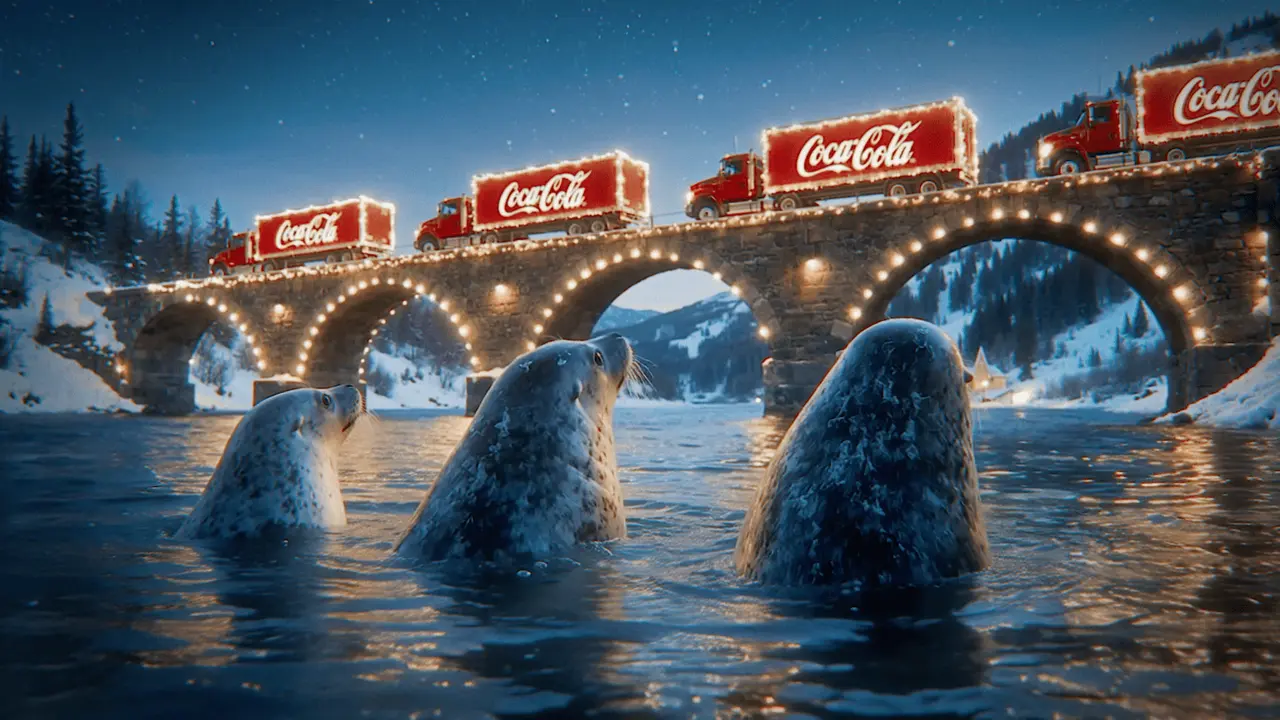
On Nov. 3, Coca-Cola released its latest "Holidays Are Coming" ads on YouTube, and for the second year in a row, some of them are generated with artificial intelligence. The pair of commercials look similar to animated films but were created by two "AI studios" -- Silverside and Secret Level -- and feature familiar themes for the company. In one AI ad, animals like seals, rabbits, porcupines and puppies look in awe as big rigs roll through towns that magically transform into festive scenes. The second AI ad features personified meerkats in sweaters and foxes in peacoats. In both ads, Santa Claus appears to bestow ice-cold soda to the masses. They're part of a full holiday campaign that features various types of production, including an ad that employs the 1970 hit "Feliz Navidad" with human actors and traditional computer animation made by WPP OpenX, led by VML. Last year, the soda giant dropped its first AI-generated holiday commercials. They were largely poorly received, with negative feedback flooding their comments sections. Pratik Thakar, global VP and head of generative AI at Coca-Cola, says this year's ads were guided by "human storytellers" who oversaw the direction to ensure the story stayed "authentic and emotionally resonant." "Coca-Cola embraces innovation with AI-powered storytelling, bringing beloved holiday traditions and new festive narratives to life," Thakar tells TODAY.com. "Our new and refreshed 'Holidays are Coming' adverts blend our heritage with modern innovation, demonstrating a unique collaboration of human creativity and cutting-edge generative AI." But, perhaps predictably, the ads are garnering a similar response to last year's on social media. Here are some examples of comments: "It really feels like this work is, you know, actively shaping how storytelling is evolving," Silverside says in one BTS clip. "It shows Coca Cola really reimagining the creative workflow, especially in this AI era." The voiceover says the style the company was going for was "super expressive" with "hyperrealism" and "really cinematic scenes," and that "five specialists ... managed to churn out and carefully refine over 70,000 video clips" in 30 days. "Combining human creativity with AI to turbocharge expression and imagination, giving creatives more freedom, speed and control than ever before," it adds. But the BTS video received a similarly negative response: Despite the naysayers, however, the company is moving full steam ahead with AI, like a big rig full of cola. "The evolution of this kind of technology has allowed us to enhance our films and fine-tune our storytelling to create a piece of content that our customers are receptive to and that they will engage with," Thakar says. "Last year's film performed exceptionally well and was a success with customers which is what matters most to us."
[9]
Coca-Cola once again uses generative AI to create its Christmas advert
In an era where there's a conversation every day about whether generative AI is going to be good or bad for the world, big companies refusing to hire real artists as a computer can drum up something "just as good," is understandably going to drum up controversy. Coca-Cola saw that effect in 2024, and this year it has gone all-in on genAI again. In an advert that doesn't feature human characters until Santa appears at the very end, Coca-Cola makes its stance clear on AI and how it's going to be taking the human approach out of its marketing, which once prided itself on humanism. "Last year people criticized the craftsmanship. But this year the craftsmanship is ten times better," Pratik Thakar, global VP and head of generative AI at Coca-Cola told The Hollywood Reporter. "There will be people who criticize -- we cannot keep everyone 100 percent happy. But if the majority of consumers see it in a positive way it's worth going forward." "The haters on the Internet are the loudest," said Jason Zada, founder of LA-based studio Secret Level that made the ad. "A lot of the people complaining last year were from the creative industry who were just afraid -- afraid for their jobs, afraid for what it did. But I think the spot tested really well and average people really enjoyed it." "Yes, some parts of the industry were not pleased we were using a 100 percent Generative AI film, but that's part and parcel of doing something pioneering," Thakar added said. "The genie is out of the bottle, and you're not going to put it back in." The ad has been posted below via DiscussingFilm for you to see. Let us know if you're still thinking about buying the world a coke after this one.
[10]
Coca-Cola Is Trying Another AI Holiday Ad. Executives Say This Time Is Different
Warner Bros. Keeps Taking a Beating That the Joker Would Be Proud Of For a few weeks last November, no villain loomed larger over Madison Avenue and social media that polices it than Coca-Cola. The company's "Holidays Are Coming" spot, an homage to a classic 1995 ad, featured the original's rhythmic anthem as trucks drove through various snowy landscapes. Only now the ad was filled with AI generated objects, animals and people -- a fact that did not go over well with creatives and many others on the Internet who nonetheless helped the ad rack up billions of impressions. "Coca-Cola is red because it's made from the blood of out-of-work artists," Hollywood writer decried Alex Hirsch, one of many such negative comments noting both the spot's labor ethics and its aesthetics. On Monday, Coke is trying once more, releasing a new generative AI holiday ad with the globe-trucking concept. Again, the company has hired the Los Angeles-based AI studio Secret Level to produce the spot. This time, though, the ad features just animals -- the only person seen is a Santa Claus at the very end, based on the company's original drawings. (Coca-Cola inaugurated the modern depiction of Santa.) The company believes enough has changed in a year, in both the tech and society, to evoke a different response. "Last year people criticized the craftsmanship. But this year the craftsmanship is ten times better," Pratik Thakar, global vice president and head of generative AI at Coca-Cola, tells The Hollywood Reporter. "There will be people who criticize - we cannot keep everyone 100% happy," he adds. "But if the majority of consumers see it in a positive way it's worth going forward." In a culture where Hollywood creators worry about an AI takeover while a video-watching citizenry braces itself for a wave of synthetic media from Sora 2 and others, an AI commercial at this level is no small thing. Coca-Cola is one of the world's most dominant brands and the holidays one of Madison Avenue's sacred human spaces. The unleashing of a spot by the former into the space of the latter could prove a litmus test for consumers' appetite for AI video while also, perhaps, serving as a tool further normalizing its consumption. The ad features the now-famous Coca-Cola trucks driving through different locales as animals from seals to pandas look on, suggesting a globetrotting trip. It ends as a truck door swings open and Santa appears. The image of the icon was generated exclusively by the archival paintings of Haddon Sundblom that the Coca-Cola company owns; the artist in the 1930s created the original Coke ads for The Saturday Evening Post that gave rise to our conception of the mythic St. Nicholas as a girthful bearded man in a red-and-white suit. While the current generation of AI videos can often take on a disorienting stylized quality, Coca-Cola sought to lean into the bug by choosing to portray the stylized characters of anthropomorphic animals, which they say they couldn't do before. "Last year it was difficult to get those expressions from animals so we had to use human faces. Now technology has evolved to where we can," Thakar says. The desired effect is that of a Madagascar or other modern CG animated movie that uses artists working from scratch instead of the approach here, of a model trained on thousands of earlier images. Jason Zada, Secret Level's founder and chief creative officer, says he hopes viewers cannot distinguish this spot from a traditional Hollywood animated movie. "The best compliment I get is when people say a video doesn't look like AI," he tells THR. The company used several Large Language Models to generate the creative. Two other versions of the "holidays are coming" ad were also made this year, an AI one with another studio, Silverside, and a traditionally-shot one without the stylized animals, for some Latin markets. AI is a perhaps unexpected focus for Coke, given the company's history of a kind of schmaltzy humanism in its marketing. In addition to the Sundblom Santa paintings, which also had the rosy-cheeked character holding a Coke bottle in the likes of Ladies Home Journal and The New Yorker, the company is famous for its 1971 ad of a panoply of people from different backgrounds standing atop a mountain singing "I'd Like To Buy The World a Coke." Thakar says Coca-Cola is going through a "major marketing transformation, a companywide transformation" with AI at the center of the effort. The company was indeed one of the first to use the tech in a major ad when in 2023 it released "Masterpiece," which brought the subjects of museum paintings to life catching and tossing Coke bottles, an ad that did not cause the backlash of last year's holiday spot. Zada believes social media gives a skewed impression of how some AI ads are going over. "The haters on the Internet are the loudest, he says. "A lot of the people complaining last year were from the creative industry who were just afraid -- afraid for their jobs, afraid for what it did. But I think the spot tested really well and average people really enjoyed it." Zada said labor fears were misplaced; while the Coke ad this year required fewer people to make it -- he estimated it at 20, compared to the at least 50 a one-minute ad of this complexity might typically entail -- such efficiencies he thinks means that more could be done in a short amount of time. Brands will allocate the same budgets, Zada believes, leading perhaps to smaller teams on a given ad but more creative overall. "You could do ten times as much at scale," he says. Whether Madison Avenue and Hollywood respond by doing more or just try to save money, however, remains to be seen. Coca-Cola's AI push can be seen as a way to increase its appeal among younger, more zeitgeist-y consumers as the company faces competition from boutique sodas and other upstart beverages. But it also, in the long run, could save the company some cash, trimming at least some dollars off its reported $5 billion advertising budget. Madison Avenue executives generally are bracing for a potential significant downsizing in budgets as AI is deployed in areas from creative to research. Thakar, who denies the company will spend less money on advertising overall in the AI age, says he's taking a long view of what the tech can do, backlash and all. "Last year we decided to go all in, and it worked out well for us," he said, noting that "consumer engagement was very high. Yes, some parts of the industry were not pleased we were using a 100% Generative AI film, but that's part and parcel of doing something pioneering. We understand that concern. But we need to keep moving forward and pushing the envelope." He said the company was open to using it for activations in other times of the year, even high-impact ones like March Madness. "The genie is out of the bottle," he says, "and you're not going to put it back in."
[11]
Coca-Cola's AI ad just ruined Christmas... again
One AI-generated Christmas ad could have be brushed off as a novelty experiment. With two in a two in a row, Coca-Cola is making AI slop a new festive tradition. Despite the backlash last year (or because of it?), the soft drinks giant has again decided to start the season with an AI-generated mess that sabotages its brand. Somehow it still doesn't see the contradiction of its 'real magic' tagline. The 60-second spot was produced by AI studio Secret Level. Like last year's effort, it references the classic Holidays Are Coming ad with Coca-Cola's red trucks crossing snowy landscapes to deliver Christmas cheer. The polar bears of old are now joined by an incongruous mix of gawping AI critters, from rabbits to seals, before the piece end with a jump scare: an AI-animated Santa Claus inspired by Haddon Sundblom's 1930s illustrations. Coca-Cola is so proud of the monstrosity that it's even posted a bizarre behind-the-scenes video that appears to have an AI-generated voiceover. Two anonymous observers marvel over how a "tiny team of five specialists" managed to "churn out and carefully refine" over 70,000 video clips in 30 days. Pratik Thakar, Coca-Cola's global VP of generative AI, told The Hollywood Reporter that the brand "controlled every cinematic detail, from camera angles to physics-driven realism, with intuitive visual annotations mimicking a director's workflow," yet the ad feels like it was shaped around the limitations of AI. Animals stand in for humans to avoid the controversy of replacing actors, and probably also because AI still isn't great at human characters. Shots switch rapidly to try to distract us from the inconsistencies, but the trucks still look different from shot to the next. There's also a fireplace with no chimney opening, setting the scene for a festive family tragedy. Branding experts are perplexed. "Firstly, can you really put aside the issues of AI generated creative displacing artists simply by using animals instead of humans?," Fergus McCallum, CEO at TBWA\MCR wonders. "Even if you can, there's no getting away from the lack of joy and authenticity. As audiences start to turn away from the AI slop being served to them on a daily basis, Coca-Cola are in danger of becoming inauthentic too. Whatever happened to 'I'd like to teach the world to sing'?!" Over on X, the public is no less caustic. "Fun fact: Coca-Cola is red because it's made from the blood of out-of-work artists," one person writes. Others are now describing Pepsi as the "artists' soda".
[12]
Coca-Cola Sparks Backlash With New, Entirely AI-Generated Holiday 2025 Ad, Insists 'The Genie Is Out of the Bottle, and You're Not Going to Put It Back In' - IGN
Coca-Cola has sparked a backlash with its new, entirely AI-generated Holiday 2025 ad, but has insisted "the genie is out of the bottle, and you're not going to put it back in." The advert, below, was created by Los Angeles-based AI studio Secret Level, and features the trademark Coca-Cola trucks, 'Holidays are Coming' chant, wide-eyed animals, and, at the end, Santa Claus -- all drenched in that generative AI shine. Coca-Cola, currently valued at a market cap of $292.38 billion, is all in on generative AI, having released its first ever Coke ad co-created by AI in 2023, then a Christmas ad created entirely by generative AI in 2024. Despite a significant backlash to last year's advert, the company has created yet another AI Christmas ad, but this time, it boasted, with even fewer humans involved -- 20 down from 50. Speaking to The Hollywood Reporter, Pratik Thakar, global vp and head of generative AI at Coca-Cola, said that while people criticized the "craftmanship" of last year's ad, the craftsmanship this time around is "10 times better." Jason Zada, Secret Level's founder and chief creative officer, said: "The haters on the Internet are the loudest. A lot of the people complaining last year were from the creative industry who were just afraid -- afraid for their jobs, afraid for what it did. But I think the spot tested really well and average people really enjoyed it." Thakar added: "Last year we decided to go all in, and it worked out well for us... Yes, some parts of the industry were not pleased we were using a 100% generative AI film, but that's part and parcel of doing something pioneering. "We understand that concern. But we need to keep moving forward and pushing the envelope. "The genie is out of the bottle, and you're not going to put it back in." Those comments and the ad itself have sparked a backlash online, with many pointing out that Coca-Cola's marketing slogan "it's always the real thing" feels out of place inside an advert made by generative AI. Alex Hirsch, who created TV show Gravity Falls, taking to social media to say: "'The genie is out of the bottle, and you're not going to put it back in' -- your boss firing you on Christmas." Others were quick to hit out at the ad. "Flexing that you put even more people out of a job is CRAZY, especially when this isn't some metaphorical genie and is a technology forcing slop onto people," said X / Twitter user @captaincupkicks. "This unarguably looks like shit, so it's very funny the only defense anyone can come up with is 'well, I mean it's the future and all that,'" added @regularaugust. "You can literally see the characters from ZOOTOPIA and SING! in this," said @unikunka. "F***ing artistic grand theft." "What the f**k does a genie bottle have to do with you being purposefully lazy about your commercials?" asked @TheJakeneutron. "The best ad I've ever seen for Pepsi," one viewer said of the advert on the official Coca-Cola YouTube channel, which, interestingly, left the comments on. The use of generative AI to create videos both commercial and non-commercial is one of the hottest topics in all entertainment. OpenAI's recent Sora 2 app, for example, has caused significant controversy after it was used to flood social media with videos containing depictions of copyrighted characters including those from popular anime and game franchises such as One Piece, Demon Slayer, Pokémon, and Mario. OpenAI CEO Sam Altman has called Sora 2 videos using copyrighted characters "interactive fan fiction." And in September, SAG-AFTRA issued a strongly worded statement in response to the emergence of Tilly Norwood, the AI-generated "actress" that has enraged Hollywood. Photo illustration by Brandon Bell/Getty Images.
[13]
Coca-Cola slammed again for 'soulless' AI-generated Christmas ad - VnExpress International
On Monday, the company unveiled its new AI-generated ad featuring anthropomorphic animals watching red Coca-Cola trucks as they pass through various locales. The one-minute spot concludes with Santa, the only human character, stepping out of one of the trucks, Forbes reported. Despite hopes for a better reception than last year's campaign, it has drawn another wave of negative responses, with many criticizing Coca-Cola for replacing human creativity with AI. In November 2024, the company released a reimagined version of its classic "The Holidays Are Coming" ad. The new version replaced traditional visuals with AI-generated imagery of animals, people, and objects. The change was met with widespread disapproval from both the creative industry and online audiences, according to The Hollywood Reporter. After viewing this year's ad, a YouTube user commented, "This is how creativity dies. We're in the darkest timeline, aren't we?" Another remarked, "Remember when they paid real animators to make commercials with heart? Now it's soulless AI," as reported by Wales Online. Others echoed similar criticism, with one user labeling the ad "AI slop" and another saying it made Coca-Cola look like a "cheap and struggling" brand. Some even called for a boycott of Coca-Cola products, vowing to switch to Pepsi instead. Pratik Thakar, Coca-Cola's global vice president and head of generative AI, defended the ad, saying the quality had greatly improved from last year's production. "Last year people criticized the craftsmanship. But this year the craftsmanship is ten times better," Thakar said. "There will be people who criticize -- we cannot keep everyone 100 percent happy. But if the majority of consumers see it in a positive way it's worth going forward." Coca-Cola's Christmas ads have long been associated with warmth and nostalgia, helping define the modern image of Santa Claus. While other companies, including Google, have also used AI-generated ads, Coca-Cola's campaigns have become central to public discussions about the impact of automation on artistic work. Jason Zada, founder and chief creative officer of Los Angeles-based AI studio Secret Level, which was hired for the project, argued that social media reactions do not reflect the general audience's views. "The haters on the internet are the loudest," he said. "A lot of the people complaining last year were from the creative industry who were just afraid -- afraid for their jobs, afraid for what it did. But I think the spot tested really well and average people really enjoyed it."
[14]
Coca-Cola reignites AI ad debate with new holiday campaign | Advertising | Campaign India
A new version of the classic 'Holidays Are Coming' reinforces the brand's commitment to generative tech and storytelling. Coca-Cola's holiday trucks are back -- and so is the backlash. A year after its first AI-driven Christmas ad was slammed online, the company has rolled out another one, sparking déjà vu across social media. This week, the beverage giant launched a new holiday campaign featuring multiple ads. The first spot, a traditionally shot 30-second TV ad titled A Holiday Memory, shows a mother preparing for the holidays and indulging in both a Coke and fond memories of her festive family singing "Feliz Navidad." Buoyant and reminiscent of the brand's history of rousing holiday marketing, the ad is slated to run in North America, Latin America and Asia South Pacific markets. The brand credits WPP Open X, a bespoke team dedicated to Coca-Cola, for the collaboration. But the spot truly commanding attention is a new AI-generated retread of the brand's iconic 1995 Holidays Are Coming ad, created in collaboration with AI creative studio Silverside. It once again features the classic Coca-Cola trucks rolling into town. For many, this marks a surprising double-down on AI advertising after last year's campaign, which garnered major backlash for its rendering of humans, wildlife and architecture. This year's ad appears to reflect at least one major learning from that experience by forgoing AI-generated humans and focusing instead on excited animals welcoming the brand's Christmastime return. (Another "Fantastical" version of the ad was created by AI studio Secret Level.) While the brand refers to the ad as an "optimized" implementation of AI, eagle-eyed viewers have pointed out some visual inconsistencies linked to the appearance of the trucks. In some shots, the trucks feature an extra row of wheels in the middle; in others, three wheels are clustered in the front or back of the vehicle where only two had previously appeared. For the second consecutive year, public response has leaned negative. The ad's YouTube post has already gained nearly 1,900 comments, many slamming the use of AI and criticizing the brand for not using traditional animation. Industry figures such as Ashley Ruthstein, the ad veteran behind the platform Stuff About Advertising, also touched on the irony of a brand leaning on AI while using the tagline "Real Magic." Two different viewpoints While criticism from both ad professionals and everyday viewers continues to mount, metrics connected to last year's AI campaign offers a different perspective. According to System1 research, consumers rated the ad positively for its effectiveness, brand alignment and emotional resonance. Coca-Cola declined to comment on the creative inconsistencies but did respond to Campaign's inquiry about the backlash via a spokesperson: "The evolution of this kind of technology has allowed us to enhance our films and fine-tune our storytelling to create a piece of content that our customers are receptive to and that they will engage with. Last year's film performed exceptionally well and was a success with customers which is what matters most to us." Pratik Thakar, Coca-Cola's global VP and head of generative AI, echoed that sentiment in recent statements to The Hollywood Reporter. "Last year we decided to go all in, and it worked out well for us," he said. "Consumer engagement was very high. Yes, some parts of the industry were not pleased we were using a 100% generative AI film, but that's part and parcel of doing something pioneering." Coca-Cola's AI strategy reflects a broader tension within advertising and marketing. While the technology promises efficiency and new creative possibilities, it also raises legitimate concerns about job displacement, creative quality and the value of human artistry. The brand told Campaign that "AI is a tool that blends human ingenuity and innovation to help us explore new possibilities and push the boundaries of storytelling," adding that it "will use GenAI when the execution and campaign deliverables call for it." Thakar also acknowledged industry concerns but said the company doesn't plan to reduce ad spend -- and intends to keep experimenting with the possibilities of AI. "We understand that concern. But we need to keep moving forward and pushing the envelope," Thakar said. "The genie is out of the bottle, and you're not going to put it back in."
[15]
Coca-Cola's new ad: GenAI scaling content or diluting creative value?
HIGHLIGHTS Coca-Cola doubles down on AI despite global backlash Inside Coca-Cola's fast-tracked AI holiday campaign process How AI is reshaping global ad production timelines The red trucks are back - and so is the algorithm behind them. For the second year in a row, Coca-Cola's "Holidays Are Coming" campaign has been powered by generative AI. What began as an experiment has now evolved into a deliberate creative direction. Despite widespread criticism of its earlier AI-made ads - panned for looking "creepy," "soulless," and "dystopian" - the company has chosen to double down. This year's global spot trades awkward, semi-realistic digital humans for AI-animated animals, polar bears, pandas, and sloths, a clear attempt to bypass last year's uncanny gap when the AI-generated humans looked almost real, but not quite. The visuals are smoother, the pacing brisker, and the timeline shorter than ever. As Coca-Cola's Global Chief Marketing Officer Manolo Arroyo told The Wall Street Journal, "Before, when we were doing the shooting and all the standard processes for a project, we would start a year in advance. Now, you can get it done in around a month." Efficiency has replaced patience, and it seems like iteration has replaced intention. Also read: ChatGPT Atlas and Perplexity Comet can bypass online paywalls, study finds For Coca-Cola, AI is no longer a side tool, it's part of the brand's creative DNA. With generative models, the company can scale content across 140 countries, instantly tweak visual themes, and generate endless festive variants at record speed. The red truck has become global software. This shift mirrors a larger trend across the advertising industry. According to the Interactive Advertising Bureau, about 30% of connected-TV and online video ads now incorporate generative AI, a figure expected to approach 40% by 2026. The lure is obvious: AI compresses production timelines, cuts costs, and ensures global consistency. But in that pursuit of scale, creative storytelling risks becoming formulaic - optimized, polished, and emotionally flat. Coca-Cola's holiday campaigns once set the emotional standard for seasonal advertising. The soft glow of truck lights, the familiar jingle, the cozy imperfection of a snow-dusted street, these details made the brand feel human. The new AI-assisted spot, though visually impressive, feels emotionally weightless. The bears grin, the snow glitters, the music swells - all perfectly arranged, yet none of it lingers. It's nostalgia rendered by pattern recognition, sentiment that is simulated rather than experienced. Also read: ChatGPT's flirting with the future when it stops being just an AI assistant: Here's why The brand insists that human artists remain central, refining AI outputs and guiding the creative process. But the artistic role has shifted from inventing to editing. That transition may be efficient, but it raises uncomfortable questions about authorship. When imagination turns into prompting and the artist's role is reduced to refinement, can the result still be called creative? Advertising has always thrived on imperfection - the offbeat, the unexpected, the small human errors that make emotion believable. AI, in its pursuit of perfection, often smooths out those edges. What emerges is a kind of algorithmic sentimentality, warm but hollow, familiar but forgettable. Coca-Cola's earlier AI ads drew laughter and derision because they tried too hard to look human. This year's pivot to animals dodges the eerie faces but not the outrage. Viewers have already branded it a hollow, corporate imitation of Christmas spirit. For many viewers, the ad may still "work." Most won't know or care that it was AI-generated. But advertising isn't just about recognition, it's about resonance. And resonance doesn't come from flawless pixels; it comes from authenticity, from the sense that someone, somewhere, felt what they were trying to show. Coca-Cola's decision to double down on AI reflects how modern marketing is shifting, creativity isn't vanishing, but it's definitely being industrialized.. Generative tools are powerful, but when they become the creative engine rather than a creative aid, they risk draining the humanity that gives stories their staying power. AI can accelerate production and expand access, but it cannot replicate emotion. It can generate beauty, but not meaning. And that distinction, between scaling content and feeling something real, will decide which brands endure in the age of machine-made storytelling. Because nostalgia, much like the holidays themselves, can't be automated. It has to be felt.
Share
Share
Copy Link
Coca-Cola releases another AI-generated holiday commercial for 2025, featuring animated animals instead of humans while facing renewed backlash from critics who argue the technology lacks the warmth and authenticity of traditional advertising.
Coca-Cola has released its second consecutive AI-generated holiday commercial, once again recreating its iconic 1995 "Holidays Are Coming" advertisement using generative artificial intelligence. The 2025 campaign represents a doubling down on controversial technology despite significant backlash from creative professionals and critics who argue that AI-generated content lacks the emotional warmth that made the original commercials beloved
1
.
Source: Digit
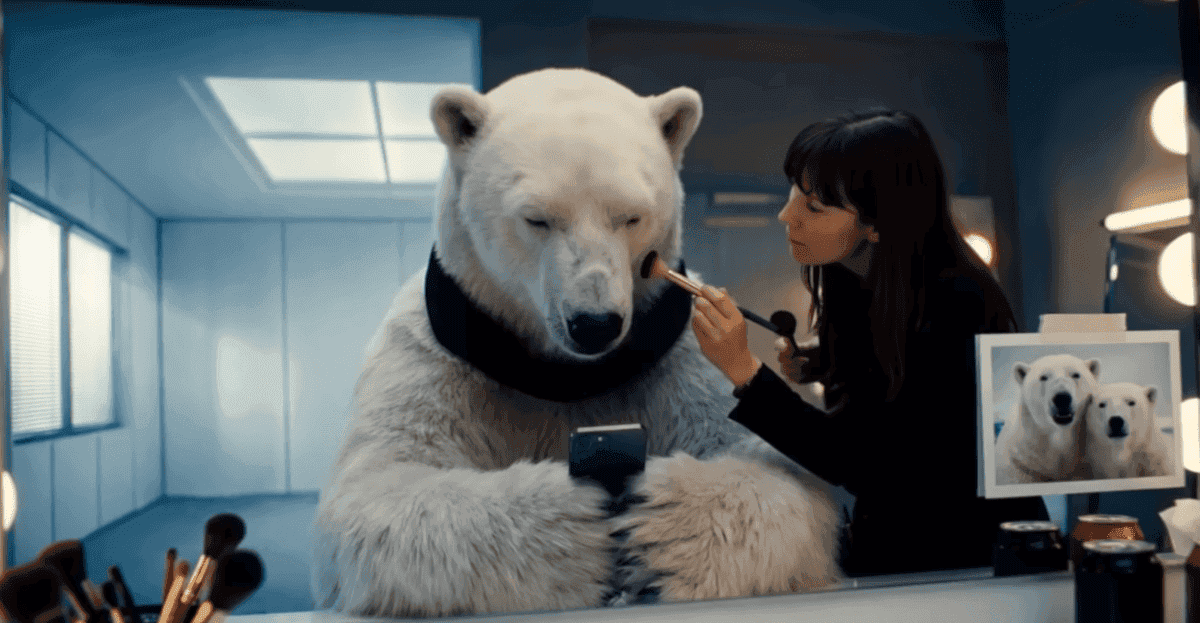
The new advertisement was created in partnership with AI studios Silverside and Secret Level, the same companies that worked on Coca-Cola's criticized 2024 AI holiday campaign. This year's version attempts to address previous criticisms by focusing on animated animals rather than humans, featuring polar bears, pandas, sloths, rabbits, and other creatures watching the iconic red Coca-Cola trucks traverse snowy landscapes
2
.
Source: The Hollywood Reporter
While the 2025 campaign shows technical improvements over its predecessor, including properly rotating truck wheels and more coherent lighting, critics argue that fundamental problems remain. The advertisement suffers from inconsistent visual styles, switching between attempted realism and cartoonish aesthetics without cohesion. The animals move unnaturally, appearing more like "flat images that have been sloppily animated rather than rigged 3D models," according to industry observers
1
.
Source: GameReactor
The production process involved approximately 100 staff members, including five "AI specialists" from Silverside who refined more than 70,000 AI-generated video clips to create the final advertisement. Despite this extensive human involvement, the end result still appears "very recognizably the work of an AI model," with movement that seems "strangely fluid, and at once weightless and suspended in half-slow motion"
5
.Coca-Cola's Chief Marketing Officer Manolo Arroyo emphasized the economic advantages of AI-generated advertising, noting that production time has been reduced from a year to approximately one month. The company declined to disclose the campaign's cost but confirmed it was cheaper and faster to produce than traditional methods
1
.This efficiency gain comes at a time when generative AI promises to reduce animation costs by up to 90 percent, making the technology increasingly attractive to major advertisers despite creative concerns. Jason Zada, founder of Secret Level, defended the approach, stating that consumer testing of the previous year's AI advertisement showed exceptional performance when AI wasn't mentioned
3
.Related Stories
The creative professional community has responded with significant criticism, viewing AI-generated advertising as a threat to traditional artistic employment and creative authenticity. Artist Alex Hirsch, creator of the television series Gravity Falls, previously criticized Coca-Cola's AI approach, suggesting the company's red color comes "from the blood of out-of-work artists"
4
.Critics argue that the AI-generated content lacks the "human spark that drives genuine emotion" and represents "an imitation of nostalgia instead of nostalgia itself." The concern extends beyond aesthetic quality to fundamental questions about craft, value, and authenticity in creative work
2
.Coca-Cola's commitment to AI advertising reflects a broader industry trend, with other major brands also embracing generative technology. Google recently introduced its first fully AI-generated commercial, suggesting that consumers "don't really care if ads are created using the technology." The NFL has also released AI-generated advertisements, indicating widespread adoption across various sectors
3
.Pratik Thakar, Global Vice President & Head of Generative AI at Coca-Cola, defended the company's approach, stating that "the evolution of this kind of technology has allowed us to enhance our films and fine-tune our storytelling to create a piece of content that our customers are receptive to." He emphasized that last year's AI campaign "performed exceptionally well and was a success with customers"
3
.Summarized by
Navi
[1]
[2]
[3]
[4]
1
Business and Economy

2
Business and Economy

3
Business and Economy