7 Sources
[1]
JPMorgan CEO Dimon says Anthropic's Mythos AI risks are a 'real issue'
July 15 (Reuters) - JPMorgan Chase (JPM.N), opens new tab CEO Jamie Dimon said on Wednesday that risks posed by Anthropic's Mythos AI model are a "real issue" that the U.S. government is on top of, underscoring concerns about the powerful model that have caused Washington to intervene. Dimon, speaking at Senator Dave McCormick's Pennsylvania Defense and Innovation Summit, added that access to advanced AI capabilities must be controlled, saying "you're giving ballistic missiles to individuals with Mythos." U.S.-based Anthropic released Mythos in April to a select group that included JPMorgan. The model has attracted interest from banks because it is considered among the most advanced AI systems for identifying cybersecurity vulnerabilities, helping firms uncover and fix weaknesses more quickly. However, in June, the U.S. government ordered Anthropic to restrict access to its top AI models, Fable 5 and Mythos 5, to foreign nationals over national security concerns, forcing the company to cut off worldwide access. The government later removed restrictions on the models after Anthropic implemented new safeguards. Governments and tech companies are grappling with AI safety concerns, including the misuse of systems capable of identifying software vulnerabilities. Washington has stepped up oversight of new model releases amid fears that advanced AI could be exploited by military intelligence in China, Russia or other countries of concern. Anthropic could not be immediately reached for comment on Dimon's remarks outside regular business hours. Reporting by Mihika Sharma in Bengaluru and Mrinmay Dey in Mexico; Editing by Rashmi Aich Our Standards: The Thomson Reuters Trust Principles., opens new tab
[2]
The Fed rang the alarm about Anthropic's Mythos AI model -- but had to go months without it
It isn't clear the work to address vulnerabilities can begin without access to Mythos. Anthropic unveiled Claude Mythos Preview and Project Glasswing in early April. The company said roughly 50 organizations had access to the model at the time, but it named only a handful, including the bank JPMorgan Chase, and tech titans such as Amazon, Apple and Google. Anthropic said it had also been in "ongoing discussions with U.S. government officials" about the model, including the Cybersecurity and Infrastructure Security Agency and the Center for AI Standards and Innovation. Anthropic expanded access to Project Glasswing in June, adding more than 150 organizations to the initiative across 15 countries. Daniel Newman, CEO of research firm the Futurum Group, said he was surprised to hear the Fed was not included. "You would think that the financial institution that sort of drives all the policy for the rest of the financial institutions would be front and center of at least having a chance to evaluate the new technology," he told CNBC on Tuesday. Mythos' rollout has sparked both intrigue and confusion in recent months, particularly as Anthropic's fraught relationship with the Trump administration caused complications. In June, Anthropic said it had to disable access to Mythos 5, an updated version of the model, and Fable 5, a version of Mythos that it released more broadly, in order to comply with an export control directive from the federal government that cited "national security authorities." Commerce Secretary Howard Lutnick granted the company permission to restore access to Mythos to a select group of "trusted partners," according to a letter viewed by CNBC. The export controls were later lifted entirely. The Trump administration has been taking a much more active role in AI regulation since President Donald Trump signed an AI executive order in June. But questions remain about who is calling the shots on AI policy behind the scenes, and the scrambling at the Fed -- which Trump chose Warsh to lead -- is another sign of chaos. Chris Fall, head of the Center for AI Standards and Innovation, resigned from his role as director just three months after he was picked for the job by the Trump administration, CNBC confirmed on Monday. Venture capitalist David Sacks previously held the position of White House AI and crypto czar, but he stepped down from that role in March. Pressure is building. Chinese open-weight models are gaining steam against leading offerings from U.S. companies like OpenAI and Anthropic, sparking concerns from tech executives and government officials about the durability of the U.S. lead in the AI race. Moonshot AI, a Chinese startup, released a model called Kimi K3 earlier this month that outperforms those companies across some industry benchmarks. Sacks said in a post on X on Friday that Kimi K3's performance is "concerning," and that "America is tying itself in knots." "This is how you lose the AI race," he wrote. "The rest of the world won't play by our rules if we bog ourselves down." Futurum's Newman said the Fed is "certainly is going to play catch up" since it hasn't had access to the cutting-edge models that other agencies have. "Every day, every week, whether it's China's innovation or U.S. innovation, technology leaders inside of large institutions are facing a constant barrage of net innovation," he said.
[3]
'You're giving ballistic missiles to individuals with Mythos': JPMorgan CEO Jamie Dimon says Anthropic's AI model poses some serious risks
* JPMorgan CEO Jamie Dimon warns controls may be needed for Claude Mythos * The AI model from Anthropic is highly advanced, and has been proven to detect zero-day vulnerabilities and even develop working exploits * The US government has previously instructed Anthropic to block access to foreign nationals, citing security concerns Artificial intelligence is becoming increasingly powerful, a fact highlighted with the US government's recent instruction to limit access to Anthropic's Claude Mythos model. Now, the CEO of JPMorgan has described the risks the technology poses as a "real issue," and likened wide access to the AI as "giving ballistic missiles to individuals." Speaking at the Pennsylvania Defense and Innovation Summit, JPMorgan's Jamie Dimon underscored the risks posed by the AI, which has already been shown to both identify and exploit cybersecurity challenges. Mythos isn't Skynet Currently, Claude Mythos is limited to a small selection of organizations, companies, and federal and military departments. Public access to the AI has been blocked, and worldwide access has been blocked due to the potential security issues of this powerful AI. Claude Mythos is not the type of threat that can become self-aware and take over military appliances like the fictional Skynet of the Terminator movie series. However, it does have the capacity to cause immense damage in the wrong hands. The AI is capable of detecting cybersecurity vulnerabilities and reporting on them; it is also able to generate automatic exploits. So, for white hat cybersecurity analysts, it is a powerful defensive tool, but in the wrong hands, it is a destructive power. In addition, its automated capabilities make it easy for black hats to scale their cybercrime operation and make ransomware, phishing, and other data-based scams more profitable. It isn't just cybersecurity where Anthropic's Claude Mythos AI has demonstrated such incredible capacities. Scientific research, specifically biology, can be targeted by attackers using AI to turn complex concepts into terms, potentially to misuse the information. There is also the challenge of a strategic imbalance between single nations or bodies having exclusive access to the technology. Will the public ever access Anthropic's Claude Mythos? Given the security considerations, it seems unlikely that Claude Mythos will be publicy available anytime soon. However, Anthropic has already stated that it intends Mythos-level features and capabilities to become more widely available. For this to happen, however, it needs to develop and apply various safeguards. The most likely scenario is that public access to Mythos is eventually unblocked, with restrictions to specific features that relate to cybersecurity and biological/medical tasks and research. Project Glasswing is already in operation with a handful of key partners (including Amazon Web Services, Anthropic, Apple, Broadcom, Cisco, CrowdStrike, and others), and will probably be expanded until the safeguards are demonstrated to be fit for purpose, and public use. Via Reuters Follow TechRadar on Google News and add us as a preferred source to get our expert news, reviews, and opinion in your feeds.
[4]
Jamie Dimon warns about Anthropic Mythos AI access
JPMorgan $JPM Chase & Co. Chief Executive Officer Jamie Dimon described the risks of broad public access to Anthropic PBC's Mythos artificial intelligence model as a "real issue," comparing it to handing ballistic missiles to individuals. He made the remarks Wednesday at Senator Dave McCormick's Pennsylvania Defense and Innovation Summit. "You're giving ballistic missiles to individuals with Mythos, basically," Dimon said. He added that the U.S. government is on top of the issue now. The warning centers on Mythos's capacity to identify software vulnerabilities at a level Anthropic has said is too dangerous for general release. JPMorgan is among a select group of companies that gained access to the model in April and has been deploying it to stress-test internal systems and coordinate on findings with vendors and peers. The month after gaining that access, Dimon said the bank had hundreds of employees working full time to strengthen its systems. JPMorgan's involvement with Mythos is part of its broader push into national security and economic resilience. The bank announced last year a "Security and Resiliency Initiative" through which it would direct $1.5 trillion over ten years toward sectors that strengthen the U.S. economy -- a figure 50% above what it would have invested otherwise. JPMorgan also tied the commitment to its separate "American Dream Initiative," pledging $24 million in a mix of loans, investments, and philanthropic grants directed at Philadelphia's shipbuilding sector. Dimon visited the Philadelphia Navy Yard earlier Wednesday as the bank announced that commitment. The Mythos model has been at the center of a broader government and industry reckoning over AI safety. The U.S. government lifted export controls on Anthropic's Claude Fable 5 and Mythos 5 models on July 1 after an 18-day shutdown triggered by Amazon $AMZN researchers documenting a technique for eliciting dangerous outputs from Fable 5 related to software vulnerability discovery. A limited group of U.S. organizations regained access to Mythos 5 after the government gave its approval on June 26; extending that access to additional domestic and international partners through Anthropic's Glasswing program remains under discussion with federal authorities, Anthropic said. Dimon has grown increasingly vocal on national security matters in recent years. His April shareholder letter argued that America must "get stronger" if it hopes to preserve its position as a military and economic power.
[5]
Anthropic's Mythos AI: JPMorgan CEO Jamie Dimon says Anthropic's Mythos AI risks are a 'real issue'
Dimon, speaking at Senator Dave McCormick's Pennsylvania Defense and Innovation Summit, added that access to advanced AI capabilities must be controlled, saying "you're giving ballistic missiles to individuals with Mythos." JPMorgan Chase CEO Jamie Dimon said on Wednesday that risks posed by Anthropic's Mythos AI model are a "real issue" that the U.S. government is on top of, underscoring concerns about the powerful model that have caused Washington to intervene. Dimon, speaking at Senator Dave McCormick's Pennsylvania Defense and Innovation Summit, added that access to advanced AI capabilities must be controlled, saying "you're giving ballistic missiles to individuals with Mythos." U.S.-based Anthropic released Mythos in April to a select group that included JPMorgan. The model has attracted interest from banks because it is considered among the most advanced AI systems for identifying cybersecurity vulnerabilities, helping firms uncover and fix weaknesses more quickly. However, in June, the U.S. government ordered Anthropic to restrict access to its top AI models, Fable 5 and Mythos 5, to foreign nationals over national security concerns, forcing the company to cut off worldwide access. The government later removed restrictions on the models after Anthropic implemented new safeguards. Governments and tech companies are grappling with AI safety concerns, including the misuse of systems capable of identifying software vulnerabilities. Washington has stepped up oversight of new model releases amid fears that advanced AI could be exploited by military intelligence in China, Russia or other countries of concern. Anthropic could not be immediately reached for comment on Dimon's remarks outside regular business hours.
[6]
Jamie Dimon Says Anthropic's Mythos Access Debate Is a Warning Sign for AI's Future - JPMorgan Chase (NYS
Anthropic has found itself at the center of debate over how governments should manage cybersecurity risks posed by powerful AI models. Anthropic has since added more companies to the project, expanding its access to approximately 150 new organizations, the company noted last month. "Project Glasswing and the capabilities of Claude Mythos Preview have sparked broad conversations -- both within the software industry and with governments -- about how AI is changing cybersecurity," Anthropic said. "We see our role as twofold. First, to help the software industry adapt by safely providing wide access to better models, tools and common infrastructure. Second, to steadily shift the support we provide, from finding vulnerabilities to disclosing, fixing, and deploying patched software," the company stated at the time. Founded in 2021 by former OpenAI employees, Anthropic has quickly established itself as a key player in artificial intelligence, building tools that are reshaping how businesses approach areas like coding and cybersecurity. In May, Anthropic overtook OpenAI as the world's most valuable startup after raising $65 billion in Series H, valuing the company at $965 billion. Altimeter Capital, Dragoneer, Greenoaks and Sequoia Capital led the funding round. Anthropic is meeting with investors ahead of a potential blockbuster IPO as it prepares to capitalize on strong demand for AI listings. Banks leading the offering are arranging investor meetings in the coming weeks, as the company is reportedly targeting an IPO as early as October. The Claude maker has hired Morgan Stanley, Goldman Sachs Group and JPMorgan Chase to work on the IPO process. Details regarding the IPO are ongoing and subject to change. Market News and Data brought to you by Benzinga APIs To add Benzinga News as your preferred source on Google, click here.
[7]
Bank of America CEO Brian Moynihan Joins Wall Street Leaders in Warning of Mythos AI Risks | PYMNTS.com
The evolution of AI technology has prompted the financial services industry and the United States government to assess potential cybersecurity threats to global markets, the report noted. Anthropic has said the Mythos model, unveiled earlier this year, excels at discovering vulnerabilities within digital infrastructures. Currently, Bank of America is among a group of Wall Street firms granted access to the platform, utilizing the AI model to test its own internal networks and share security information with industry peers. The model has not been released to the general public. Earlier this week, JPMorgan Chase & Co. CEO Jamie Dimonwarned that granting broad access to the system would be equivalent to "giving ballistic missiles to individuals." In an interview broadcast Thursday on Bloomberg Television, Moynihan detailed the operational requirements these AI tools impose on financial institutions. "It is a big change in the amount of work that will have to go on and the pace [at] which these tools will affect vulnerabilities in your systems, and how fast you have to take care of that," Moynihan stated. "We are all working hard on it." He further noted that the bank is monitoring external partnerships, adding, "We are making sure the third parties are doing the work and working cooperatively with the team." These warnings follow recent regulatory interventions regarding Anthropic's technology. According to a July 1 report by PYMNTS, the U.S. Department of Commerce had previously enacted export controls and disabled access to Anthropic's Mythos 5 and Fable 5 AI models. The export control directive cited unspecified "national security authorities" and concerns over a potential method for bypassing, or "jailbreaking," the Fable 5 model. Notably, this specific security concern involved a vulnerability within Fable 5's internal safeguards, which is distinctly separate from the Wall Street concerns regarding the Mythos model's capability to uncover vulnerabilities in external systems. The federal government recently lifted these restrictions after Anthropic worked with agencies to address the cybersecurity concerns. Following this regulatory approval, Anthropic announced it had restored access to Mythos 5 for a set of U.S. organizations. The artificial intelligence company noted it will continue working with the government to offer secure access to domestic and foreign partners involved in its Glasswing cybersecurity initiative.
Share
Copy Link
JPMorgan Chase CEO Jamie Dimon raised alarm bells about Anthropic's Mythos AI model, calling the risks a 'real issue' and comparing unrestricted access to handing out ballistic missiles. The powerful AI system can identify cybersecurity vulnerabilities with unprecedented precision, prompting U.S. government temporary restrictions in June before new safeguards were implemented.
JPMorgan Chase CEO Jamie Dimon delivered a stark warning about Anthropic Mythos AI at the Pennsylvania Defense and Innovation Summit, describing the AI risks as a "real issue" that demands immediate attention. Speaking at Senator Dave McCormick's event, Dimon emphasized that access to such advanced cybersecurity capabilities must be tightly controlled, stating "you're giving ballistic missiles to individuals with Mythos"
1
. His comments underscore growing concerns among financial leaders about powerful AI systems that can both defend against and potentially enable sophisticated cyber attacks.
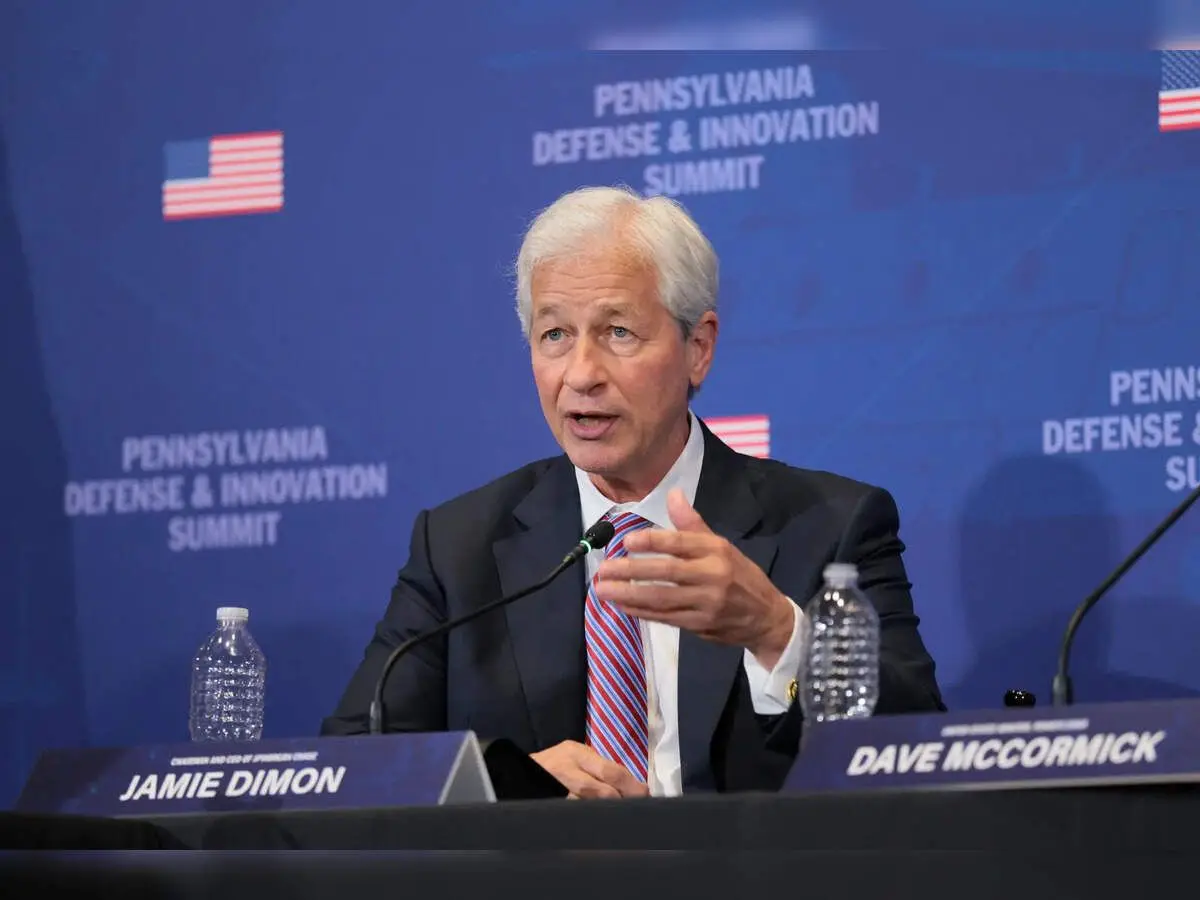
Source: ET
The JPMorgan chief's remarks carry particular weight given his bank's direct experience with the technology. JPMorgan is among roughly 50 organizations that gained early access to Anthropic Mythos AI when Anthropic released it in April
2
. The model has attracted interest from banks because it is considered among the most advanced AI systems for identifying cybersecurity vulnerabilities, helping firms uncover and fix weaknesses more quickly1
. By May, just one month after gaining access, Dimon said JPMorgan had hundreds of employees working full time to strengthen its systems based on Mythos findings4
.The U.S. government's response to Mythos demonstrates the seriousness of the national security concerns surrounding this technology. In June, federal authorities ordered Anthropic to restrict access to its top AI models, Fable 5 and Mythos 5, to foreign nationals, forcing the company to cut off worldwide access
5
. The export controls triggered an 18-day shutdown after Amazon researchers documented a technique for eliciting dangerous outputs from Fable 5 related to software vulnerability discovery4
.The government later removed restrictions on July 1 after Anthropic implemented new safeguards, though government oversight of advanced AI remains intense
4
. Commerce Secretary Howard Lutnick granted the company permission to restore access to Mythos to a select group of "trusted partners" before lifting export controls entirely2
. Washington has stepped up oversight of new model releases amid fears that advanced AI could be exploited by military intelligence in China, Russia or other countries of concern1
.The technology's dual-use nature presents a complex challenge for AI safety experts. Mythos is capable of detecting cybersecurity vulnerability issues and reporting on them, but it can also generate automatic exploits
3
. For white hat cybersecurity analysts, it serves as a powerful defensive tool, but in the wrong hands, it becomes a destructive power. Its automated capabilities make it easy for bad actors to scale their cybercrime operations and make ransomware, phishing, and other data-based scams more profitable3
.
Source: PYMNTS
Anthropic expanded access to Project Glasswing in June, adding more than 150 organizations across 15 countries to the initiative
2
. Partners include Amazon Web Services, Anthropic, Apple, Broadcom, Cisco, and CrowdStrike3
. However, Daniel Newman, CEO of research firm the Futurum Group, expressed surprise that the Federal Reserve was not initially included in early access, noting "you would think that the financial institution that sort of drives all the policy for the rest of the financial institutions would be front and center"2
.Related Stories

The Mythos situation unfolds against mounting pressure from international AI competition. Chinese open-weight models are gaining ground against leading offerings from U.S. companies like OpenAI and Anthropic. Moonshot AI, a Chinese startup, released a model called Kimi K3 that outperforms those companies across some industry benchmarks
2
. Former White House AI and crypto czar David Sacks called Kimi K3's performance "concerning," warning that "America is tying itself in knots" and "this is how you lose the AI race"2
.

Source: TechRadar
JPMorgan's involvement with Mythos connects to its broader push into national security and economic resilience. The bank announced a "Security and Resiliency Initiative" directing $1.5 trillion over ten years toward sectors that strengthen the U.S. economy—a figure 50% above what it would have invested otherwise
4
. While Anthropic has stated it intends Mythos-level features to become more widely available, unrestricted access to Mythos seems unlikely without developing and applying various safeguards to specific features relating to cybersecurity and biological research tasks3
.Summarized by
Navi
01 May 2026•Policy and Regulation

19 Jun 2026•Policy and Regulation

11 May 2026•Policy and Regulation

1
Technology

2
Technology

3
Technology