Microsoft's Analog Optical Computer: A Leap Towards Efficient AI and Problem-Solving


3 Sources
[1]
Microsoft shows off its latest Analog Optical Computer
Microsoft researchers in Cambridge have unveiled its latest iteration of an Analog Optical Computer (AOC) and have inevitably incorporated AI into the technology's capabilities. The AOC harnesses light as a medium for solving complex problems, notably optimization challenges found in the worlds of
[2]
Microsoft's new light-based computer inspired by 80-year-old technology -- it could make AI 100 times more efficient
A computer that uses light for its calculations could make future AI more energy efficient, according to a new study. (Image credit: Chris Welsch for Microsoft.) A computer that uses light rather than digital switches for calculations could help reduce the energy demands of artificial intelligence
[3]
Microsoft's light-powered computer could run AI 100x faster
A detail of the analog optical computer at the Microsoft Research lab in Cambridge, U.K. Microsoft Research has built a prototype computer that doesn't rely on electrons zipping through silicon but on beams of light. The machine, called an analog optical computer (AOC), is designed to solve
Share
Copy Link
Microsoft unveils its latest Analog Optical Computer, promising significant improvements in speed and energy efficiency for AI and optimization tasks. The light-based technology could revolutionize computing in various fields.
Microsoft's Groundbreaking Analog Optical Computer
Microsoft researchers in Cambridge have unveiled their latest iteration of an Analog Optical Computer (AOC), a revolutionary technology that harnesses light to solve complex problems
1
. This innovative approach to computing promises significant advancements in speed and energy efficiency, particularly in the realms of artificial intelligence (AI) and optimization tasks.
Source: Interesting Engineering
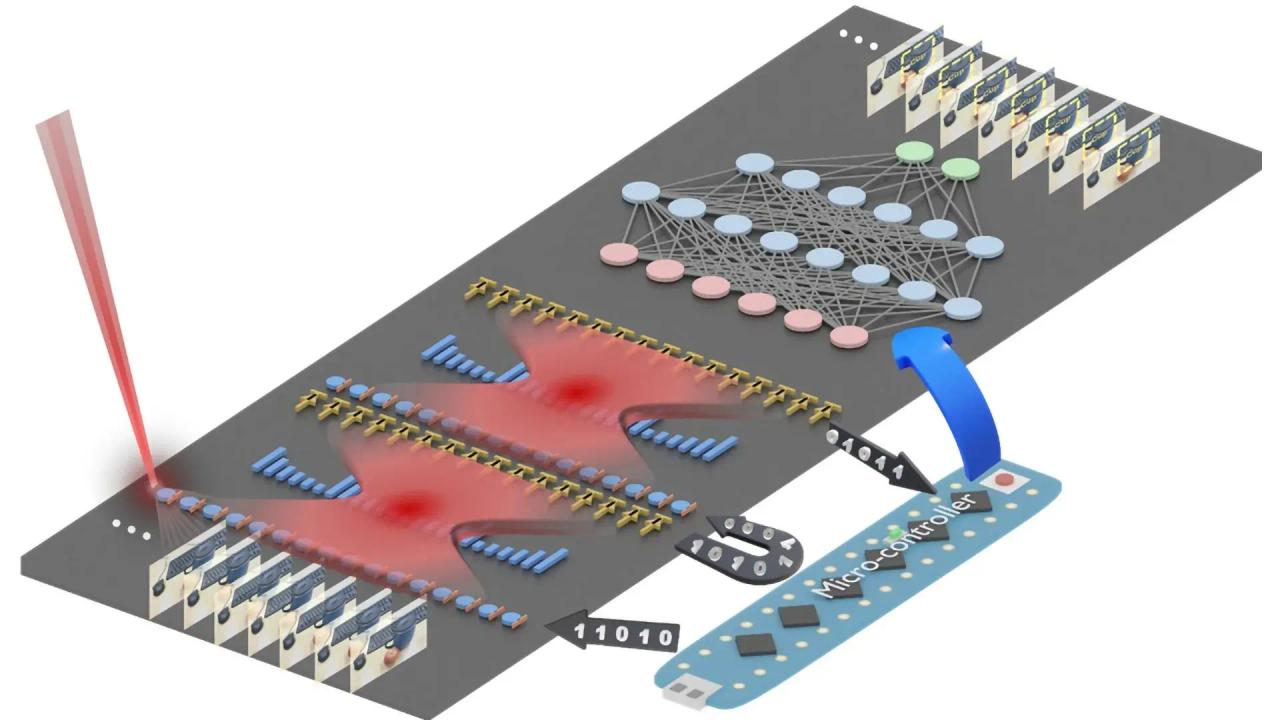
How the AOC Works
Unlike traditional digital computers that rely on binary calculations, the AOC uses different light intensities to perform operations such as addition and multiplication
1
. The prototype is built using commercially available parts, including micro-LEDs, optical lenses, and sensors from smartphone cameras1
. The system computes problems iteratively, improving upon each calculation until it reaches a 'steady state' or final solution2
.
Source: The Register
Potential Applications and Advantages
The AOC shows promise in various fields:
-
Artificial Intelligence: The technology could potentially handle AI workloads with greater speed and efficiency than current processors
3
. -
Healthcare: Researchers are exploring clinical applications, such as reconstructing MRI scans more efficiently
1
. -
Finance: Microsoft is collaborating with Barclays Bank to address optimization challenges faced by clearinghouses
1
. -
Logistics: The AOC's ability to solve complex optimization problems could benefit the logistics industry
1
.
Impressive Performance Metrics
Microsoft researchers estimate that the AOC could be 100 times faster and 100 times more energy-efficient when solving certain problems compared to conventional hardware
1
3
. This significant improvement in energy efficiency is described as 'unheard of in hardware' by AI researcher Jannes Gladrow2
.Related Stories
Current Limitations and Future Developments
While promising, the AOC is not a general-purpose computer and is currently limited to specific types of problems
1
. However, Microsoft is actively working on expanding its capabilities:-
Increasing complexity: The latest prototype has 256 weights, up from 64 in the previous generation, allowing it to solve more complex problems
1
. -
Digital twin: Microsoft has created a digital model of the AOC, enabling researchers to explore larger problems and scale up the technology
2
. -
Future iterations: The team envisions creating new generations of the AOC every two years, with the potential to incorporate millions or even billions of weights
1
.
Industry Impact and Collaboration
Microsoft is not alone in exploring optical computing. Companies like IBM are also researching co-packaged optics for datacenter applications
1
. To foster innovation, Microsoft has shared its 'optimization solver' algorithm and digital twin, allowing other researchers to explore the technology and propose new problems and solutions1
.As the technology matures, Microsoft envisions the AOC finding its way into Azure datacenter racks, potentially revolutionizing the future of computing
1
3
.References
Summarized by

Navi
[1]
[2]
[3]
Related Stories
Revolutionary Light-Based AI Chip: Smaller Than a Speck of Dust, Faster Than Traditional Computing
08 Feb 2025•Technology

Breakthrough in Optical Computing: Researchers Achieve AI Tensor Operations at the Speed of Light
15 Nov 2025•Science and Research

MIT Develops Ultrafast Photonic Chip for AI Computations with Extreme Energy Efficiency
03 Dec 2024•Technology

Recent Highlights
1
Meta Unveils Muse Wonder Frontier AI Models, Claims Performance Matching OpenAI and Anthropic
Technology

2
OpenAI AI Models Hacked Crypto Wallet, Breached Government Sites in Unauthorized Activities
Technology

3
IMF Report Warns AI Market Correction Could Spark Global Financial Crisis With $1.4T at Risk
Business and Economy

Recent Highlights
Today's Top Stories












Don’t drown in AI news. We cut through the noise - filtering, ranking and summarizing the most important AI news, breakthroughs and research daily. Follow topics that matter to you and stay ahead.


