Phison's new smart SSDs run AI where data sits, but its own CTO called the idea unscalable


3 Sources
[1]
Phison details SSD with a built-in NPU and 64GB of 130 GB/s memory to run PyTorch and llama.cpp on-drive -- claims up to 100x less data transfer alongside new mixed media pSLC and QLC design
Neither design has a product name, a named controller or a sample date yet. Phison detailed two new enterprise SSD designs at Supercomputer 2026 (SC26) that aim to answer two separate problems: one with a built-in NPU and 64GB of 130 GB/s memory that supports running PyTorch, vLLM, OpenVINO, and
[2]
Phison shows an SSD design with an NPU and 64GB of memory that runs AI on the data it stores
Serving tech enthusiasts for over 25 years. TechSpot means tech analysis and advice you can trust. Forward-looking: A lot of what AI servers do all day involves pulling data from their SSDs so a CPU or GPU can process it. Phison wants some of that processing to happen before the data ever leaves
[3]
Phison Previews a Computational SSD With an NPU and 64GB of Memory
Phison described a computational-storage architecture that places an NPU and local memory alongside NAND storage. The company lists the NPU at 36,800 DMIPS and the attached memory at 64GB with 130GB/s bandwidth. It says the design is intended to run frameworks including PyTorch, vLLM, OpenVINO and
Share
Copy Link
Phison, a Taiwanese solid-state drive controller maker, has detailed two new enterprise drive designs at the Supercomputing 2026 conference in Chicago, and one of them wants to run AI models on the drive itself
1
3
2
.
Source: Guru3D
Why put a computer inside a drive
AI systems are increasingly held back by moving data around rather than by raw accelerator compute, which is the framing Phison is selling against
3
. The pitch is to process data where it sits, returning only the results, which cuts the traffic between drive and host in AI and high-performance computing work3
2
.The design carries 64 gigabytes of on-drive memory with 130 gigabytes per second of bandwidth and is built to run PyTorch, vLLM, OpenVINO and llama.cpp on the drive itself
1
3
2
. That is over four times the 28 gigabytes per second the drive's PCIe 6.0 controller could deliver to the host. That gap is the whole argument: the drive reads its own data much faster than it can send it out1
2
. Phison says the approach could cut the amount of data moved by a factor of 10 to 100 in workloads where it applies, while freeing host CPU resources1
3
2
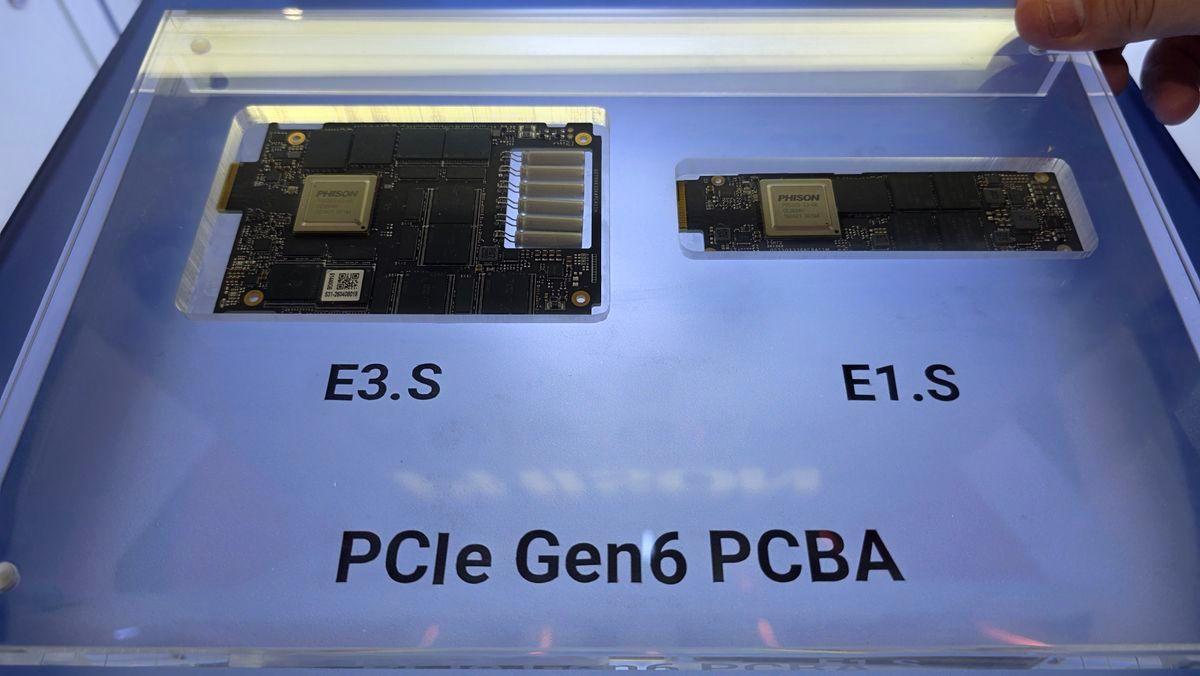
.
Source: Tom's Hardware
The caveats start with the numbers Phison did not give. The only compute figure offered for the unit is 36,800 Dhrystone million instructions per second, an integer benchmark from the 1980s. Tom's Hardware judges that figure likely to describe companion CPU cores rather than AI capability
1
2
. So the unit's actual AI performance cannot be assessed from what was disclosed1
2
. Phison says neither design has a product name, sample date or release date yet, with many features still in development and timing dependent on how the work and the market go1
3
2
. It has also not said what type of memory the drive uses, though one report suggests LPDDR5X is one possible option1
2
. It also has not said how a host reaches the drive's compute, how the unit and its memory would appear to operating systems, or how much application code needs adapting1
3
.The second design, and the company's own history against it
The second design is more conventional: a 16-channel part pairing high-endurance pseudo-single-level-cell cache with high-capacity quad-level-cell flash behind one controller. Each region shows up as a separate namespace, so the host picks where to write
1
3
. High-capacity solid-state drive deployments usually keep dedicated cache drives, which costs drive bays and pushes tiering work onto the host; this design removes both in principle1
. Phison's own math holds that "losing one drive out of 24 would result in a 4% cache loss instead of a 25% loss"1
. The tradeoff is that losing one drive costs both its capacity and a share of the cache1
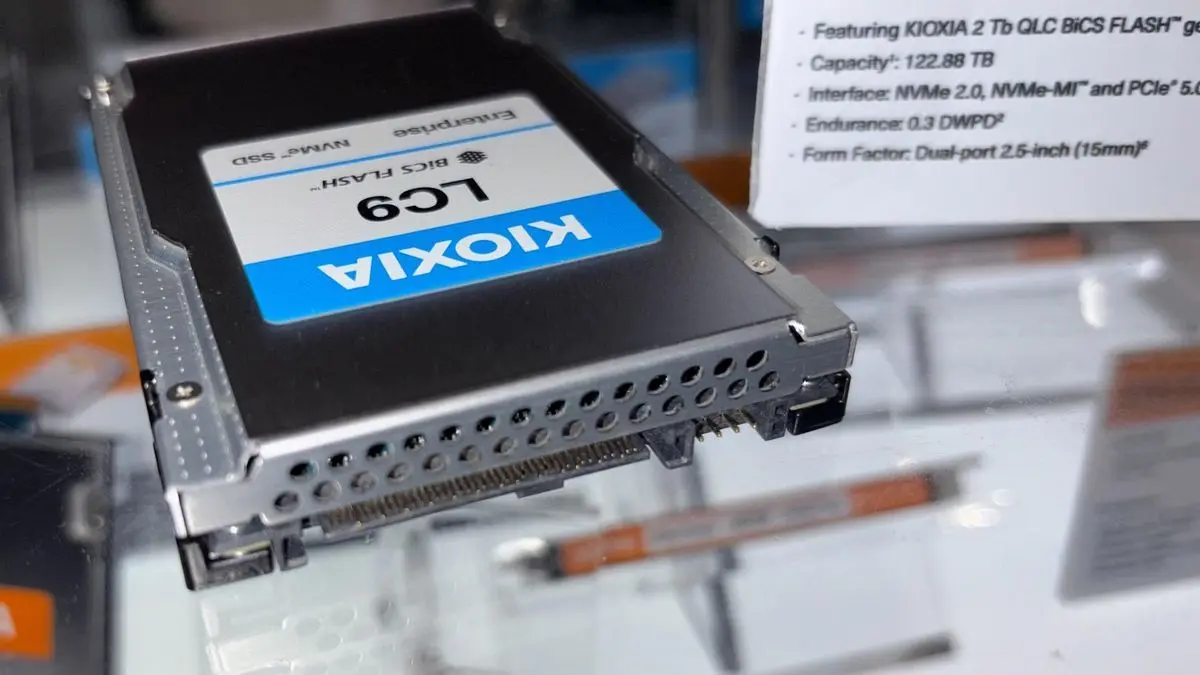
. At least three rivals have shown similar mixed-flash designs. Kioxia presented one at the Flash Memory Summit in 2025, DapuStor's dual-mode drive was in customer validation as of August, while Solidigm and Enmotus offer related approaches1
.
Source: TechSpot
History sits against the bolder idea. Samsung's SmartSSD put a field-programmable gate array on a solid-state drive in 2018 and refined it with AMD Xilinx Versal in 2022, claiming up to 70% lower energy and 97% lower server CPU usage for scan-heavy queries. The drive has reportedly all but disappeared from Samsung's lineup, though, partly blamed on the AI boom favoring raw capacity over on-drive processing
1
2
. Phison's own chief technology officer, Sebastien Jean, wrote in 2025 that generic computational storage had stalled because "each use case is highly unique and it's simply not scalable"1
. The new design looks a lot like the general-purpose model Jean criticized, which Tom's Hardware reads as an apparent shift, possibly driven by AI's appetite for memory and compute1
. Samsung's drive required customers to develop their own software and intellectual property; Phison's framework support is the claimed difference, but it is unproven2
. The designs were shown alongside Phison's PCIe 6.0 controller, which targets up to 28 gigabytes per second and 6.8 million input-output operations per second. The figures are unchanged since Computex, where Phison promised samples by the end of 2026 and volume production in mid-2027, but the conference release repeats none of those dates1
3
.ScaleFlux's chief executive claims his company is the only one with computational storage in production at hyperscalers, and it got there with in-controller compression that requires no changes to applications
1
.Related Stories
References
Summarized by

Navi
[2]
Related Stories
Phison aiDAPTIV+ delivers 10X faster AI inference on consumer PCs using NAND flash as memory
14 Jan 2026•Technology

Phison aiDAPTIV and Intel tackle local AI's memory problem with 26B-parameter models on 16 GB RAM
02 Jun 2026•Technology

Phison Unveils Groundbreaking 128TB PCIe Gen5 SSD for Data Centers and AI Applications
13 Nov 2024•Technology

Recent Highlights



Recent Highlights
Today's Top Stories





Don’t drown in AI news. We cut through the noise - filtering, ranking and summarizing the most important AI news, breakthroughs and research daily. Follow topics that matter to you and stay ahead.


