Pope Leo XIV warns AI warfare drives world toward 'spiral of annihilation' at historic university visit


3 Sources
[1]
Pope Leo XIV denounces AI warfare and European rearmament in first papal visit to La Sapienza since 2008
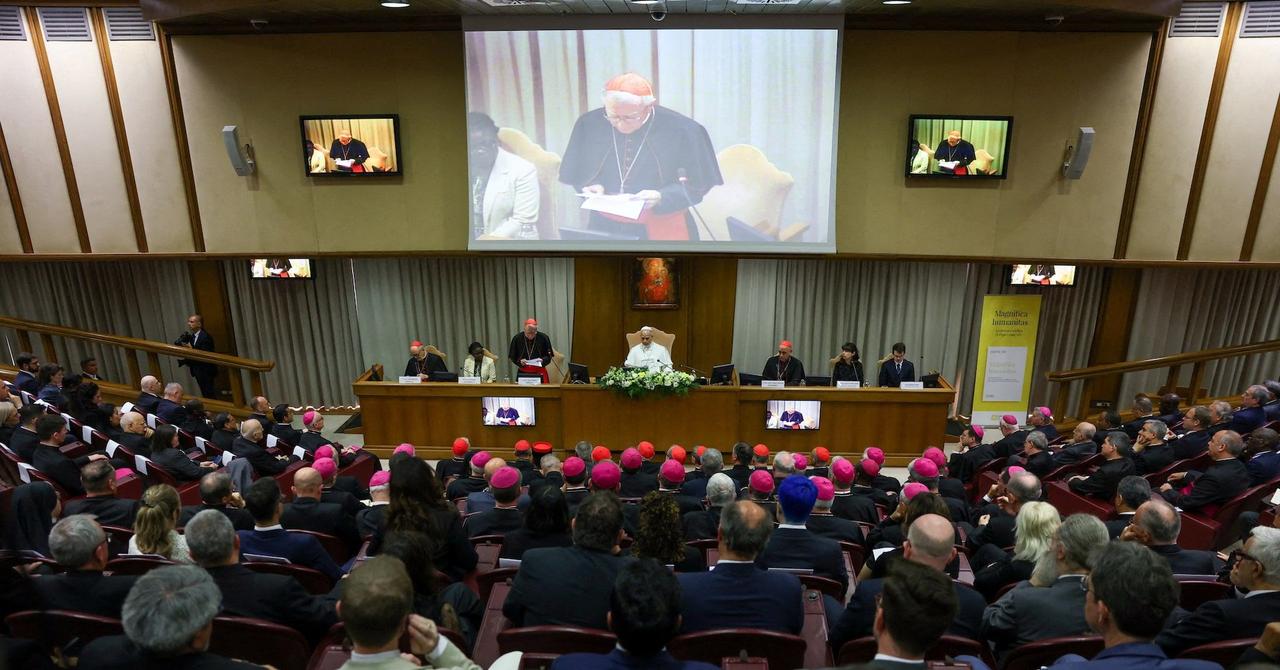
Pope Leo XIV used a historic visit to Europe's largest university to denounce the growing role of artificial intelligence in warfare, warning that investments in AI-directed weaponry are driving the world toward what he called a "spiral of annihilation." Speaking at Rome's La Sapienza University on
[2]
Pope Leo warns of 'spiral of annihilation' as AI warfare leads to symphony of destruction | Fortune
Pope Leo XIV on Thursday denounced how investments in artificial intelligence and high-tech weaponry were leading the world into a "spiral of annihilation," as he called for peace in the Middle East and Ukraine during a visit to Europe's largest university. Leo's speech at Rome's La Sapienza
[3]
Pope blasts the use of AI in warfare, saying it's leading to a 'spiral of annihilation'
Pope Leo's comments on AI were made in a speech at Rome's La Sapienza University. Pope Leo XIV on Thursday denounced how investments in artificial intelligence and high-tech weaponry were leading the world into a "spiral of annihilation," as he called for peace in the Middle East and Ukraine
Share
Copy Link
Pope Leo XIV delivered a stark warning about artificial intelligence in warfare during his first papal visit to La Sapienza University since 2008. Speaking to Europe's largest university, he condemned investments in AI and high-tech weaponry as driving humanity toward a 'spiral of annihilation,' citing conflicts in Ukraine, Gaza, Lebanon, and Iran as evidence of technology's inhuman evolution in war.
Pope Leo XIV Denounces AI Warfare at Historic La Sapienza Visit
Pope Leo XIV used a groundbreaking papal visit to La Sapienza University to issue a forceful warning about the use of AI in warfare, declaring that investments in AI and high-tech weaponry are propelling the world toward a "spiral of annihilation."
1
Speaking at Rome's La Sapienza University on Wednesday, the American-born pontiff called for stricter monitoring of AI development and criticized European rearmament efforts that prioritize military budgets over education and healthcare.2

Source: Fast Company
The address marked the first papal visit to La Sapienza since Pope Benedict XVI cancelled a planned speech at the campus in 2008 after protests from faculty and students.
3
This time, Pope Leo XIV received a warm reception, including from 72 young Palestinians who arrived in Italy this week from Gaza through a humanitarian corridor organized by the Diocese of Rome, the Sant'Egidio Community, and the university. These students will continue their studies at La Sapienza University on full scholarships, with accommodation, academic tutoring, and psychological support provided through 2029.1
AI Weapons Transform Modern Conflicts Across Ukraine and Middle East
"What is happening in Ukraine, in Gaza and the Palestinian territories, in Lebanon, and in Iran illustrates the inhuman evolution of the relationship between war and new technologies in a spiral of annihilation," Pope Leo XIV stated.
2
The conflicts he cited span contexts where AI-enabled systems have been deployed or proposed, from autonomous drone operations to surveillance and targeting infrastructure. The pontiff framed AI weapons not as a future risk but as a present reality already transforming the nature of war.He called for better monitoring of AI development so that it "does not absolve humans of responsibility for their choices and does not exacerbate the tragedy of conflicts."
3
This language echoes the Vatican's longstanding position, articulated in its 2020 Rome Call for AI Ethics, that technology must serve human dignity and never replace human accountability in decisions about life and death.1
European Rearmament Criticized as Military Spending Surges
Pope Leo XIV reserved particular criticism for European rearmament, pointing to how military spending had increased dramatically in 2025 and 2026 at the expense of education and healthcare. European NATO members increased military expenditure by 14 per cent in 2025, to $864 billion, the fastest rate of growth since 1953 according to SIPRI. NATO allies agreed at The Hague summit on a new benchmark of 3.5 per cent of GDP for core defense spending, up from the previous 2 per cent target.
1
The pope denounced military budgets that enriched "elites who care nothing for the common good" while education and healthcare suffered.
2
He urged the university's students and faculty to move in the opposite direction, toward research and education that values life, "the lives of peoples who cry out for peace and justice."1
Related Stories
Vatican Positions Itself as AI Governance Leader
The La Sapienza address is part of a broader campaign by Pope Leo XIV to position the Vatican as a serious interlocutor on AI governance. Two days after the speech, the Vatican announced the creation of an Interdicasterial Commission on Artificial Intelligence, a body comprising representatives from seven Vatican departments including the Dicastery for the Doctrine of the Faith and the Pontifical Academy of Sciences.
1
Pope Leo XIV has identified AI as one of the most critical matters facing humanity, especially its application in warfare and everyday life. His first encyclical, reportedly titled Magnifica Humanitas, is expected in the coming weeks and will place AI at the center of Catholic social teaching alongside labor, human dignity, and peace.
1
3
The encyclical is understood to draw a parallel between the current AI revolution and the industrial upheaval that prompted Leo XIII's landmark 1891 encyclical Rerum Novarum, which addressed workers' rights. By choosing the name Leo, the American-born pope, born Robert Francis Prevost in Chicago in 1955, signaled from the start that he intended to engage with the economic and technological disruptions of his era.1
References
Summarized by

Navi
[1]
[2]
Related Stories
Pope Leo XIV Takes Stand on AI: Calls for Ethical Framework and Regulation
19 Jun 2025•Policy and Regulation
Pope Leo Warns AI Labs Risk Creating 'Paradise of Machines' Amid Growing Ethical Concerns
21 Sept 2026•Policy and Regulation
Pope Leo XIV launches AI encyclical with Anthropic co-founder amid Trump administration clash
14 May 2026•Policy and Regulation

Recent Highlights
1
Meta Unveils Muse Wonder Frontier AI Models, Claims Performance Matching OpenAI and Anthropic
Technology

2
IMF Report Warns AI Market Correction Could Spark Global Financial Crisis With $1.4T at Risk
Business and Economy

3
Eight States Sue OpenAI Over ChatGPT Safety Concerns and Unlawful Collection of Children's Data
Policy and Regulation

Recent Highlights
Today's Top Stories









Don’t drown in AI news. We cut through the noise - filtering, ranking and summarizing the most important AI news, breakthroughs and research daily. Follow topics that matter to you and stay ahead.


