AI Bubble Concerns Intensify as Leading Chatbots Compare Market to Dot-Com Crash


2 Sources
[1]
I asked ChatGPT, Gemini, Claude and Perplexity if there really is an AI bubble and when it's going to burst -- and one compared it to the dot-com crash
Learning about the factors that could lead to a crash for the AI industry With the ongoing "RAMageddon", the rapid development of data centers and the pure vitriol brought against "AI slop" these days, I can see why AI skeptics are hoping for an AI industry market crash. Once the news of China's
[2]
AI chatbot boom enters a riskier phase: more dot-com than disaster
Bubble signs grow as investment concentrates around OpenAI and Anthropic The AI chatbot boom is in a touchier stage now. Fresh numbers suggest parts of the market are starting to look bubble-like, even if that still falls short of saying a crash has to happen. Ask OpenAI's ChatGPT, Google's
Share
Copy Link
Major AI chatbots acknowledge growing AI bubble risks as investments hit projected $2.7 trillion by 2026. ChatGPT and Gemini draw parallels to the dot-com crash, citing infrastructure overbuild and circular revenue patterns. OpenAI and Anthropic alone captured 43% of startup funding, raising questions about economic sustainability.
AI Chatbots Acknowledge Growing Bubble Risks
Leading AI chatbots are sounding cautious notes about the AI industry bubble, with some drawing direct comparisons to the dot-com crash that wiped out trillions between 2000 and 2002
1
. When asked whether an AI bubble exists and when it might burst, ChatGPT, Gemini, Claude, and Perplexity delivered remarkably aligned responses: the financial risks are real, but a complete market collapse isn't inevitable1
2
. OpenAI's ChatGPT emphasized a critical distinction between AI's genuine utility in writing, coding, research, and automation versus whether investors are paying too much for companies building these tools1
. The chatbot noted that useful technology can continue advancing even as overvalued companies fail, mirroring the dot-com era when the internet transformed the economy while many internet companies still collapsed1
.Investment Concentration Raises Red Flags
The AI chatbot boom has entered a riskier phase as bubble-like signs multiply across the market
2
. Global AI investments are projected to reach $2.7 trillion by 2026, representing nearly 50% growth above 2025 levels2
. AI companies captured 74% of the $498.2 billion in overall VC funding during the first half of the year, with OpenAI and Anthropic alone accounting for 43% of startup funding2
. In Q1, OpenAI, Anthropic, xAI, and Waymo raised $188 billion, roughly 65% of global VC funding2
. Anthropic reportedly brought in $16.3 billion in first-half 2026 revenue, up 1,368%, while pursuing a $1.5 trillion valuation2
. This extreme concentration of capital around a handful of players mirrors classic bubble conditions that preceded previous market corrections2
.Striking Parallels to the Dot-Com Crash
Gemini identified three striking similarities between the current AI industry bubble and the dot-com crash
1
. First, infrastructure overbuild: telecom companies laid millions of miles of fiber-optic cables in the late 1990s anticipating immediate demand that took years to materialize, causing widespread insolvencies. Today's massive GPU clusters and data center build-out mirrors this dynamic, risking underutilized compute capacity if software adoption lags1
. Second, circular revenue feedback loops: dot-coms spent venture funding buying services from their own sponsors, just as modern AI startups often spend funding on cloud credits and GPU compute leased back from their venture backers1
. Third, narrative overreach: both booms were predicated on genuine technological revolutions, but monetization timelines were wildly compressed compared to reality1
.Related Stories

Market Volatility Signals Investor Concerns
Late October delivered a roughly $1 trillion Nasdaq 100 sell-off and a $500 billion one-day drop for Alphabet as investors scrutinized capital expenditures, negative free cash flow, and debt risk
2
. Prominent analysts including Torsten Slok and Ray Dalio have indicated the signs resemble classic bubble conditions2
. ChatGPT identified 2027 through 2029 as a potential reckoning period if AI industry revenue fails to keep pace with infrastructure spending or if customers discover AI delivered less measurable value than expected1
. The central question remains whether the money AI generates can eventually justify the money being spent on it1
.Economic Sustainability Depends on Revenue Justification
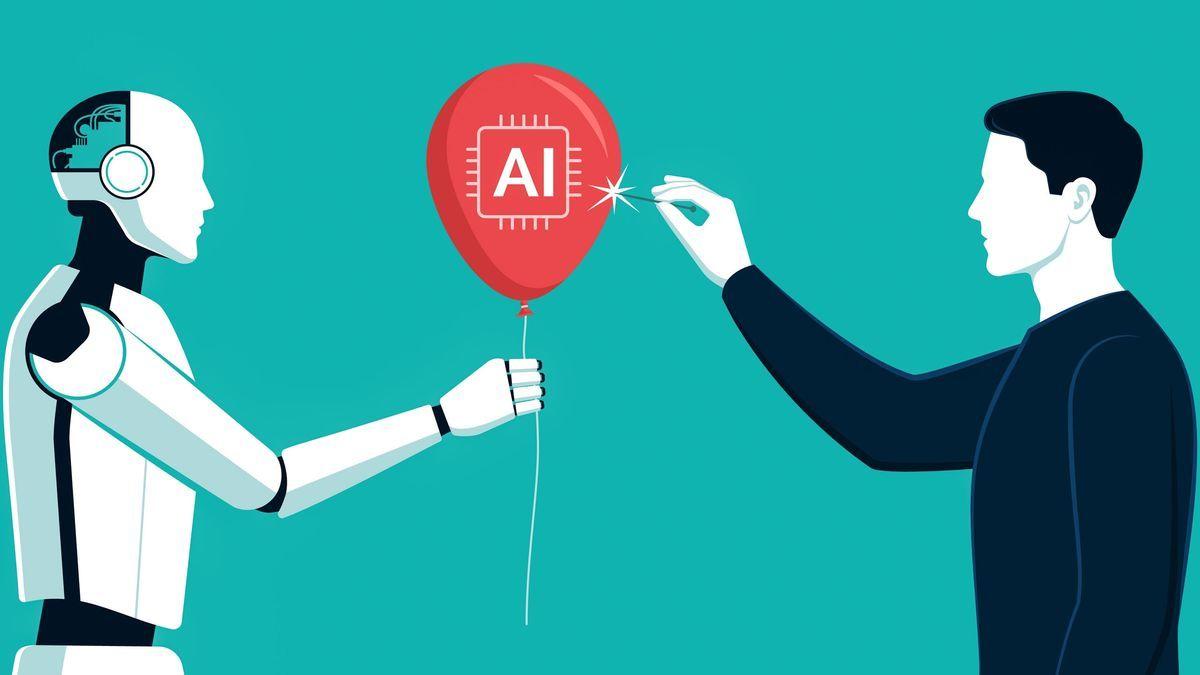
Source: Tom's Guide
ChatGPT framed the economic sustainability debate around a simple proposition: if AI revenue ultimately justifies current spending, this investment boom will be remembered as an expensive but productive period of technological development. If not, investors, startups, lenders, and workers could face severe consequences while the technology itself continues advancing
1
. The AI chatbot boom shows that parts of the market are starting to look bubble-like, though experts maintain this falls short of guaranteeing a crash2
. High valuations and negative cash flows remain persistent concerns as the market enters this touchier phase2
. The distinction between AI's genuine value and investor overenthusiasm will likely determine whether the industry experiences a correction similar to the dot-com era or justifies its current trajectory.References
Summarized by

Navi
Related Stories
OpenAI's Trillion-Dollar Gamble: Massive Investments in AI Computing Power Raise Bubble Concerns
03 Oct 2025•Business and Economy

AI Bubble Debate Intensifies as Industry Weighs Investment Reality Against Hype
13 Nov 2025•Business and Economy

AI Bubble Surpasses Dot-Com Era, Economists Warn of Potential Market Crash
18 Jul 2025•Business and Economy

Recent Highlights
1
OpenAI's AI Models Disprove 27-Year Exponential Time Hypothesis, Rendering Decades of Research Obsolete
Science and Research

2
Google DeepMind unveils Genie 4 world model with audio and 2-minute interactive simulations
Technology

3
Apple Releases iOS 27.2 With Siri AI Memory, 5 New Languages & 160+ Security Fixes
Technology

Recent Highlights
Today's Top Stories










Don’t drown in AI news. We cut through the noise - filtering, ranking and summarizing the most important AI news, breakthroughs and research daily. Follow topics that matter to you and stay ahead.


