Kioxia's next enterprise drive aims to let GPUs reach past their own memory


2 Sources
[1]
Kioxia GP2 targets 18 million IOPS for GPU-accessible flash
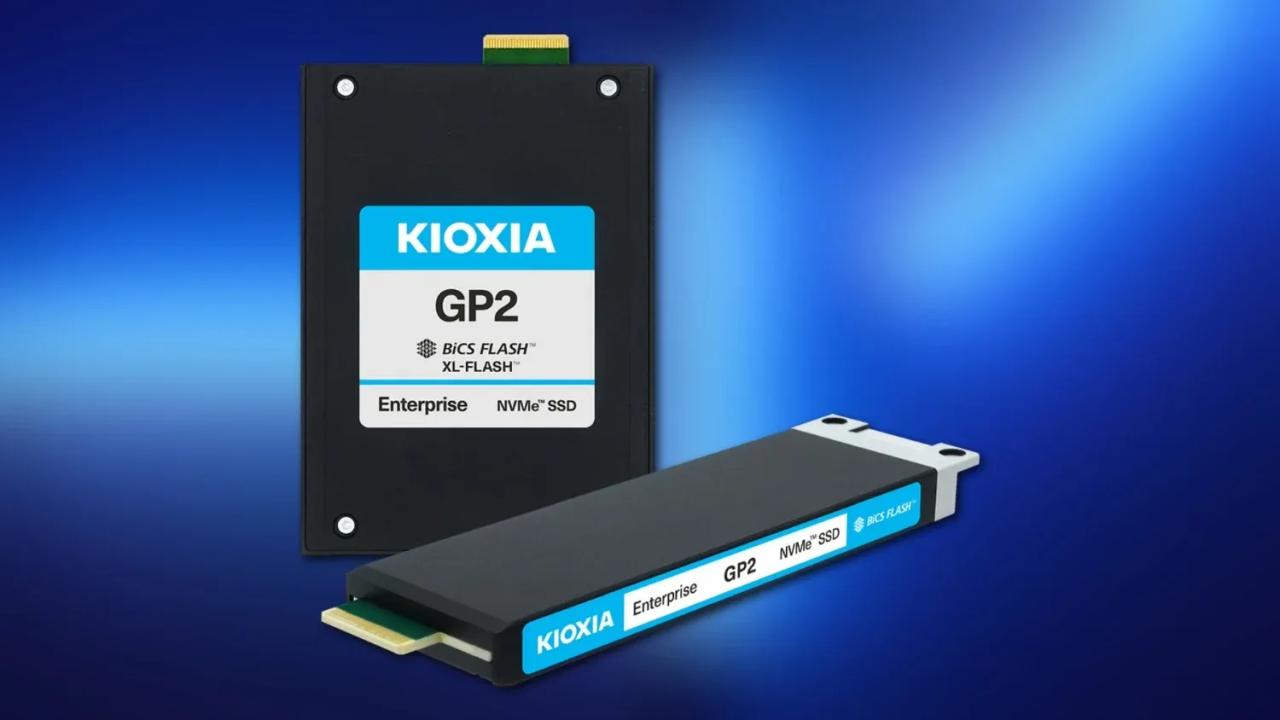
Kioxia has announced its GP2 Series, an enterprise SSD under development that aims to let GPUs work directly with a low-latency flash tier. Built around the company's third-generation XL-FLASH memory, GP2 is designed to extend the effective dataset capacity available to GPU workloads, rather than
[2]
KIOXIA's PCIe 6.0 GP2 Series SSDs deliver next-gen performance, up to 28 GB/s for GPU memory expansion
KIOXIA's GP2 Series of SSDs delivers an impressive 18 million random read IOPS at a 512-byte block size, with up to 28GB/s read throughput. KIOXIA's GP Series of SSDs is built and optimized for direct GPU access, where performance, reliability, and durability are all key. KIOXIA unveiled the
Share
Copy Link
Kioxia has announced a new enterprise solid-state drive, still under development, built so GPUs can reach a low-latency flash tier directly over PCIe 6.0
2
1
. It is the second generation of the company's line in months2
, aimed at AI infrastructure rather than anyone's desktop1
.
Source: TweakTown
Why GPUs want flash
The pitch is that a storage tier exposed directly to the GPU can let systems work with larger datasets without buying more of the expensive memory beside the processor
2
1
. That should keep the GPUs themselves busier. Kioxia, a flash memory maker with its own low-latency flash technology and a business unit devoted to such drives, builds the drive on the third generation of that flash2
1
. The design centers on small 512-byte accesses. A GPU reaching into a large working set needs small pieces of it, where a standard drive is built to move big blocks1
. So the headline number is performance at tiny block sizes, with sequential speed a secondary figure.The numbers, and what they are not
Kioxia quotes more than 18 million random-read operations per second at 512-byte block sizes, nearly double the 10 million of its previous drive, announced in August 2026
2
1
. Sequential reads are stated at up to 28 gigabytes per second, a figure the company expects from PCIe 6.0 bandwidth and evaluation testing rather than one it has measured1
. Kioxia's own comparison puts its third-generation flash at about 2.5 times the random-read rate of its triple-level-cell drives at 512-byte accesses, with endurance up to 50 drive writes per day2
1
.It also targets NVMe 2.3, supports direct liquid cooling, and is planned in two compact data-center form factors, which Guru3D describes as under consideration
2
1
. There is no consumer M.2 version; this one is for enterprise and AI infrastructure buyers1
. Every headline number is a development target, not an independently run benchmark1
. Kioxia's Neville Ichhaporia, who runs the drive business at Kioxia America, named vector search, graph processing and recommendation engines as the intended workloads2
. He called the drive another step toward the company's long-term vision of storage reaching 100 million operations per second2
. That 100 million target is for a later generation of the line1
.Kioxia has given no capacity points, no pricing and no release date; evaluation samples reach select customers by the end of 2027
1
.Related Stories



References
Summarized by

Navi
Related Stories
Recent Highlights
1
Anthropic mathematician says Claude helped him prove math's most famous problem
Science and Research

2
Two states sue SpaceX, saying weak Grok safeguards were no accident
Policy and Regulation

3
Jensen Huang is back at Nvidia 11 days after quitting, and the scrutiny came back with him
Business and Economy

Recent Highlights
Today's Top Stories











Don’t drown in AI news. We cut through the noise - filtering, ranking and summarizing the most important AI news, breakthroughs and research daily. Follow topics that matter to you and stay ahead.


