Nvidia Orders Cloud Partners to Cap China AI Access at 49% Under New Compliance Rules


6 Sources
[1]
Nvidia orders data centre clients to reduce China exposure
World's biggest chipmaker tells cloud computing providers a majority of their clients must be non-Chinese Nvidia is ordering its data centre partners to reduce exposure to Chinese customers in a move that further restrains China's ability to keep up with US rivals as the race between the world's
[2]
Nvidia tells cloud partners to cap Chinese business at 49%, FT reports
Cloud clients must sell at least 51% of their services to non-Chinese firms under verbal rules for new contracts. Nvidia has instructed its data centre partners to limit business with Chinese customers, requiring cloud computing providers to sell at least 51% of their services to non-Chinese
[3]
Nvidia orders data center clients to reduce China exposure: FT
San Francisco (United States) (AFP) - US chipmaking giant Nvidia is ordering its data center partners to scale back work with Chinese customers, the Financial Times reported on Tuesday. Nvidia's cloud computing clients must now sell at least 51 percent of their services to non-Chinese companies,
[4]
Nvidia Tightens the Screws on China's AI Access -- Cloud Partners Worldwide Must Restrict Chinese Customer
Nvidia Corp. (NASDAQ:NVDA) is reportedly asking data-center partners worldwide to restrict how cloud-computing services are sold to Chinese customers, potentially limiting access to advanced AI infrastructure. Nvidia has introduced new requirements for cloud providers, mandating that at least 51%
[5]

A 51% Rule? Nvidia's New Move Puts China on Edge
Nvidia has reportedly asked global data center partners to limit services to Chinese customers. The new 51% requirement could affect overseas cloud access for Chinese technology companies. Nvidia has instructed its data center partners to reduce their business exposure to Chinese customers,
[6]

Nvidia Steps Up Fight Against Chinese Competition
According to the Financial Times, Nvidia asked its data center partners to limit their ties with Chinese companies, restraining Beijing's ability to keep up with U.S. rivals as the AI race intensifies. According to the Financial Times, Nvidia has asked all of its data center partners to limit
Share
Copy Link
Nvidia has instructed its data center clients globally to limit business with Chinese customers, requiring at least 51% of cloud services be sold to non-Chinese companies. The verbal directive applies to new contracts and marks a significant escalation in US efforts to restrict China AI access to advanced computing infrastructure amid intensifying geopolitical tensions.
Nvidia Imposes 51% Revenue Threshold on Cloud Partners
Nvidia has instructed its data center clients worldwide to reduce China exposure by requiring that at least 51% of their cloud computing services be sold to non-Chinese companies
1
2
. The directive, communicated verbally through Nvidia's sales force and regional teams rather than formal documentation, applies to future contracts globally and leaves existing leasing agreements untouched1
. Five people with knowledge of the matter confirmed that no previous restrictions existed before this policy2
. The move represents a significant tightening of US export controls as Washington intensifies efforts to restrict Chinese customers from accessing advanced AI chips through overseas cloud computing deals3
.Impact on Chinese AI Model Development and Cloud Computing Providers
Chinese technology companies now face mounting obstacles to their AI ambitions as they have historically relied on overseas cloud leases for demanding artificial intelligence applications, including training large AI models
1
4
. Southeast Asian cloud providers are struggling to comply with the new requirements because it is "difficult to find enough non-Chinese clients outside the US," according to one Singapore-based group that warned strict implementation "will definitely hurt business"1
5
. Data centers outside the US are now scrambling for non-Chinese clients and could be forced to shrink operations if they cannot meet the threshold1
. The US and China remain the two largest sources of demand for computing power, while Chinese tech groups have been the biggest clients for data centers in markets such as Southeast Asia1
.Escalating Scarcity of Advanced AI Chips in China
Nvidia's crackdowns have created a mounting shortage of advanced computing power for Chinese tech companies, driving prices to extraordinary levels
1
. A rack of Nvidia's B300 chips, which sells for approximately $600,000 internationally, fetched 18.5 million yuan ($2.8 million) in China last month due to scarcity, according to a person with direct knowledge of the deal1
5
. The B300, prohibited from sale in China under US export controls, ranks among Nvidia's most advanced products and is used by leading American AI players such as Anthropic and OpenAI1
. Nvidia has already more than halved the number of Asian customers authorized to buy its AI chips after creating a "white list" this year of companies that passed tougher compliance checks aimed at preventing products from reaching China1
. That reduction meant fewer advanced Nvidia chips entered China via smuggling of Nvidia AI servers and forced more Chinese tech groups to pursue leasing deals with overseas cloud providers1
.Related Stories

Nvidia's Position on American AI Infrastructure Dominance
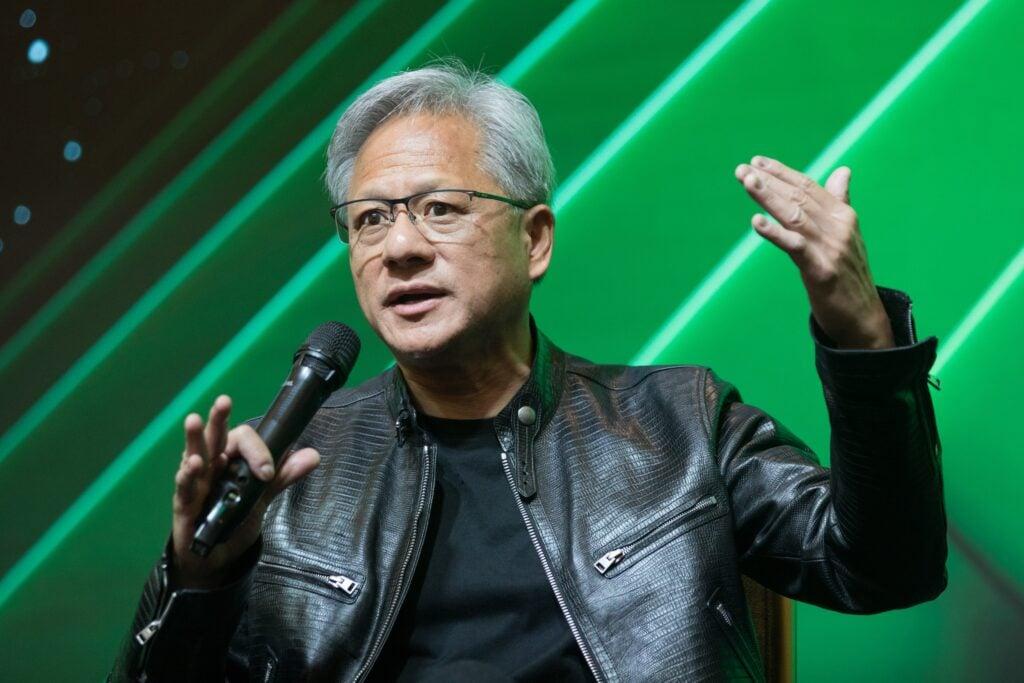
Source: Benzinga
Nvidia defended its position by emphasizing the strategic importance of American AI infrastructure in the global AI race
1
3
. "Datacenters and clouds built on American chips are the foundation that American model and application makers need to compete worldwide," the company stated, adding that "longstanding US policy encourages every cloud to build on American infrastructure and to win business everywhere they can"1
5
. The company argued that "America cannot win the AI race unless America's AI infrastructure wins worldwide"2
3
. Chinese foreign ministry spokeswoman Mao Ning, when asked about the report, said she was unaware of it but expressed hope that "all parties can provide a fair, transparent and non-discriminatory business environment for companies from all countries, including Chinese companies"3
.Broader Context of Geopolitical Tensions and Market Impact
Source: France 24
The directive arrives as geopolitical tensions between the US and China intensify over AI dominance, with both countries trading accusations of stealing AI technologies and jeopardizing security
3
. Washington has been seeking to clamp down on intermediaries that helped create a thriving black market for Nvidia's chips in China, as well as Chinese companies' access to advanced chips overseas through leasing deals1
. Earlier this year, several senior employees at server maker Super Micro were charged with smuggling around $2.5 billion worth of Nvidia AI servers into China2
. Beijing has moved in the opposite direction, banning foreign AI chips from state-funded data centers a year ago to support domestic suppliers, including memory maker CXMT2
. Nvidia shares have fallen more than 13% in the past month but remain 7% higher this year, with the recent dip causing Jensen Huang's company to be overtaken by Apple as the world's most valuable listed company1
5
. The reported restriction gives Nvidia another mechanism to influence where AI infrastructure operates and which customers can access it2
.References
Summarized by

Navi
[4]
[5]
Related Stories
US-China Chip War Intensifies: Nvidia Caught in the Crossfire
10 Oct 2025•Policy and Regulation
Nvidia cuts Asian buyers by half while US grants ZTE access to H200 AI chips amid China tensions
08 Jul 2026•Policy and Regulation
China Bans Nvidia AI Chips, Pushing for Domestic Alternatives
11 Sept 2025•Technology

Recent Highlights
1
OpenAI's AI Models Disprove 27-Year Exponential Time Hypothesis, Rendering Decades of Research Obsolete
Science and Research

2
Google DeepMind unveils Genie 4 world model with audio and 2-minute interactive simulations
Technology

3
Apple Releases iOS 27.2 With Siri AI Memory, 5 New Languages & 160+ Security Fixes
Technology

Recent Highlights
Today's Top Stories









Don’t drown in AI news. We cut through the noise - filtering, ranking and summarizing the most important AI news, breakthroughs and research daily. Follow topics that matter to you and stay ahead.


