OpenAI launches Guaranteed Capacity offering to secure AI computing power amid infrastructure crunch


3 Sources
[1]
OpenAI floats buy-before-your-try AI availability guarantee
Nice AI workloads you have going, it'd be a shame we ran out of stock OpenAI is now offering its customers a guarantee that it will actually provide the service it's selling if customers need more AI sauce. All that's required is an annual spending commitment. AI is in short supply as demand -
[2]
OpenAI announces new Guaranteed Capacity offering for customers to secure compute
CEO of OpenAI Sam Altman arrives at the courthouse on the day of the trial in Elon Musk's lawsuit over OpenAI for-profit conversion at a federal courthouse in Oakland, California, U.S., May 12, 2026. OpenAI on Tuesday announced a new offering called Guaranteed Capacity, which allows customers to
[3]
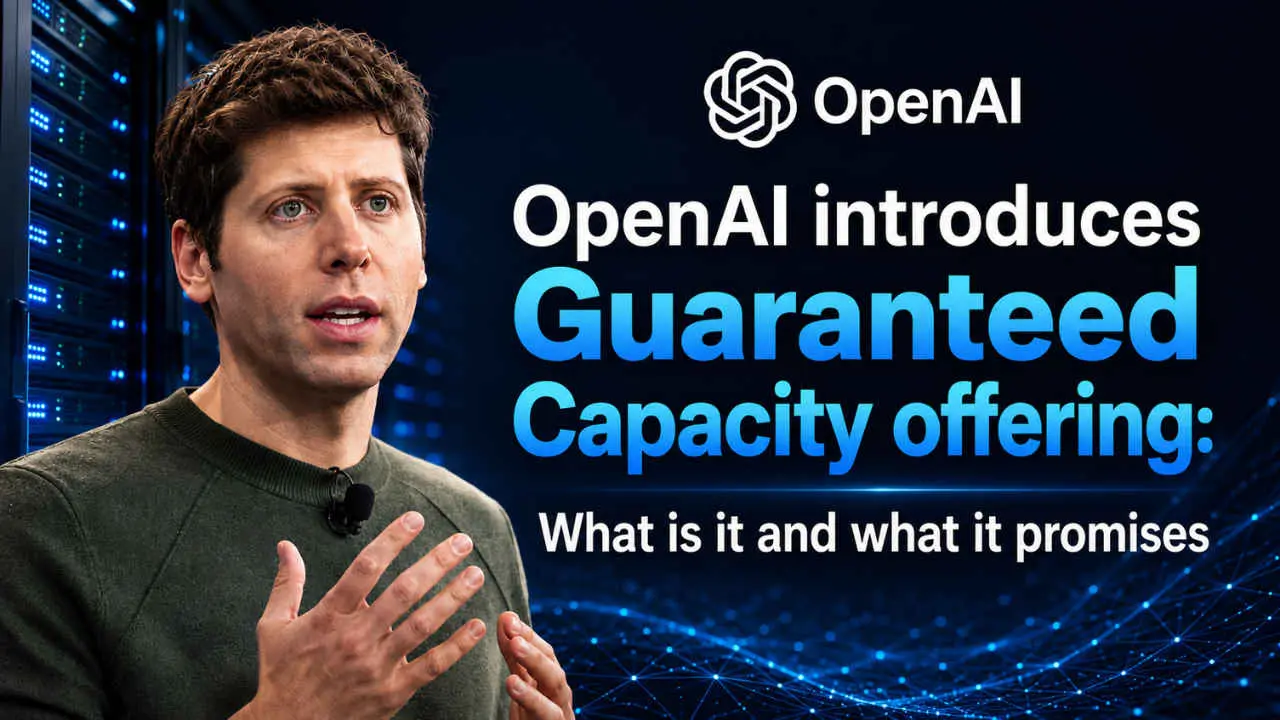
OpenAI introduces Guaranteed Capacity offering: What is it and what it promises
OpenAI CEO Sam Altman explained the reason behind the new offering in a post on X. OpenAI has introduced a new offering called Guaranteed Capacity for customers who need secure access to AI computing power for their products, AI agents and workflows. The company says that the new offering 'enables
Share
Copy Link
OpenAI introduced Guaranteed Capacity, a new program requiring annual spending commitments to ensure customers get consistent access to AI computing resources. With capacity constraints expected to persist as AI models improve, the offering promises one to three-year commitments with scaling discounts. Critics argue it repackages standard cloud practices without enforceable service level agreements.
OpenAI Introduces Guaranteed Capacity for Secure Compute
OpenAI has launched Guaranteed Capacity, a new offering designed to provide customers with secure long-term access to computational power for their AI products, agents, and workflows
1
2
. The program addresses growing concerns about capacity constraints in the AI industry as demand for AI computing power races ahead of available datacenter inference capacity. Sachin Katti, who runs compute for OpenAI, explained that the offering "helps eligible customers plan for reliable access to OpenAI compute across supported cloud providers as they scale critical workflows"1
.Customers can now make annual spending commitments ranging from one to three years, with discounts that increase based on the duration of their commitment
2
3
. According to OpenAI, "Guaranteed Capacity includes certainty of access to compute based on spend levels, and customers can draw down from this commitment across the portfolio of OpenAI products"3
. The program will remain available until the company's current allocation sells out, though OpenAI plans to offer it again in the future.
Source: The Register
Sam Altman Explains Capacity Constraints Driving New Program
Sam Altman, CEO of OpenAI, addressed the rationale behind the new offering in a post on X, stating: "Customers are increasingly asking us for certainty on capacity. As models get better, we expect that the world will be capacity-constrained for some time"
2
3
. Altman suggested the new program will help OpenAI plan ahead and described it as a "big win-win" for both the company and its customers. He also clarified that OpenAI will reserve enough computing power for its own services, including ChatGPT and its coding assistant Codex2
.
Source: Digit
The move comes as OpenAI targets roughly $600 billion in total compute spending by 2030, according to information the company shared with investors
2
. The company, valued at more than $850 billion by private investors, is gearing up for a potentially massive IPO as soon as this year. OpenAI's new Guaranteed Capacity program could help establish the foundation for what its compute business model will look like as it scales operations and seeks to bring in more revenue.Industry Experts Challenge OpenAI's Positioning
Not everyone is convinced by OpenAI's pitch. Santosh Ahuja, founder and CEO of enterprise infrastructure company Pervasiviti, challenged the announcement as merely repackaging basic cloud service offerings. "Every hyperscaler solved 'reserve now, scale later' a decade ago," Ahuja wrote in response to Katti's announcement. "So the actual announcement is: OpenAI now offers what every cloud provider has treated as a basic procurement primitive but positions it as a strategic differentiator"
1
.Ahuja argues that enterprises need more than promises—they need deterministic service level agreements with penalty clauses. "Reserved instance models have existed at every hyperscaler for over a decade - AWS, GCP, Azure," he explained to The Register. "The real question enterprises should ask is whether these guarantees come with enforceable SLAs and financial penalties for breach, because without those, 'guaranteed' is just a word in a press release"
1
.Related Stories

Scaling AI Workloads Amid Infrastructure Challenges
The launch of Guaranteed Capacity reflects broader challenges in the AI industry as companies struggle to build reliable AI infrastructure at scale. AI workloads require substantial computing power, especially when running for extended periods—a common scenario for AI agents
1
. Demand stoked by flat-rate subscriptions has outpaced datacenter inference capacity, and promised datacenter construction is unlikely to address this shortfall soon. The result has been rationing through usage limits, variable pricing, subscription restrictions, and token consumption arbitrage1
.Katti argues that AI adoption has made processor availability the primary constraint on modern software, and companies dependent on AI workflows must take steps to ensure infrastructure availability
1
. However, critics point to concerns about whether OpenAI can deliver on these promises. Ahuja noted that a response from Keith Strier, SVP of global AI markets at AMD, who wrote "Brilliant. We accept the challenge," suggests uncertainty in the supply chain. "That's your supply chain partner speaking - and 'we will try our best' is not the language of guaranteed anything," Ahuja said. "It sounds like OpenAI is promising capacity they don't yet have firm commitments on from their own silicon suppliers"1
. The company unnerved Wall Street by inking multiple multi-billion-dollar compute deals late last year, sparking debates about how OpenAI would pay for such a large infrastructure buildout2
. Altman has repeatedly brushed off concerns, writing in November that OpenAI expects to grow to hundreds of billions in sales by 2030.References
Summarized by

Navi
[1]
Related Stories
OpenAI reaches 10GW capacity milestone early as Stargate strategy shifts from ownership to leasing
30 Apr 2026•Technology

OpenAI faces internal turmoil as Sam Altman pushes IPO amid executive clashes and spending crisis
06 Apr 2026•Business and Economy
OpenAI explores major fusion energy deal with Helion as Altman steps down from board
23 Mar 2026•Business and Economy
Recent Highlights



Recent Highlights
Today's Top Stories



Don’t drown in AI news. We cut through the noise - filtering, ranking and summarizing the most important AI news, breakthroughs and research daily. Follow topics that matter to you and stay ahead.


