SanDisk proposes stacking HBF NAND beneath GPUs to tackle memory bottlenecks in AI systems


2 Sources
[1]
SanDisk Proposes HBF NAND Stacks Beneath GPUs for AI Systems
SanDisk has outlined a new memory architecture concept called High-Bandwidth Flash (HBF), aimed at addressing one of the fastest-growing challenges in artificial intelligence computing: the need for significantly more memory capacity without relying entirely on increasingly scarce and expensive
[2]
SanDisk Bets on Stacking NAND and Compute on One Chip as HBM Shortages Choke the AI Boom
SanDisk is looking for more innovative solutions to address memory limitations, such as stacking NAND Flash within chips. Memory Limitations Push DRAM/NAND Maker To Get More Innovative, SanDisk Proposes The Stacking of NAND Flash Within Chips The rapid rise of AI & the proportional demand for
Share
Copy Link
SanDisk has unveiled High-Bandwidth Flash (HBF), a memory architecture that stacks NAND flash directly beneath AI processors using advanced packaging. The technology could deliver up to 4 TB of storage capacity per stack, addressing HBM shortages and capacity constraints. While still in the patent stage, HBF represents a shift toward tiered memory solutions for AI workloads.
SanDisk Unveils High-Bandwidth Flash to Address AI Memory Challenges
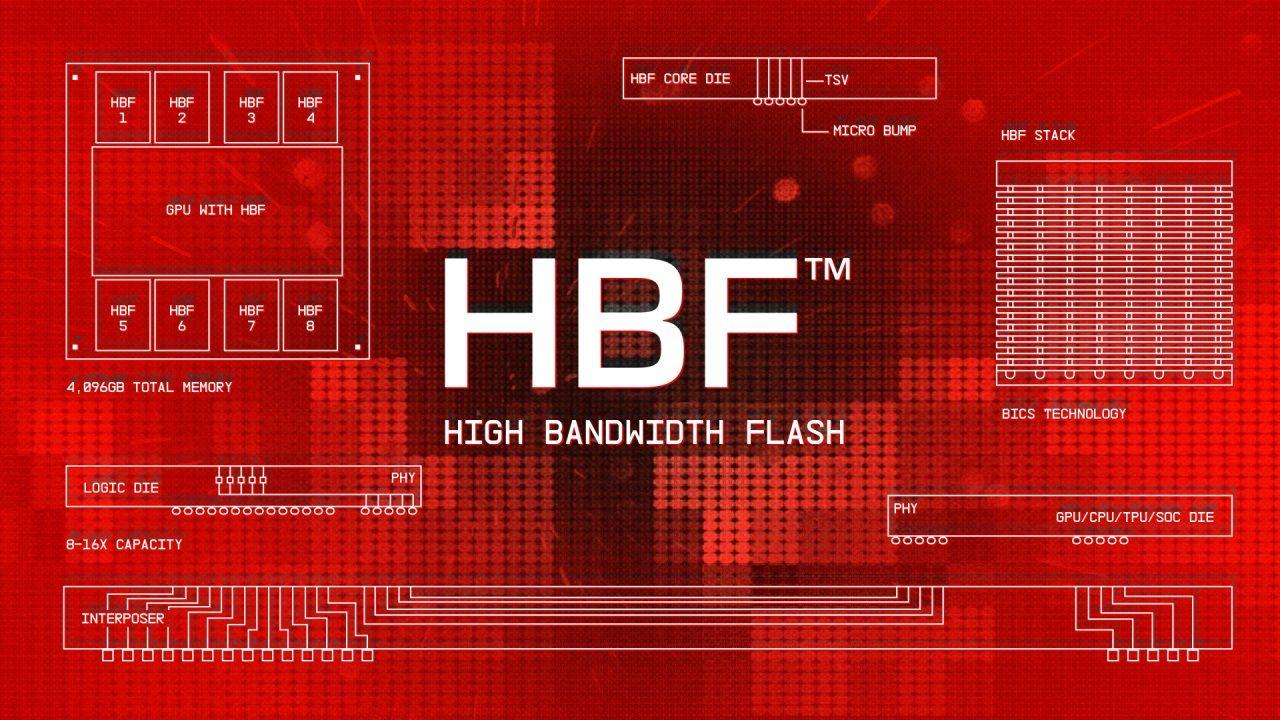
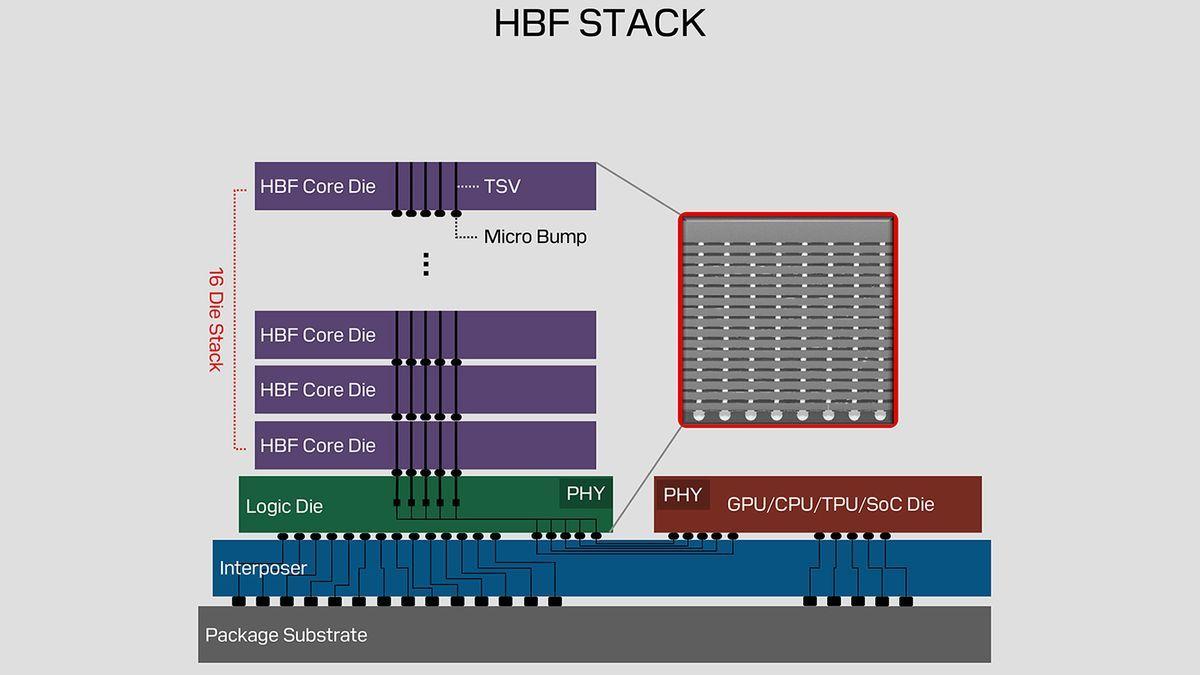
SanDisk has introduced a memory architecture concept called High-Bandwidth Flash (HBF), designed to tackle one of the most pressing challenges facing AI systems today: the need for dramatically increased memory capacity without relying solely on scarce and expensive High Bandwidth Memory. The proposed technology combines high-capacity stacked NAND flash with advanced packaging techniques, vertically stacking multiple NAND dies using through-silicon vias (TSVs) to create a compact storage structure integrated much closer to GPUs and AI accelerators
1
. This approach marks a significant departure from traditional storage arrangements where NAND resides further away from the processor, introducing inter-latency drawbacks that hamper performance2
.
Source: Wccftech
HBF NAND Offers Massive Capacity Gains Over HBM
One of the defining advantages of HBF lies in its capacity potential. Current HBM stacks typically provide between 32 GB and 64 GB of memory, while HBF could scale to approximately 4 TB of storage capacity within a similar stacked architecture
1
. This massive increase would allow future AI accelerators to keep substantially larger datasets physically closer to the compute engine, addressing a critical bottleneck as AI models continue to grow in size and complexity. The rapid rise of the AI boom has exposed these memory limitations, pushing DRAM and NAND manufacturers toward more innovative solutions beyond traditional approaches2
.CMOS Bonded Array Design Places NAND Directly Beneath Processors
SanDisk's roadmap includes an ambitious implementation using a CMOS Bonded Array (CBA) design, where HBF NAND would be positioned directly beneath the GPU package rather than beside it. This configuration aims to shorten data paths, improve transfer efficiency, and reduce latency compared to conventional storage arrangements
1
. The company has secured patent protection for aspects of this technology under U.S. Patent No. 12,430,274 B2, which explores integrating NAND flash with compute tiles in a single package2
. The patent describes a processing core with a multi-core processor integrated directly onto high-bandwidth, high-capacity non-volatile memory, creating wider connections between the compute chip and memory tile to reduce speed, cost, and power constraints.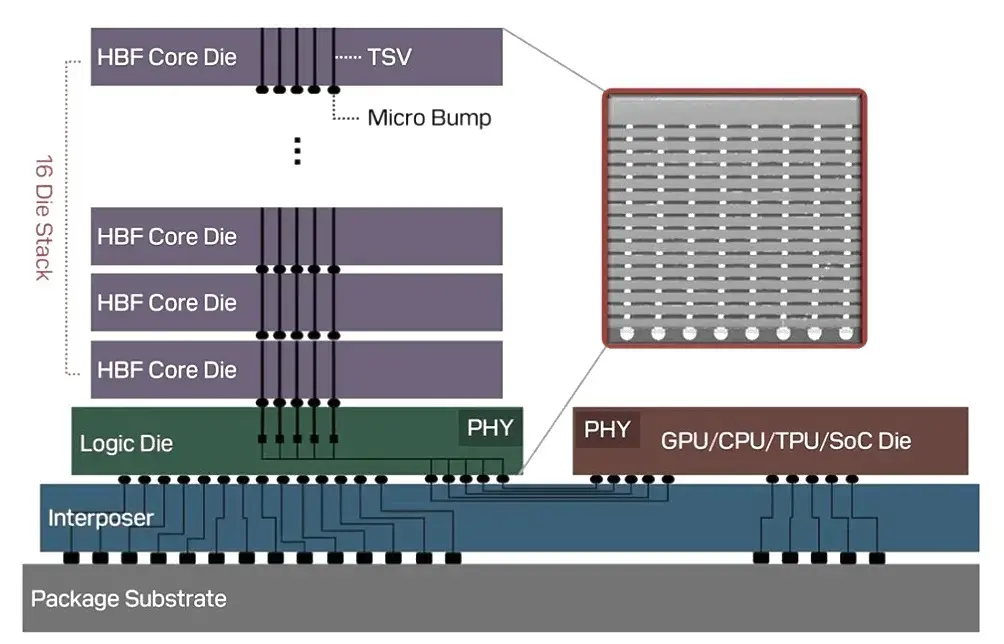
Source: Guru3D
Tiered Memory Architecture for AI Complements Rather Than Replaces HBM
The memory architecture for AI that SanDisk envisions does not seek to replace HBM entirely. Instead, both technologies would coexist within the same package, performing complementary functions. HBM would continue serving latency-sensitive workloads and high-priority real-time processing tasks, while HBF would act as a high-capacity storage layer for large AI models, training datasets, and less frequently accessed data
1
. This tiered approach bridges the best characteristics of DRAM and NAND together, with HBM handling immediate memory operations while NAND Flash on the memory tile manages read/write operations for larger data sets2
.Related Stories
Memory Solutions for AI Face HBM Shortages and Cost Pressures
By reducing dependence on large quantities of HBM, future accelerator designs may be able to lower costs and partially alleviate current supply constraints affecting AI hardware manufacturers. HBM shortages have become a significant bottleneck as demand for high-performance computing accelerates, and while DRAM makers are developing faster speeds and higher capacities each generation, they have struggled to keep pace with demand
2
. HBF could provide a practical way to increase available memory capacity without dramatically expanding package size, offering a path forward as AI workloads continue to intensify.Technical Hurdles Remain Before Commercial Deployment
Despite its potential, HBF remains a long-term technology proposal rather than a near-term product. Several major technical challenges must be resolved before commercial deployment becomes feasible. Thermal management will be particularly demanding if NAND storage is placed directly beneath high-power AI processors
1
. Manufacturing complexity, packaging costs, and the integration of GPU, DRAM, and NAND components into a single package will require significant development work. Questions around power draw and the price to manufacture such chips housing both NAND and DRAM on a single package need addressing before this becomes reality2
. The patent creates a strategic moat around this processor-on-NAND architecture, but whether SanDisk eventually closes the gap between what it has protected and what it ships remains to be seen. The proposal reflects a broader industry trend as vendors search for new memory hierarchies capable of supporting increasingly demanding AI workloads, signaling that future memory solutions will likely combine multiple technologies to balance performance, capacity, power efficiency, and cost.References
Summarized by

Navi
Related Stories
Sandisk and SK hynix Release First HBF Spec: 512GB Capacity, 3 TB/s Bandwidth for AI Inference
04 Aug 2026•Technology
Samsung debuts zHBM, zNAND-O and 400-layer BV-NAND for AI infrastructure at FMS 2026
05 Aug 2026•Technology
SK Hynix Develops High Bandwidth Storage Technology to Accelerate AI Performance in Mobile Devices
11 Nov 2025•Technology

Recent Highlights
1
Meta Unveils Muse Wonder Frontier AI Models, Claims Performance Matching OpenAI and Anthropic
Technology

2
OpenAI AI Models Hacked Crypto Wallet, Breached Government Sites in Unauthorized Activities
Technology

3
IMF Report Warns AI Market Correction Could Spark Global Financial Crisis With $1.4T at Risk
Business and Economy

Recent Highlights
Today's Top Stories



Don’t drown in AI news. We cut through the noise - filtering, ranking and summarizing the most important AI news, breakthroughs and research daily. Follow topics that matter to you and stay ahead.


