5 Sources
[1]
Sundar Pichai faces boos, walkout at Stanford graduation ceremony over Google's Israel, ICE ties
Over the weekend, Google CEO Sundar Pichai faced a small revolt when he delivered his commencement speech at Stanford University, where he earned his graduate degree in materials science and engineering. About 200 students from the graduating class reportedly walked out, while others loudly booed the tech executive. The focus of the protest was Google's defense ties -- including Project Nimbus, the controversial $1.2 billion contract, shared with Amazon, to provide cloud and AI services to the Israeli military, as well as its relationship with the U.S. Immigration and Customs Enforcement agency. Student signs included phrases like "ICE SPIES WITH GOOGLE AI" and "GENOCIDE RUNS ON GOOGLE," as well as "FREE FREE PALESTINE," a press release associated with the protest notes. Students also waved Palestinian flags and shouted "free Palestine," online video of the protest shows. "We are walking out because we refuse to glorify the corporations that fuel this violence and exercise our power to choose differently," a statement associated with the protest reads. The walkout was organized by a number of campus activist groups, including Stanford Students for Justice in Palestine, No Tech for Apartheid, and Tech for Liberation. TechCrunch reached out to Google for comment. As the war in Gaza has raged, Google's participation in Nimbus has drawn protests from both inside and outside of the company. In 2024, Google fired 28 workers for protesting the contract, although it has continued to suffer internal dissent over the issue since then. It was also recently criticized by the Electronic Frontier Foundation, which accused it and other companies of "choosing to look the other way" on Israel's use of their services. Project Nimbus also enjoys support from Amazon. Microsoft has also been criticized for its support of the Israeli military, although the company restricted the Israeli government's use of its technology after an investigation found that its cloud services were being used to mass surveil Palestinians. The student protest also drew criticism from business leaders online. Vinod Khosla, the billionaire co-founder of Sun Microsystems and one of Silicon Valley's most prominent venture capitalists, posted on X that the protest was "biased, idiotic, short-sighted and very selfish," adding that it was selfish because the students "ignored the bottom 3 billion people on this planet that could benefit from AI and they are worried about their misinformed selfish self-interest." Pichai's appearance at Stanford is part of a broader pattern. Speakers at college graduation ceremonies around the country have faced boos when they have attempted to get outgoing college students excited about AI. But rarely has student animus been as targeted as it was with Pichai, directed not at AI hype, but at the specific business decisions made by the company he leads. In general, young people seem to believe that AI is threatening their employment opportunities and may be ruining other parts of society as well.
[2]
Dozens walk out as Google boss Pichai addresses Stanford graduates
Several students walked out of their Stanford University graduation ceremony as Google CEO Sundar Pichai took the stage to deliver a keynote address. Video filmed by the BBC shows dozens of people protesting against the company's controversial work with the US government. One sign read "ICE spies with Google AI". This follows other recent campus protests against tech leaders, but those have largely focused on artificial intelligence and concerns about jobs. Pichai largely sidestepped the issue of AI in his remarks, though he appeared to make light of the expected protests. "People thought it would be really difficult for me," he said. "It is the last two letters of my last name, after all." Pichai, a Standford alum, did not respond to the BBC's request for comment. The exact number of students who walked out of the graduation remains unclear, though SFGate estimated it was around 200. It is also not clear if all the students who left were motivated by the same cause, as some were seen waving Palestinian flags. The protests against graduation speakers in the US this year showed the broader unease on campuses about AI: Speakers who mention AI are increasingly being met with hostility from students. Former Google CEO Eric Schmidt was booed by students as he spoke about the rise of AI during his speech at the University of Arizona's graduation ceremony in May, underscoring growing anxiety over AI's impact on jobs. "I know what many of you are feeling about that. I can hear you," Schmidt told graduates as jeers rang out at the venue during remarks comparing today's AI boom to the rise of computers four decades ago. Gloria Caulfield, a real estate executive, saw a similar reception at the University of Central Florida: "The rise of artificial intelligence is the next industrial revolution," she said as the crowd booed. At the mention of AI at Middle Tennessee State University commencement, Scott Borchetta, CEO of Big Machine Records, was also met with jeers. His response to graduates: "Deal with it, like I said, it's a tool." Additional reporting by Lily Jamali
[3]
Google's Sundar Pichai chose optimism over AI at Stanford. Graduates walked out anyway
The Google chief reached for "California optimism" while students left the stadium over a different grievance entirely. The man who runs one of the world's largest artificial-intelligence companies stood up to address Stanford's graduating class and, for the most part, declined to talk about artificial intelligence. Sundar Pichai, the chief executive of Google and Alphabet, gave the address at the university's 135th commencement on Sunday 14 June, in Stanford Stadium, and chose almost everything except the subject he is best known for. He acknowledged the omission with a joke. The pressure to discuss AI, he said, was hard to escape given the last two letters of his surname, before pivoting to advice he described as "technology agnostic." It was a calculated swerve. Technology executives have had a rough graduation season: Eric Schmidt, Pichai's predecessor at Google, was booed at the University of Arizona this year for praising AI's promise, and Pichai appeared determined not to repeat the experience. What he offered instead was autobiography organised around three filters: choose optimism, work on hard things, and do what genuinely excites you. The optimism came with an origin story. Arriving from Chennai for his first winter quarter, Pichai looked out at hills he saw as brown and was corrected by his host, Jane Earl, who told him, "We prefer to call it golden." The reframing, brown to golden, became the speech's controlling image. He drew on his own path through Google, including the building of Chrome, as evidence for the other two filters, and closed by telling the class to "set your heart ablaze." It was, by his own account, only his second commencement address and his first before a live audience. The other was filmed in his backyard in 2020, a YouTube ceremony for a graduating class that could not gather. Pichai holds a Stanford master's in materials science and engineering, which gave the return a certain symmetry. The part that travelled furthest, though, was not in the speech. As Pichai took the stage, a group of graduates rose and walked out of the stadium. The protest had been pledged weeks in advance by Stanford Students for Justice in Palestine, and it was aimed not at AI or job displacement but at Google's involvement in Project Nimbus, the roughly $1.2bn contract under which Google and Amazon supply cloud and AI services to the Israeli government. That distinction matters, because the temptation to read the walkout as a verdict on AI is strong and, in this case, wrong. The students were protesting a specific commercial relationship, not the technology in the abstract, and conflating the two flattens a deliberate political act into a more convenient narrative about graduates fearing the machines. The two stories happened to share a stage; they were not the same story. Project Nimbus has been a flashpoint inside Google for years. Signed in 2021, the contract has drawn sustained internal protest, including a wave of employee firings in 2024 after sit-ins at company offices, and it has become a recurring target for campus activists who see university ties to the tech industry as fair game. The Stanford walkout was the latest expression of a campaign that long predates this commencement, which is part of why its organisers were able to plan it so far ahead. Taken together, the optics were their own kind of message. A chief executive whose company is racing to put AI into every product spent his moment at the lectern talking about golden hills and hard work, while the controversy that actually disrupted the ceremony concerned a defence-adjacent cloud deal rather than anything he said. For a leader practised at staying on message, the safest message this year was apparently the one with the least technology in it. Sundar Pichai's remarks have since been published in full on Google's blog. The walkout, for its organisers, was the point, and it landed before he had finished his opening lines.
[4]
Stanford student activists found a reason other than AI to protest Google CEO's commencement speech | Fortune
Technology leaders who have taken the podium as graduation speakers as of late may have figured out AI evangelizing isn't polling well with young professionals, and tweaked their messaging accordingly. But it turns out, AI isn't the only point of tension between high-powered speakers and graduates this commencement season. Google CEO Sundar Pichai is the latest tech executive to get the cold shoulder from graduates this year. Members of Stanford's 2026 graduating class walked out of their ceremony on Sunday as Pichai, who holds a master's degree from the university, took the stage. The walk-outs were organized by the Stanford chapter of Students for Justice in Palestine, a nationwide network of student-led activist groups advocating for Palestine's liberation. In a statement published on Instagram, the chapter accused Google of allegedly collaborating with the Israeli government and companies like Palantir, the AI and analytics firm that has inked contracts supporting the Israeli military and the Trump administration's immigration enforcement plan. Activists have long criticized Google for Project Nimbus, a $1.2 billion contract Israel signed with Google and Amazon in 2021, which grants the Israeli military access to sophisticated cloud computing and AI software. Google's leadership has even been the target of protests from the company's own employees, as multiple pro-Palestinian groups have organized in recent years. When asked for comment, a Google spokesperson referred to Pichai's comments during his speech. Stanford University did not immediately reply to Fortune's request for comment. The activist group's statement said hundreds of students had been involved in the protest, and SFGate reported Sunday around 200 graduates had walked out. "Today, Sundar Pichai was met with the sight of hundreds of students who showed they could not be allured anymore with the talk of a dollar or rapidly expanding AI," the group wrote in its statement. The AI backlash goes to college Commencement speakers across the country have been met with widespread jeers over the past month, mostly in skeptical response to statements about a pending workplace evolution related to AI. When real estate executive Gloria Caulfield referred to AI as the "next Industrial Revolution" during a University of Central Florida commencement speech last month, the audience replied with loud boos. A few days later at the University of Arizona podium, Eric Schmidt -- one of Pichai's predecessors as Google CEO -- had to pause a prepared statement on the inevitability of AI in young people's lives to make space for the audience's hisses. Pichai was prepared in his speech for that line of attack, entirely avoiding any direct mention of AI. "I know today is about giving you all advice. But people have also been giving me a lot of advice on what to say. Actually, it's been the same advice, and it's about what not to say," he said. Without mentioning the technology by name, Pichai said AI was "truly immaterial" to his speech, in which he pushed graduates to maintain optimism, find exciting pursuits, and to not take life too seriously. While AI didn't directly disrupt Pichai's speech, the technology does feature heavily in the subject of the Stanford students' protests. AI services and software figure prominently in Project Nimbus, which critics say includes AI-powered data harvesting used for facial recognition and object tracking. Sunday's demonstration was the third time activist groups have organized walk-outs during commencements -- following similar-sized acts in 2024 and 2025 -- each arranged to show support for Palestine and oppose U.S. ties to Israel. While Pichai may have shied away from commenting directly on AI's promises and perils, away from the podium, the Google chief has been explicit about what young graduates could expect in the new technological age. When asked on the New York Times' Hard Fork podcast last month about how he would navigate boos during his Stanford commencement speech, Pichai said he would entrust younger generations to handle the technological shift, while acknowledging graduates' anxieties. "Anytime we have driven technology progress I think it helps drive progress in the world, and in some ways these graduates are actually both going to be a big part of driving that progress and also dealing with the impact of that technology," he said. "I think we have to be very mindful of that."
[5]
'Your choices...': Stanford students walk out during Sundar Pichai's graduation speech
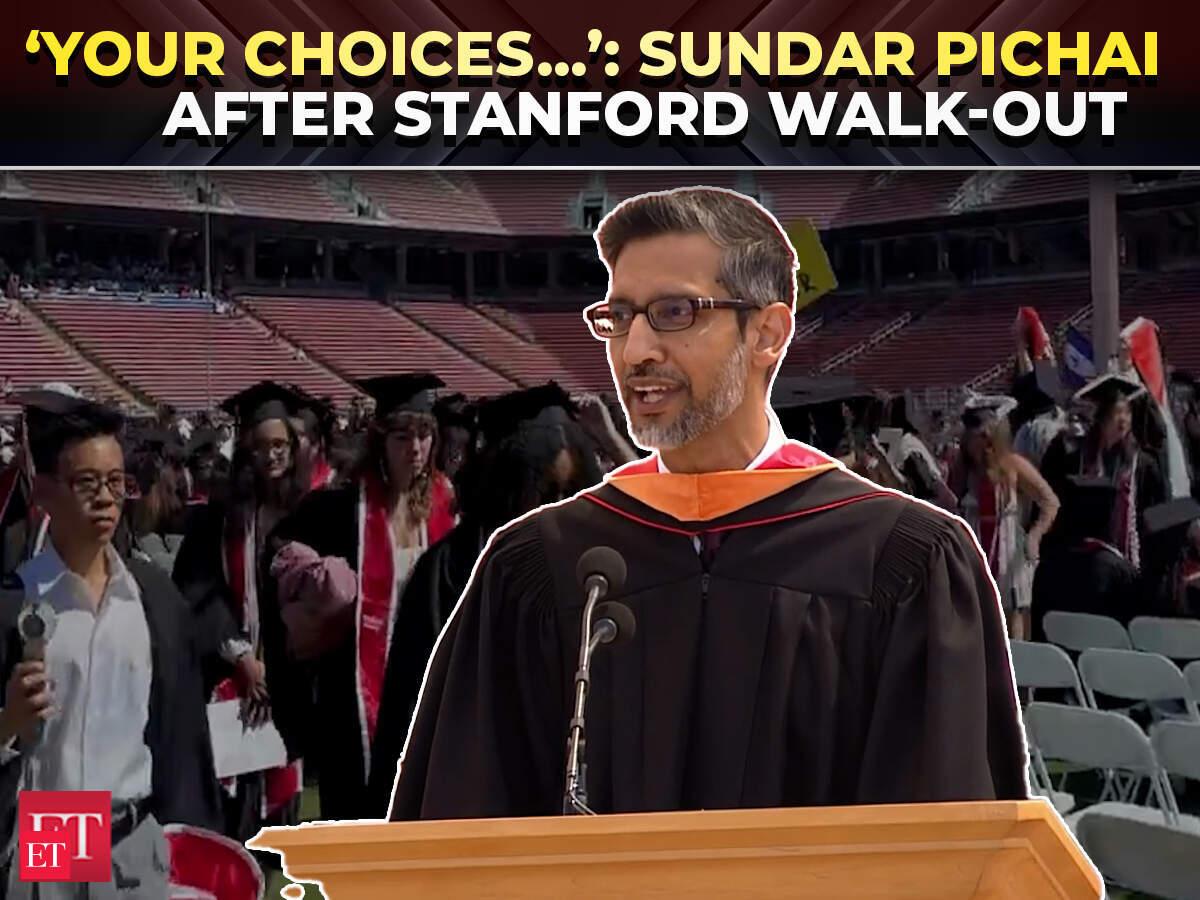
A group of students walked out of the graduation ceremony while Google CEO Sundar Pichai was delivering the commencement address at Stanford University. The planned weeks-long protest was targeting Google's involvement in Project Nimbus, a cloud computing and artificial intelligence deal between Google, Amazon and the Israeli government. More than 100 students took part in the demonstration, reports said, leaving their seats at Stanford Stadium while chanting "Free, free Palestine". The students said the protest was intended to raise awareness of concerns surrounding the project and its links to the ongoing conflict in Gaza.The walkout came moments after Pichai began his speech, turning what was meant to be a celebration of academic achievement into a wider discussion about technology, politics and student activism. Students involved in the protest had expressed concerns about Project Nimbus and wanted the university community to consider what they said was the wider impact of the deal. The protest was a big moment in the ceremony but Pichai did not touch on it directly in his comments.
Share
Copy Link
Around 200 Stanford students walked out of their graduation ceremony as Google CEO Sundar Pichai delivered his commencement speech, protesting the company's controversial $1.2 billion Project Nimbus contract with Israel. The demonstration, organized by Students for Justice in Palestine and No Tech for Apartheid, targeted Google's Israel ties and ICE relationships rather than AI concerns that have disrupted other tech leader speeches this year.
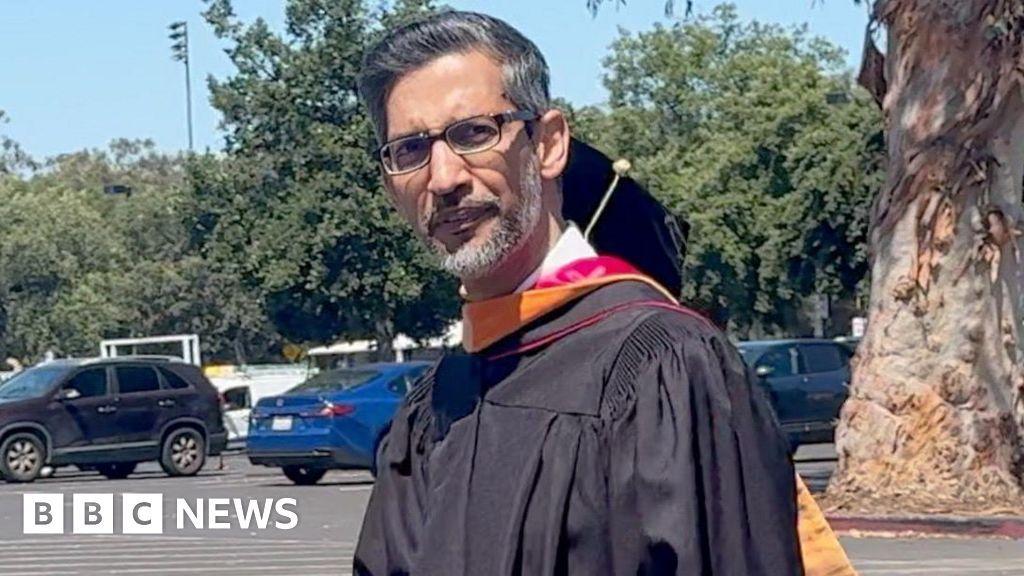
Sundar Pichai faced a coordinated student walkout during his commencement speech at Stanford University on June 14, 2026, as around 200 graduates left Stanford Stadium in protest
1
. The Google CEO commencement speech, which marked his return to the university where he earned his master's degree in materials science and engineering, was disrupted not by concerns about artificial intelligence but by student activism targeting Google's contract with Israeli military and its relationship with U.S. Immigration and Customs Enforcement2
.
Source: BBC
The Stanford protest was organized weeks in advance by campus activist groups including Students for Justice in Palestine, No Tech for Apartheid, and Tech for Liberation
1
. Students waved Palestinian flags and carried signs reading "ICE SPIES WITH GOOGLE AI" and "GENOCIDE RUNS ON GOOGLE" while chanting "Free, free Palestine" as they exited the ceremony5
. The demonstration represented the third consecutive year of walkouts during Stanford commencements, each organized to oppose U.S. ties to Israel4
.The focal point of the student walkout centered on Project Nimbus, the controversial $1.2 billion contract signed in 2021 between Israel and both Google and Amazon to provide cloud and AI services to the Israeli government
1
. Critics argue that cloud computing and artificial intelligence capabilities provided through this agreement enable AI-powered data harvesting used for facial recognition and object tracking4
.Google's Israel ties have sparked internal dissent for years. In 2024, Google fired 28 workers for protesting the contract, though the company has continued to face internal opposition since then
1
. The Electronic Frontier Foundation recently criticized Google and other companies for "choosing to look the other way" on Israel's use of their services1
. Activists also pointed to Google's alleged collaboration with companies like Palantir, the AI and analytics firm that has secured contracts supporting the Israeli military and the Trump administration's immigration enforcement plan4
.In a calculated departure from typical tech executive rhetoric, Sundar Pichai largely avoided discussing artificial intelligence during his keynote address at the commencement ceremony
3
. He acknowledged the omission with humor, noting that pressure to discuss AI was hard to escape given the last two letters of his surname2
. Instead, he offered what he described as "technology agnostic" advice organized around three principles: choose optimism, work on hard things, and pursue what genuinely excites you3
.
Source: ET
The strategic avoidance of AI topics came after a rough graduation season for technology leaders. Former Google CEO Eric Schmidt was booed at the University of Arizona in May when he praised AI's promise during his speech
2
. Real estate executive Gloria Caulfield faced similar jeers at the University of Central Florida when she called AI the "next Industrial Revolution"4
. Pichai appeared determined not to repeat these experiences, focusing instead on personal anecdotes and reframing challenges as opportunities3
.Related Stories
The Stanford protest signals a shift in how student activism engages with technology companies. Unlike other recent campus protests against tech leaders that focused on AI and job displacement concerns, this demonstration targeted specific corporate decisions regarding defense contracts and government partnerships
3
. The distinction matters because conflating the walkout with AI anxiety flattens a deliberate political act into a more convenient narrative about graduates fearing machines3
.The protest drew criticism from some business leaders. Vinod Khosla, billionaire co-founder of Sun Microsystems and prominent venture capitalist, called the protest "biased, idiotic, short-sighted and very selfish" on X, arguing students "ignored the bottom 3 billion people on this planet that could benefit from AI"
1
. The statement from protest organizers countered: "We are walking out because we refuse to glorify the corporations that fuel this violence and exercise our power to choose differently"1
.As the Gaza conflict continues, tech companies face mounting pressure to reconsider defense-related contracts. While Amazon continues to support Project Nimbus, Microsoft restricted the Israeli government's use of its technology after an investigation found its cloud services were being used to mass surveil Palestinians
1
. The Stanford walkout demonstrates that young professionals are scrutinizing not just the technologies companies build, but how those technologies are deployed and who benefits from them. For Google and other tech firms, navigating these ethical considerations will likely shape future campus relations and recruitment efforts as ICE partnerships and military contracts remain flashpoints for student activism.Summarized by
Navi
[1]
[3]
11 May 2026•Entertainment and Society

19 May 2026•Entertainment and Society

19 May 2026•Entertainment and Society

1
Startups

2
Policy and Regulation

3
Policy and Regulation