Share
Linkedin
Twitter
Facebook
Whatsapp
Copy Link
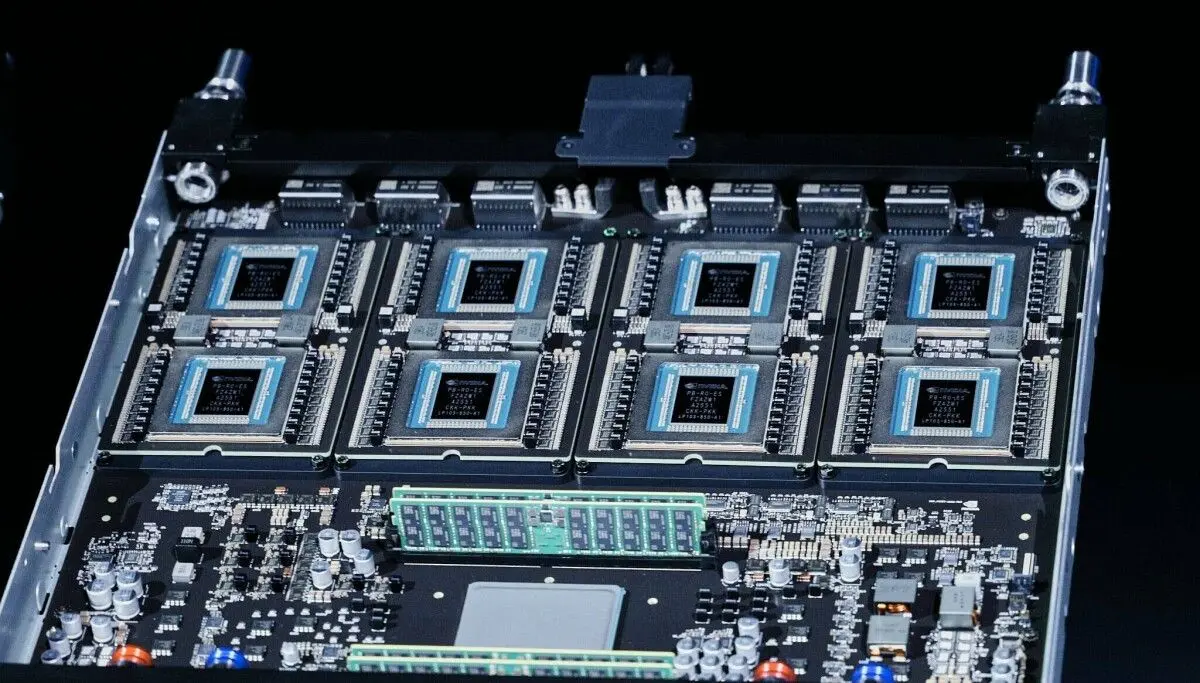
Elon Musk announced SpaceX and xAI will exclusively use Nvidia GPUs, calling them "the best" available. The partnership includes deploying Vera Rubin NVL72 systems in terrestrial data centers and launching Starmind AI satellites to create orbital compute infrastructure starting 2027, addressing Earth's power and land constraints.
Samsung unveiled three next-generation memory technologies at the Future of Memory and Storage 2026 conference. The company introduced zHBM, a vertically stacked high-bandwidth memory architecture, zNAND-O for edge AI applications, and V10 BV-NAND featuring over 400 layers. All three technologies leverage advanced wafer bonding to address the growing demands of AI data centers and infrastructure.
AMD reported record Q2 2026 revenue of $11.5 billion, up 50% year-over-year, driven by surging demand for AI-focused data-center chips. The company's data center business more than doubled to $6.7 billion, now representing 58% of total revenue. However, gaming revenue fell 31% to $779 million amid console cycle slowdown and component shortages.
Nvidia launched Alpamayo 2 Super, an open commercial AI model for autonomous vehicles that reasons out loud. The 34-billion-parameter model explains driving decisions through chain of causation traces and is now available under a permissive license on Hugging Face for commercial deployment.
Marvell Technology shares jumped 10% after unveiling next-generation AI memory and storage solutions at Flash Memory Summit 2026. The company introduced the Bravera SC6 PCIe 6.0 SSD controller and rack-scale memory systems designed to address AI memory bottlenecks, while announcing a $250 million India R&D expansion.
Corvex stock doubled in pre-market trading after the AI cloud-computing company announced a multi-year agreement to provide clusters of NVIDIA Blackwell GPUs to an unnamed leading AI company. The deal expands an earlier customer commitment and showcases Corvex's ability to deploy liquid-cooled Blackwell capacity in roughly two weeks.
NVIDIA announced it is open-sourcing its cuFile API at the Future of Memory and Storage conference, enabling direct GPU-to-storage data access in microseconds. The company also launched Storage-Next, bringing together over 40 storage vendors including DDN, Kioxia, and Micron to standardize GPU-driven storage solutions for AI workloads.
Strong AI-driven demand forecasts from Palantir and ON Semiconductor pushed stock futures higher, with the S&P 500 and Dow Jones Industrial Average hitting record highs. The rally comes as 85.2% of companies beat second-quarter earnings estimates, while Middle East deal hopes and Federal Reserve policy decisions keep investors cautious about future rate moves.
Singapore's Ministry of Trade and Industry sharply raised its full-year economic growth outlook to 4.5-5.5% from 2-4%, as the city-state's economy expanded 5.9% in Q2 2026. The upgrade reflects stronger-than-expected AI-related capital expenditure, with manufacturing sector expansion driven by semiconductor supercycle and robust demand for electronics.
Google has assembled one of the largest infrastructure financing programmes in history—worth roughly $200 billion—to sell Tensor Processing Units to Anthropic. The effort brings together Broadcom, Apollo, Blackstone, and Morgan Stanley in a web of transactions spanning chip manufacturing to data centre development, potentially unlocking $252 billion in TPU revenue by 2028.
Sandisk and SK hynix released the first High Bandwidth Flash technical specification through the Open Compute Project, defining a new memory tier for AI inference systems. The specification establishes capacities up to 512GB with bandwidth ranging from 0.4 TB/s to 3 TB/s, using UCIe interconnect to bridge the gap between HBM performance and NAND capacity.
ON Semiconductor reported second-quarter revenue of $1.6 billion, surpassing analyst expectations as demand for power management chips in AI data centers accelerated. CEO Hassane El-Khoury revealed the company prioritized AI data center customers over automotive clients, shifting manufacturing capacity to meet surging demand for intelligent power solutions.
Startup Infinity used AI coding agents to rebuild CUDA-like software for chip firm D-Matrix in just 10 hours, signaling a credible challenge to Nvidia's two-decade software dominance. As the AI chip market shifts from model training to inference workloads, chip-agnostic software and AI-generated code threaten to erode the technical moat that has kept Nvidia's dominance intact.
Tel Aviv startup Majestic Labs has unveiled Prometheus, a GPU-free server that uses up to 128TB of LPDDR6 memory and Arm cores to tackle AI's memory wall. The company claims one rack matches 25 Nvidia Vera Rubin racks at lower power, but hardware hasn't shipped or been independently tested yet.
Amazon market capitalization surpassed $3 trillion for the first time, fueled by artificial intelligence optimism and Amazon Web Services revenue hitting $42.2 billion with 37% growth. CEO Andy Jassy raised capital expenditure projections to $220 billion as AI demand outpaces capacity.
Don’t drown in AI news. We cut through the noise - filtering, ranking and summarizing the most important AI news, breakthroughs and research daily. Follow topics that matter to you and stay ahead.