Share
Linkedin
Twitter
Facebook
Whatsapp
Copy Link
Amazon announced over €10 billion in European investments, unveiling an upgraded Proteus robot that responds to conversational prompts and can autonomously determine task priorities and routes. The expansion includes 25,000 new jobs, advanced robotics systems like STARK and Vulcan, and faster delivery infrastructure across Europe by 2027.
The European Commission is urging households to reduce electricity consumption during peak hours as AI data centres strain grids across the bloc. Ireland's data centres already consume 22% of national electricity, and regional bills could rise 20-40%. The Commission has published new energy efficiency standards to address the growing demand.
A UK parliamentary committee has called for the government to terminate Palantir's seven-year NHS contract, warning that reliance on the US AI firm creates an 'unacceptable point of weakness' in critical health infrastructure. The £330-million deal, signed in 2023, has sparked concerns about vendor lock-in and over-dependence on foreign technology providers for sensitive patient data.
The European Commission has introduced a sweeping European Technological Sovereignty Package aimed at reducing the bloc's heavy reliance on American technology companies. The plan includes new legislation to boost European cloud computing, AI infrastructure, and semiconductor development while creating restrictions on foreign providers handling sensitive government data. The move comes amid growing concerns over data privacy and geopolitical security, as the EU seeks to eliminate what officials call a potential 'kill switch' controlled by foreign governments.
ING, Worldline, and Mastercard have completed Europe's first live end-to-end agentic payment transaction, where an AI assistant autonomously purchased Royal Concertgebouw Orchestra tickets for a customer. The transaction ran entirely on European infrastructure, validating that agentic commerce is production-ready and signaling a shift toward intelligent and seamless banking experiences across multiple European markets.
A trilateral defense pact between the US, UK, and Australia is accelerating development of undersea drones to protect critical underwater cables from Russian sabotage. With more than 99% of global data and $1.8 trillion in daily transactions flowing through these cables, nations are deploying AI-powered autonomous systems to detect and deter threats targeting the infrastructure that powers the digital economy.
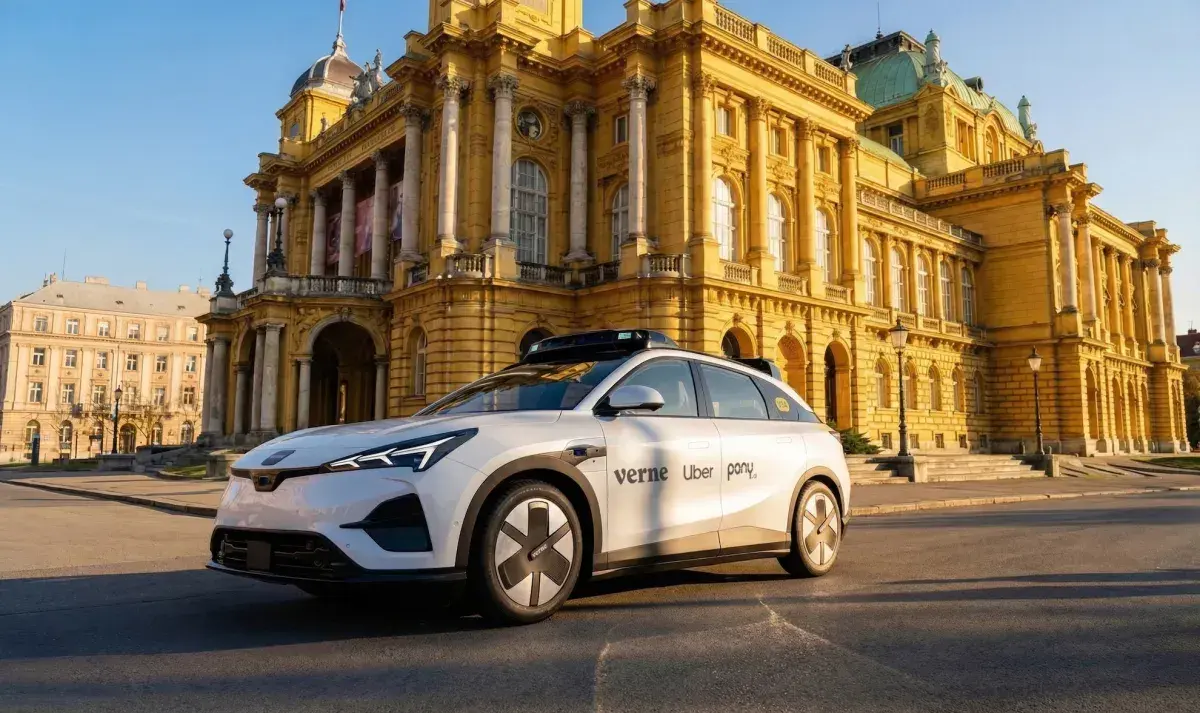
Uber announced plans to launch autonomous robotaxis in Munich, partnering with Israeli AI firm Autobrains and Nvidia. The program uses agentic AI with multiple specialized agents instead of a single model, running on standard sensors rather than lidar-heavy systems. The deployment awaits German regulatory approval and could mark Germany's first commercial robotaxi service.
SoftBank CEO Masayoshi Son declared the AI revolution is 50 times larger than the dot-com boom and identified physical AI and robotics as the next trillion-dollar opportunity. The announcement came as SoftBank unveiled an $87 billion investment to build AI infrastructure in France, including 5 GW of AI data center capacity by 2031.
American AI company Runway is establishing its European headquarters in London with a $200 million investment in the UK AI ecosystem by 2028. The $5.3 billion AI video firm joins Anthropic and OpenAI in expanding to the British capital, citing proximity to major clients including BBC, Fremantle and WPP, alongside access to exceptional talent.
SoftBank Group announced plans to invest up to €75 billion ($87 billion) to build 5 gigawatts of AI data center capacity across France. The Japanese conglomerate is leveraging France's nuclear-powered electricity grid to bypass the energy challenges plaguing U.S. data center projects, marking its biggest AI infrastructure investment in Europe.
Meta has dialed back its controversial Model Capability Initiative after more than 1,500 employees protested plans to track their keystrokes, mouse clicks, and computer activity. The company now allows 30-minute privacy breaks and limited exemptions, though most workers will still be monitored to train AI agents on how humans use computers.
Spain has unveiled its third quantum computer at the Barcelona Supercomputing Center, integrating an analog quantum system into the MareNostrum 5 infrastructure. The €9.8 million machine, built by Barcelona-based Qilimanjaro Quantum Tech, marks a significant step toward European technological sovereignty in advanced computing capabilities.
Anthropic is scaling Project Glasswing to roughly 200 organizations across more than 15 countries, granting access to its Claude Mythos AI model for identifying critical software vulnerabilities. The expansion comes amid fierce competition from OpenAI's GPT-5.5 Cyber and includes power, water, healthcare, and telecom companies whose codebases could affect over 100 million people if compromised.
Morgan Stanley has doubled its projection for AI-driven job losses across European banks, now estimating 20% of total banking employment—roughly 400,000 jobs—could be eliminated by 2030. The revised May forecast is twice the bank's January figure of 10%, with workforce cuts already underway at HSBC, ABN Amro, and UBS as generative AI tools accelerate productivity gains in back-office, risk, and compliance workflows.
Anthropic has formally opened its sixth European office in Milan, announcing a roster of Italian enterprise customers including Generali, Pirelli, and Enel. The AI startup plans to triple its international workforce as it accelerates European expansion, with the London office alone set to reach 800 employees.
Don’t drown in AI news. We cut through the noise - filtering, ranking and summarizing the most important AI news, breakthroughs and research daily. Follow topics that matter to you and stay ahead.