AI Stocks Face $2 Trillion Rout as Midterm Elections Trigger Data Center Construction Concerns


18 Sources
[1]
Chipmakers lead Asian stocks lower on post-midterm AI fears
Concerns mount that Democratic control of Congress will slow data centre build-out Investors sold off Asian semiconductor and data centre stocks on Thursday as they bet that Democratic control of the US Congress would slow the AI data centre build-out that has supercharged equity markets across
[2]
Global AI sell-off eases after Nasdaq's worst month in over a year
US tech stocks set to start week higher following bruising rout A global AI sell-off eased on Monday, with US technology stocks set to open higher after a bruising rout last week. Futures for the tech-heavy Nasdaq 100 index and the broad-based S&P 500 rose 0.9 per cent and 0.5 per cent,
[3]
Fears about an AI crackdown after midterms sparks a $2 trillion rout in tech stocks
Two days after Democrats won overwhelmingly in the national midterm elections -- and in state races across the country -- investors started to come to terms with the potential consequences. Fears that an incoming Democratic Congress would crack down on AI sent the tech-heavy Nasdaq down more than
[4]
It's going to be tough to tap the brakes on the AI race
Slowing an investment boom on the scale of the AI buildout is a tricky business -- as Thursday's rout in the stock market demonstrated. Why it matters: Americans may have voted in the midterms to tap the brakes on the AI race, but curbing the investment boom -- or some might say, gently deflating
[5]
Dow sheds more than 1,800 points as midterm results spur investor exodus from tech and AI
The stock market tanked on Thursday amid concerns that a shift in congressional political control following the U.S. midterm elections could slow the construction of data centers that power artificial intelligence services. Stocks sank across the board, but technology companies with a hand in the
[6]

ASX steady; Nasdaq plunges on AI regulation fears
The Nasdaq 100 index was set to lose a whopping $US1.8 trillion ($2.6 trillion) in stock value as investors feared that the sweeping midterm victory of Democrats could stall the pace of artificial intelligence infrastructure expansion. Shares of semiconductor and neocloud companies, which were
[7]
Stocks crater as investors recoil from tech companies amid AI risks
The stock market tanked on Thursday amid concerns that a shift in congressional political control following the U.S. midterm elections could slow the construction of data centers that power artificial intelligence services. Stocks sank across the board, but technology companies with a hand in the
[8]

Why the midterm blue wave just triggered a red Wall Street
Midterm election results are weighing on U.S. stocks, particularly shares in data center and artificial intelligence, as investors worry a Democratic Congress will slow their development. Around 12:35 pm ET. the tech-heavy Nasdaq was down 4.88%, or 1,255 points, at 24,510.83. At one point, the
[9]

Wall Street stocks rally after heavy AI-related selloff
Wall Street's trading session presented a mixed scenario as the S&P 500 and Nasdaq climbed, contrasting with a modest dip in the Dow. Investor apprehensions regarding impending regulations for the AI sector, especially after recent Democratic electoral successes, led to increased market volatility.
[10]

AI Stocks Could Fall Further Despite Strong GPU Demand - NVIDIA (NASDAQ:NVDA)
Warren Pies still believes in the AI boom. But he turned cautious on stocks ahead of Thursday's sharp technology selloff. His firm, 3Fourteen Research, downgraded its outlook for stocks from overweight to neutral, citing weakening market signals and rising borrowing costs. Pies believes the
[11]
China, Hong Kong stocks fall as US tech rout sparks AI bubble fears
Chinese and Hong Kong stocks took a hit as American tech shares slumped overnight, fueling worries about the durability of the artificial intelligence surge. This uncertainty cast a shadow over investor confidence across Asia. Nevertheless, the Chinese mainland market saw some recovery driven by
[12]
NVIDIA Claws Back Losses After $400 Billion Bloodbath, but the AI Scare Isn't Over - NVIDIA (NASDAQ:NVDA)
NVIDIA Corp. (NASDAQ:NVDA) stock rebounded nearly 5% in Friday's premarket trading after a sharp selloff wiped more than $400 billion from its market value Thursday. Investors are weighing whether tighter scrutiny of data-center construction could slow AI chip demand. S&P 500 futures rose 0.5%
[13]
Nasdaq Outlook: Is the worst over for AI-fuelled tech stocks?
Wall Street's AI-led rally faced a sharp setback as the Nasdaq recorded its biggest single-day fall since June. Heavy losses in technology stocks reflected growing investor concerns over hyperscaler spending and the returns on artificial intelligence investments. Wall Street's technology-driven
[14]

Global AI stock selloff wipes trillions off Wall Street as Nasdaq plunges 5.5%
Technology stocks suffer a sharp rout as investors question AI spending, data centre expansion and the impact of US political changes Global technology stocks suffered a massive selloff on Thursday, November 5, wiping trillions of dollars off Wall Street as mounting concerns over artificial
[15]

Wall Street stocks in relief rally after heavy AI-related selloff
NEW YORK/LONDON -- Wall Street equities mostly rallied on Friday, reversing course after trillions of dollars of world stock market value was wiped out over fears that Democratic election victories this week would bring tighter U.S. regulations for the AI industry. Benchmark S&P 500 and the Nasdaq
[16]

AI Stock Selloff Wipes USD 3 Trillion From Wall Street Markets
A global AI stock selloff erased USD 3 trillion from Wall Street. Chipmakers led heavy losses as investors questioned spending and regulation. The rout spread into Asian markets, triggering a trading halt in South Korea. Global technology shares plunged on Thursday, November 5, as fears over
[17]

A $3 Trillion Wall Street Rout Doesn't Hand China the AI Race
A $3 trillion wipeout on Wall Street in a single session shows how nervous money has become about artificial intelligence. Where some of that money went is more revealing. As the Nasdaq suffered its worst day since April 2025, the main US-listed China funds edged higher. Investors dumped American
[18]

AI, data-center stocks slip as Democratic sweep clouds expansion plans
Nov 5 (Reuters) - AI and data center-linked stocks slipped in premarket trading on Thursday as Democrats' sweeping US midterm victory raised concerns about potential hurdles to the industry's rapid expansion. Neocloud stocks, which have become a barometer of investor anxiety over heavy AI
Share
Copy Link
Democratic victories in US midterm elections triggered a massive sell-off in AI stocks and chipmakers, with the Nasdaq plunging 5.5% as investors fear regulatory tightening on data center construction. The tech-heavy index wiped out over $2 trillion in market value, raising questions about the sustainability of the AI infrastructure boom.
Democratic Midterm Wins Trigger Massive Tech Stocks Sell-Off
AI stocks experienced a brutal market rout following the US midterm elections, with the tech-heavy Nasdaq Composite Index plummeting 5.5% and erasing more than $2 trillion in market value
3
. The Nasdaq 100 fell 6.4% in its steepest decline since the March 2020 pandemic panic, while the SOX semiconductor index tumbled 12.3%4
. The Dow Jones Industrial Average shed 1,835 points, dropping 3.4%, and the S&P 500 declined 4.6%5
. This marked a stark reversal from Wednesday's initial post-election rally, when investors had sent shares higher, relieved the midterms concluded decisively.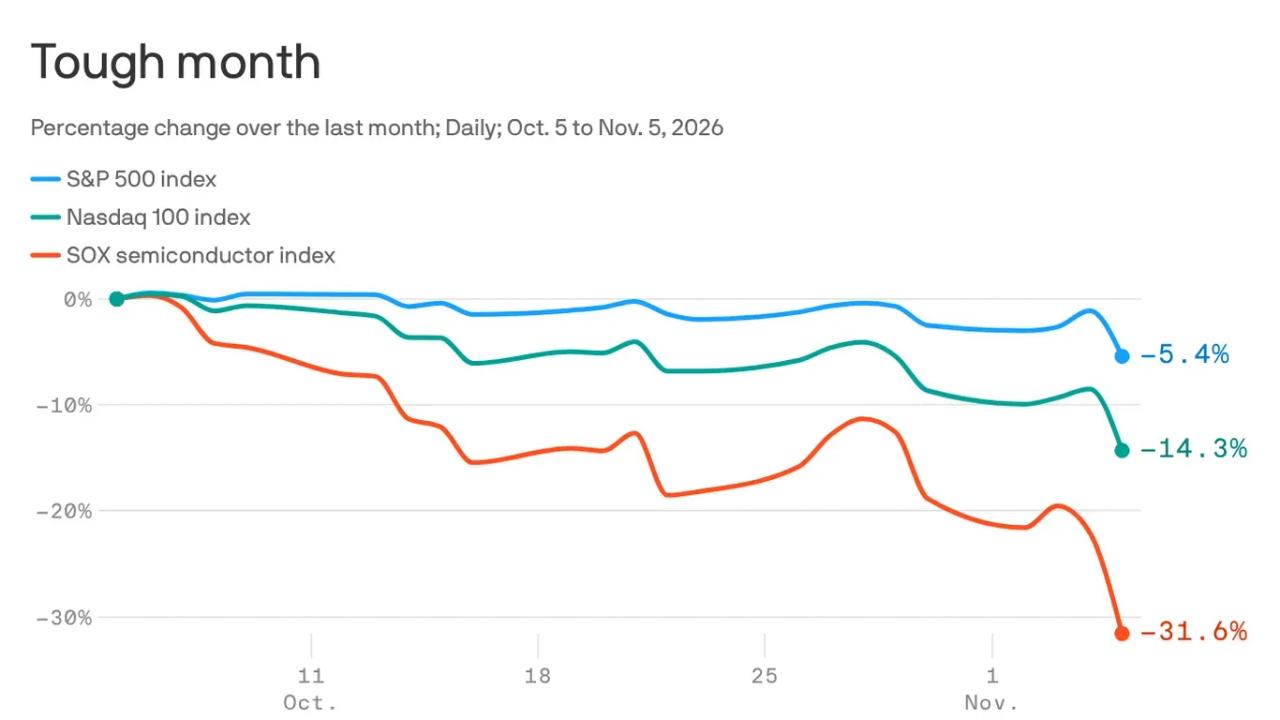
Source: Axios
Investor Fears Center on Data Center Regulatory Tightening
The market volatility stems from concerns that Democratic control of Congress will slow AI-related data center construction through tighter regulation
1
. Voters across the country revolted against AI infrastructure projects, supporting Democrats who pledged to push back against data center proliferation due to concerns about water and energy consumption3
. Over 50% of planned data center capacity sits in just three states—Ohio, Georgia, and Texas—all of which elected Democratic governors who campaigned against unrestricted AI infrastructure development4
. "There is some concern regarding AI regulation, and fears that there could be far more regulations coming to AI technology, as well as a pushback on the buildout of data centers across the country," said David Busch, chief investment officer of Trajan Wealth3
.
Source: Market Screener
Chipmakers and Semiconductor Stocks Bear the Brunt
Chipmakers and semiconductor stocks faced particularly severe losses during the investor exodus. Nvidia shares dropped 7.5%, becoming the heaviest weight on the S&P 500, while AMD plummeted 14.6%
5
. Advanced Micro Devices fell 17.3%, and companies tied to AI infrastructure experienced dramatic declines—Coherent dropped 13%, Ciena fell 15%, and Dell dove 15%4
. In Asian markets, Japan's Nikkei 225 fell 0.5%, led by a 17% drop in Ibiden, while South Korea's Kospi declined 3.8%1
. SK Hynix and Samsung Electronics, representing around 50% of the Kospi, were heavily impacted by concerns about reduced demand for memory chips if data center construction slows1
.Asian Markets Show Mixed Response to AI Infrastructure Concerns
Asian semiconductor stocks displayed varied reactions to the regulatory uncertainty. While SK Hynix gained 4.6% and Samsung Electronics rose 2.2% in one trading session, driving South Korea's Kospi up 2.7%
2
, the broader trend remained negative. Japanese memory-chip maker Kioxia, which ranked as Japan's most valuable company in June, continued sliding, losing more than 70% of its market capitalization from that peak1
. The company slumped an additional 14% after its profit outlook fell short of expectations2
. "Koreans and the Taiwanese are much more exposed to the US capex which is the uncertainty right now," said Nicholas Yeo, head of Chinese equities at Aberdeen1
.Related Stories

AI Equity Bubble Concerns Mount Among Investors
Market watchers are questioning whether the enormous investment in AI infrastructure has created an equity bubble, with sky-high valuations becoming detached from underlying fundamentals
5
. "What we are witnessing is structural uncertainty about the AI build-out expressing itself through episodic panic," wrote Ajay Rajadhyaksha, global chair of research at Barclays2
. John D. Turner, a finance professor at Queen's University Belfast who authored "Boom and Bust: A Global History of Financial Bubbles," noted that once major investment booms are in motion, tempering them without sparking an investor stampede proves difficult4
. The historical record shows market collapses have featured prominently in past investment booms like canals, railroads, and the internet.
Source: Benzinga
Broader Economic Implications and Future Outlook
The AI stock market rout raises critical questions about the sustainability of the technology sector's growth trajectory. AI has become a significant driver of the US economy, helping it post solid annual growth of 3.4% in the July-September quarter
3
. Both sophisticated Wall Street investors and average Americans holding shares through retirement portfolios like 401(k)s and pension funds face exposure to a prolonged AI market downturn3
. Uncertainty remains about whether the volatility will spread to corporate debt markets, where a large chunk of data center construction financing is expected4
. Bruce Kirk, Japan equity strategist at Goldman Sachs, suggested investors might shift into AI-adjacent thematics like physical AI or cybersecurity rather than making wholesale moves into consumer stocks1
.References
Summarized by

Navi
Related Stories
Tech Sell-Off Shakes Markets as Investors Question AI Spending and Profitability
23 Jun 2026•Business and Economy
AI Stocks Tumble as Investors Question Massive AI Infrastructure Spending and Valuations
13 Jul 2026•Business and Economy
AI Infrastructure Boom Hits $10 Trillion Wall as Debt-Fueled Growth Faces Reality Check
17 Oct 2026•Business and Economy
Recent Highlights



Recent Highlights
Today's Top Stories






Don’t drown in AI news. We cut through the noise - filtering, ranking and summarizing the most important AI news, breakthroughs and research daily. Follow topics that matter to you and stay ahead.


